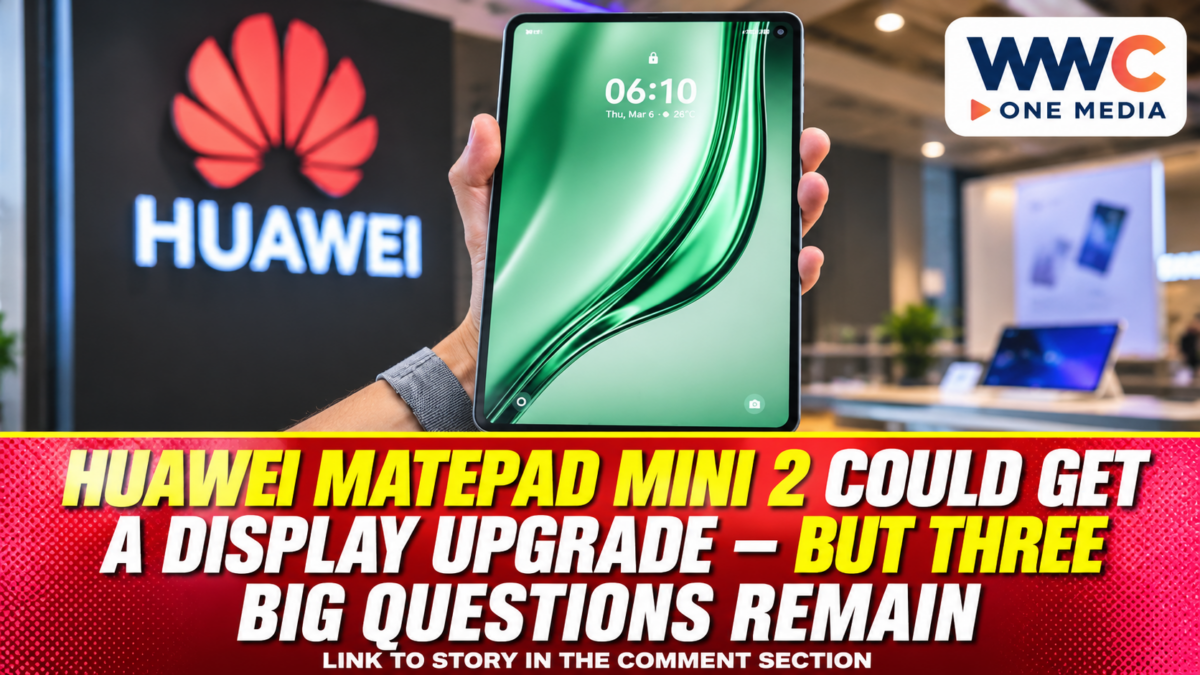
Huawei’s next-generation compact tablet is attracting attention amid reports of possible screen improvements, but the company has not officially confirmed the MatePad Mini 2 or published specifications for a successor. The most reliable benchmark for evaluating any potential upgrade remains Huawei’s existing 8.8-inch MatePad Mini, whose official specifications already include a high-resolution OLED panel and a peak brightness rating of 1,800 nits.
That distinction matters for buyers: a rumoured improvement is not the same as a confirmed hardware change. Until Huawei releases a product announcement or technical specification sheet, the successor’s display, launch date, price and Philippine availability remain unsettled.
Huawei MatePad Mini 2 faces a high display benchmark
The first MatePad Mini gives Huawei a demanding starting point for a second-generation model.
Huawei’s published Chinese product specifications list an 8.8-inch flexible OLED display with a resolution of 2,560 × 1,600 pixels and a pixel density of 343 pixels per inch. The company also lists a 2,000,000:1 contrast ratio, 1.07 billion colours and support for the P3 wide colour gamut.
Its stated peak brightness is 1,800 nits. Huawei notes that this is a peak figure based on laboratory data and that actual brightness can vary depending on the environment and displayed content.
These specifications put the current model in a strong position on paper. A successor would therefore need to deliver measurable improvements rather than simply use broad marketing language about a better viewing experience.
For readers comparing Huawei’s hardware direction with other manufacturers, WWC has also examined how OLED technology is being positioned in ASUS creator laptops.
Brightness is only one part of a better screen
A brighter display can be useful when a tablet is used in a well-lit room or outdoors. But peak brightness alone does not tell buyers how consistently a screen performs.
A meaningful comparison would need to examine sustained brightness, automatic brightness behaviour, reflections, colour reproduction and how the panel handles different types of content.
Huawei’s existing specification sheet provides a peak brightness figure, but it does not establish how a future MatePad Mini 2 would perform under identical testing conditions. Without an official successor specification or independent testing, claims of a brighter panel cannot be treated as established improvements.
The distinction is particularly important for compact tablets. Their screens are smaller than those of conventional productivity tablets, so readability, contrast and viewing comfort can influence whether the device works well for reading, browsing, video and note-taking.
Colour accuracy needs more than a marketing promise
Colour performance is another area where a new tablet could distinguish itself.
Huawei lists P3 wide colour gamut and 1.07 billion colours for the current MatePad Mini. Those figures describe aspects of the screen’s colour capabilities, but they do not automatically establish how accurately every unit reproduces a particular colour standard.
A proper comparison would require more information, such as supported colour profiles, calibration data and measured colour error. A wider colour range and accurate colour reproduction are related but different concepts.
For photographers, illustrators and people who edit visual content, that difference can matter. A display may produce vivid colours without necessarily reproducing them accurately.
Huawei has not published corresponding MatePad Mini 2 measurements in the official material reviewed. Any claim that the next model will deliver more accurate colours therefore remains unconfirmed.
Eye comfort depends on the full viewing experience
Screen comfort is not determined by a single specification. Reflections, brightness settings, ambient lighting, text size and software controls can all influence how comfortable a display feels during extended use.
Huawei’s existing product information describes its PaperMatte treatment as an optical design that diffuses reflected light. The company also lists eye-comfort and reading-related display functions on its product materials.
However, the standard flexible OLED model and the PaperMatte edition should not be treated as identical configurations. Huawei’s specifications distinguish the display treatment used on the different versions.
For a successor, buyers would need to know whether any changes involve the physical panel, its surface treatment, software settings or a combination of these elements. Without that detail, a claim of improved eye protection is too broad to evaluate.
WWC has previously explored the wider competition around compact and foldable devices in its coverage of Huawei’s expanding foldable-device strategy.
What Huawei has officially announced — and what it has not
Huawei’s official tablet catalogue in the Philippines lists the MatePad Mini as part of its compact-tablet range. The company’s published product material identifies the existing model and its display characteristics.
Its official event archive also documents product launches in November 2026, including the November 24 event. The event listing does not identify a MatePad Mini 2 among the products named there.
That does not prove Huawei will not introduce another compact tablet at a later date. It does mean that the reviewed official announcements do not establish a confirmed MatePad Mini 2 launch.
The same standard applies to reports about advanced OLED panel construction. A particular display architecture should not be attributed to the successor unless Huawei identifies it in an official product specification or announcement.
The broader tablet market shows why the question matters. Manufacturers are competing not only on screen size, but also on display quality, portability, software features and accessories. WWC has also looked at the reported possibility of an OLED upgrade for Apple’s iPad mini, another example of how display technology has become part of the compact-tablet conversation.
What happens next
The next meaningful step is an official Huawei announcement or a published product specification sheet for the alleged successor. That would allow buyers to compare the new model against the existing tablet using confirmed information.
The most useful details to watch are the screen size, resolution, refresh rate, peak and sustained brightness, colour specifications, display finish and eye-comfort features. Pricing and regional availability will also determine whether the device is a practical option for Filipino consumers.
Until those details are released, shoppers should avoid treating reported upgrades or possible launch dates as confirmed purchasing information.
FAQ
Has Huawei officially announced the MatePad Mini 2?
The official Huawei materials reviewed do not confirm a MatePad Mini 2 announcement or provide specifications for a second-generation model.
What display does the current Huawei MatePad Mini use?
Huawei lists an 8.8-inch flexible OLED display with a resolution of 2,560 × 1,600 pixels, 343 PPI and a stated peak brightness of 1,800 nits.
Will the MatePad Mini 2 have a brighter screen?
That has not been confirmed by Huawei. The current model’s published peak-brightness figure provides a benchmark, but no official successor measurement is available in the records reviewed.
Will the MatePad Mini 2 be released in the Philippines?
Huawei has not confirmed Philippine availability for a MatePad Mini 2 in the official materials reviewed. A local release date and price should be treated as unknown until announced.
Should buyers wait for the MatePad Mini 2?
Buyers who need a tablet immediately can assess the currently listed MatePad Mini against their needs. Those willing to wait should look for an official successor announcement and compare confirmed specifications and pricing before making a decision.