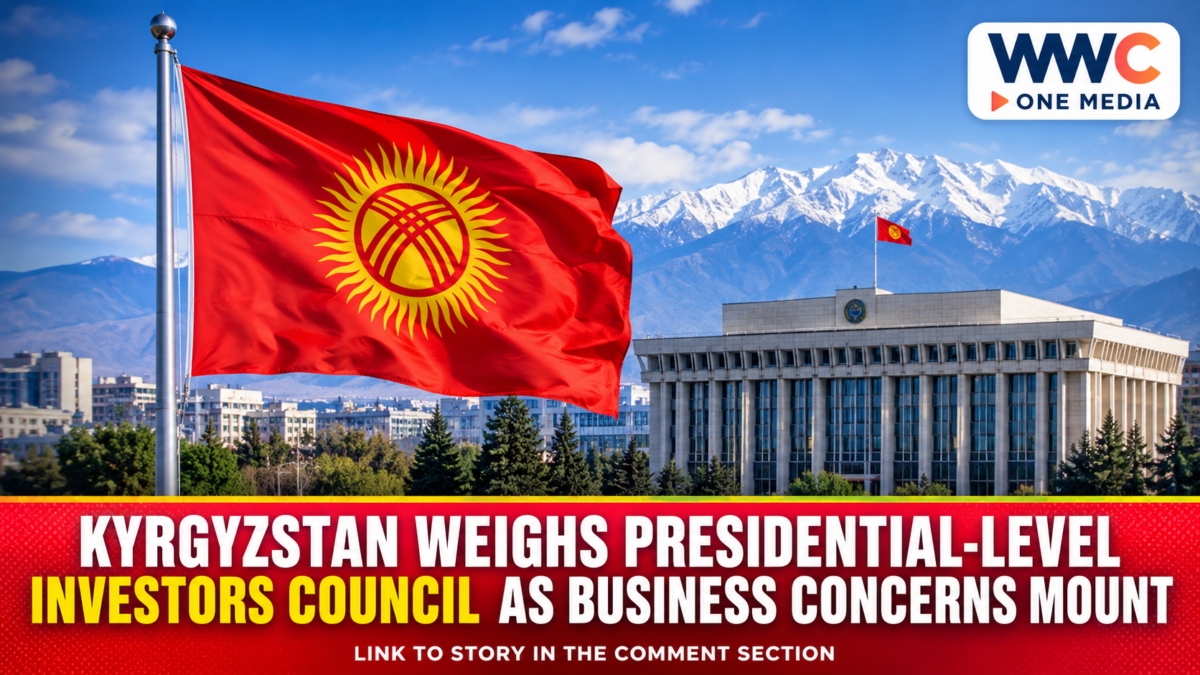
Kyrgyzstan is considering a stronger mechanism for addressing investor concerns at the highest level of government, as officials seek to improve the country’s investment climate and remove obstacles facing businesses.
The proposal for an Investors Council under the country’s leadership was included in discussions at the second “Investment Vector: State and Business – Open Dialogue” forum in Bishkek on November 27, according to the National Investment Agency under the President of the Kyrgyz Republic.
The forum brought together government officials, judicial and law enforcement representatives, business associations, development funds, diplomats and domestic and foreign investors. Its agenda included closer coordination between government institutions and businesses, stronger investment-project support and digital systems for handling investor concerns.
The discussion comes as Kyrgyzstan reports billions of dollars in investment agreements and sets an ambitious target for annual foreign direct investment growth. But the effectiveness of any new council will depend on whether it can turn business complaints into measurable government action.
Kyrgyzstan investors council enters the policy discussion
The National Investment Agency’s official announcement identifies the establishment of an Investors Council under the country’s leadership as one of the subjects discussed at the November 27 forum.
It also identifies three connected priorities: maintaining continuous dialogue with business representatives, improving support for investment projects and digitising communication between the state and investors through the Investments automated information system.
The announcement does not establish that the proposed council has already been formally created. It also does not provide a final membership list, operating rules, reporting structure or schedule of meetings.
Those details matter because the institutional design will determine whether the council can resolve problems or simply provide another venue for discussion.
The distinction is important. A presidential-level body could potentially bring together officials from several institutions when an investment project encounters administrative, legal or regulatory obstacles. However, its practical authority would depend on its mandate and the responsibilities assigned to participating agencies.
The National Investment Agency’s announcement provides the official basis for reporting that the idea was under discussion. It does not amount to a completed government decision.
$12.4 billion in investment agreements raise the stakes
The forum took place against the backdrop of substantial investment commitments reported by the Kyrgyz government.
According to the National Investment Agency, the Cabinet of Ministers and investors signed 91 investment agreements worth a combined US$12.4 billion from 2023 through 2026.
Of that total, 33 agreements worth US$3.6 billion were signed in 2026.
The agency also reported 19 public-private partnership agreements signed during 2026, with a combined value exceeding 31.4 billion Kyrgyz soms.
These figures illustrate the scale of investment activity being pursued by the country. They should not, however, be interpreted as proof that the entire announced value has already entered the economy or that every project has been completed.
An investment agreement, a public-private partnership commitment and realised foreign direct investment are different measures. Actual economic results depend on project financing, implementation, construction, operations and the movement of capital.
For investors, the quality of government coordination can be as important as the availability of investment opportunities. Delays involving permits, land access, judicial disputes or administrative decisions can affect project costs and timelines.
That makes the proposed council’s eventual authority and accountability particularly important.
Government sets a target of at least 20% annual FDI growth
The National Investment Agency said the forum was intended to advance priorities assigned by President Sadyr Japarov at a republican meeting on October 21, 2026.
One stated objective is to improve the investment climate and increase foreign direct investment inflows by at least 20% annually.
Agency head Ravshanbek Sabirov said the government wanted to strengthen trust between the state and business, address systemic problems affecting investment projects and increase the accountability of government institutions.
The forum was organised by the National Investment Agency in cooperation with the Supreme Court, the Prosecutor General’s Office and the Chamber of Commerce and Industry. The participation of these institutions reflects the range of government functions that can affect investors.
Investment protection is not limited to attracting capital or offering incentives. Businesses also need predictable rules, functioning dispute-resolution mechanisms and confidence that government decisions will be applied consistently.
A council involving senior leadership could provide a channel for escalating problems that cannot be resolved by a single ministry or agency. Whether it delivers that benefit will depend on how cases are referred, assigned, monitored and concluded.
Digital systems and investor protection are part of the plan
The forum’s agenda also included digitising interactions between investors and government through the Investments automated information system.
A digital platform can make it easier to submit requests, track applications and identify which government office is responsible for a particular issue. If implemented with clear procedures, it could also help authorities identify recurring problems affecting multiple projects.
But digitisation alone does not guarantee faster decisions.
A useful system needs transparent processing rules, clear deadlines, reliable records and a way to escalate unresolved cases. Investors must also be able to determine whether a complaint has been received, which institution is handling it and what action has been taken.
The National Investment Agency also said the forum would include an agreement on cooperation with the Supreme Court within the limits of the institutions’ respective powers.
That cooperation is relevant because commercial disputes and the protection of investment rights can influence confidence in a market. It does not mean the government can direct judicial outcomes or guarantee that every investor will prevail in a dispute.
The broader issue is whether institutional cooperation can make procedures more predictable while preserving the independence and legal responsibilities of each institution.
What happens next?
The next important development is whether Kyrgyzstan formally establishes the proposed Investors Council and publishes its operating framework.
Investors and businesses will need clarity on who will lead the body, which agencies will participate, how private-sector representatives will be selected and whether the council will have authority to require responses from government institutions.
A regular meeting schedule would also matter. Without deadlines and follow-up procedures, recurring complaints could remain unresolved even if they are raised before senior officials.
The government’s reported investment agreements provide a significant reason to strengthen the investment environment. But the value of those commitments will ultimately be judged by implementation, operating projects and sustainable economic returns.
For now, the official record confirms that a presidential-level Investors Council was discussed at the November 27 forum. It does not yet establish that the body has been created or that its powers have been finalised.
The next test for Kyrgyzstan will be whether its plans for closer state-business dialogue translate into faster problem resolution, stronger investor protections and more predictable conditions for doing business.
Frequently asked questions
Is Kyrgyzstan creating an Investors Council under the President?
The National Investment Agency said the establishment of an Investors Council under the country’s leadership was discussed at the November 27, 2026 forum. Its announcement does not confirm that the council has already been formally established.
What is the purpose of the proposed council?
The stated objective is to strengthen dialogue with businesses, address systemic problems affecting investment projects and improve coordination between investors and government institutions.
How much investment has Kyrgyzstan reported securing?
The National Investment Agency reported 91 investment agreements worth US$12.4 billion from 2023 through 2026. It also reported 19 public-private partnership agreements worth more than 31.4 billion soms in 2026.
What is Kyrgyzstan’s foreign investment growth target?
The National Investment Agency identified a target of increasing foreign direct investment inflows by at least 20% annually.
Has the government finalised the council’s structure?
The official forum announcement does not provide a final membership list, legal framework, meeting schedule or detailed powers for the proposed council.