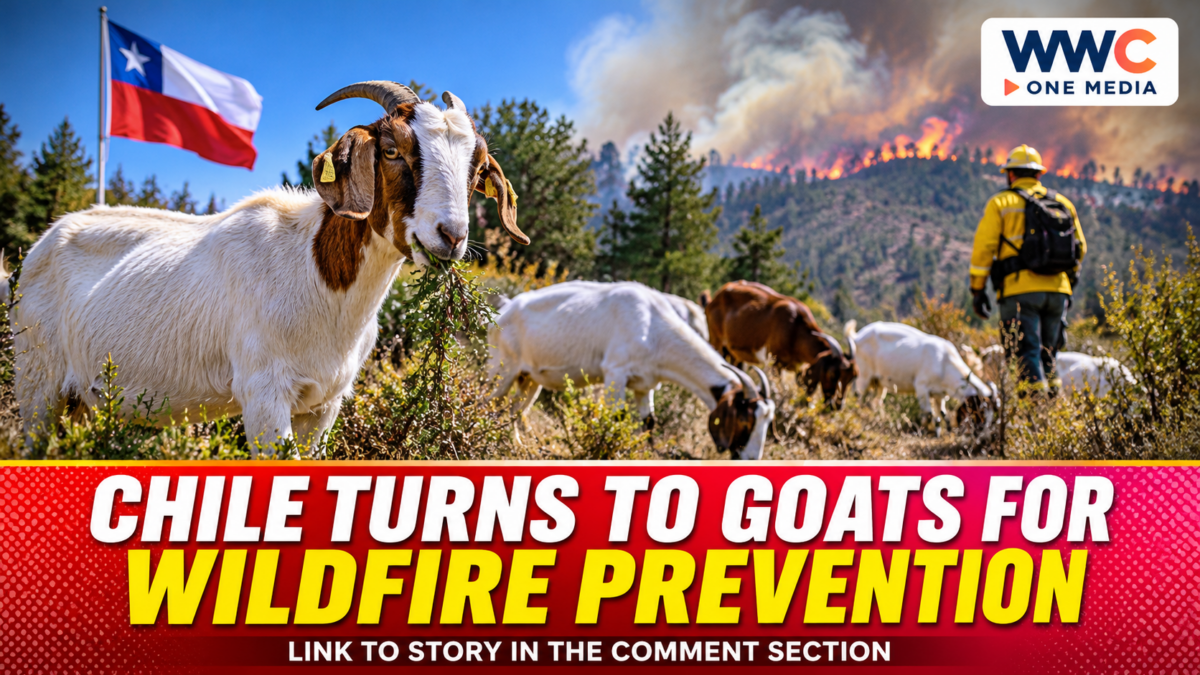
Chile is using an unusual tool in its wildfire-prevention efforts: herds of goats that eat grasses and shrubs before dry vegetation can become fuel for spreading flames. The University of Concepción has documented a programme involving more than 60 goats, while authorities in the Biobío Region are preparing a much broader prevention operation for the 2026–2027 fire season.
The approach combines controlled grazing with conventional firebreak construction, vegetation removal, patrols and firefighting resources. It highlights a practical challenge facing fire-prone regions: preventing a wildfire is not only about having aircraft and emergency crews ready, but also about reducing the combustible material that can help a fire spread.
How Chile’s goat-grazing strategy works
The University of Concepción, known as UdeC, brought a goat brigade back to its Concepción campus in December 2025 as part of its 2025–2026 forest-fire management plan.
The university documented a herd of more than 60 goats working with Buena Cabra, an organisation that uses managed grazing to reduce vegetation in areas considered vulnerable to fire. The programme was already operating during the previous year, making its return part of a continuing prevention effort rather than a one-time experiment.
The animals were assigned to areas requiring the reduction of grass and undergrowth, particularly locations with steep slopes where vegetation-clearing work can be difficult or hazardous for human workers.
The university also identified areas around medium-voltage electrical lines as part of the grazing operation. The herd was kept within protected, fenced areas and accompanied by a shepherd.
This is not simply a matter of releasing livestock into an open landscape. The method relies on controlled or rotational grazing, with animals directed to selected sections so that vegetation can be managed progressively.
The university’s December 2025 announcement said the goats could consume between 60% and 70% of the biomass in the areas where they worked. That figure describes the programme as presented by the university; it should not be interpreted as a nationwide reduction in wildfire risk.
Why grazing can help reduce wildfire fuel
Wildfires need combustible material to spread. Dry grass, shrubs, leaves and branches can provide fuel, particularly when weather conditions favour ignition and rapid fire movement.
Strategic grazing addresses part of that problem by reducing the amount and height of certain types of vegetation. Goats naturally browse a range of plants, allowing them to reach areas that may be difficult to clear using machinery.
The method can be particularly useful on slopes and uneven ground. In those locations, manual clearing may require more labour and expose workers to difficult conditions. Grazing can help reduce the vegetation burden before other maintenance work is carried out.
Chile’s own forestry guidance recognises livestock grazing as a possible vegetation-management measure. A technical manual published by the National Forestry Corporation, or CONAF, describes the use of herbivores to consume smaller vegetation, grasses and shrubs. It also identifies grazing as a possible tool in high-risk areas, particularly near roads, infrastructure and places where communities meet forested land.
The important distinction is that grazing is a preventive land-management measure, not a substitute for fire suppression. It cannot remove every type of fuel, stop an ignition or guarantee that a wildfire will not spread.
Biobío’s wider wildfire-prevention operation
The goat programme forms part of a much larger picture of wildfire preparation in Biobío.
On Nov. 4, 2026, CONAF presented its regional forest-fire protection plan for the 2026–2027 season, with an announced investment of 25.57 billion Chilean pesos.
The plan includes 42 forest brigades and approximately 545 firefighters, including four specialised teams for night operations. The regional distribution places 17 brigades in Concepción Province, 15 in Biobío Province and 10 in Arauco Province.
The response system also includes aircraft and early-detection infrastructure. CONAF outlined 10 regional aircraft, including helicopters and AT-802 planes, with a heavy Hercules C-130 aircraft available nationally for deployment according to operational needs. The authority also reported access to 106 remote-detection cameras through arrangements with forestry companies, alongside four detection towers.
These measures show that wildfire prevention and emergency response require several layers of preparation. Vegetation management can reduce available fuel, detection systems can help identify fires, and ground and aerial teams can respond when an incident occurs.
The scale of the regional programme also places the goat initiative in perspective: it is one specialised method within a wider system, not the central defence against every possible fire.
More than 1,200 kilometres of firebreak and vegetation work
A separate regional initiative announced by CONAF and the Ministry of Public Works on Nov. 26, 2026, sets out an extensive programme of vegetation-management work across Biobío.
The Regional Firebreak Plan for 2026–2027 covers 1,262.9 kilometres of vegetation-fuel reduction works across the region’s 33 municipalities.
The programme divides the planned work between the two institutions. The Ministry of Public Works’ Road Directorate is responsible for 876.51 kilometres, while CONAF is assigned 386.39 kilometres.
At the time of the announcement, the two agencies reported that 729.3 kilometres of preventive works had already been completed.
The work includes constructing and maintaining firebreaks and clearing strips of vegetation. These interventions are intended to reduce the continuity of combustible material, particularly near homes and communities.
The plan also includes additional work through CONAF’s Emergency Employment Programme, which covers 206 interventions across approximately 398.7 hectares.
This wider programme is important because fire prevention cannot rely on isolated cleared patches. Vegetation management must consider the landscape around roads, homes, infrastructure and other areas where fire could move from one section to another.
Why the method matters beyond Chile
The use of animals to manage vegetation offers another option for places where mechanical clearing is difficult or where land managers want to limit the use of some chemical or burning methods.
UdeC’s earlier project documentation describes the goat brigade as part of a plan to reduce combustible vegetation around the campus. Its annual report also records the use of controlled grazing as a way to lower vegetation height and make it less favourable for fire propagation.
That makes the programme relevant to broader discussions about landscape management and wildfire resilience.
The issue is not limited to Chile. WWC ONE MEDIA has also examined the wider consequences of forest fires through its coverage of Indonesia’s prolonged wildfire season, the wildlife toll documented during Indonesia’s forest fires and the effects of Indonesian wildfire haze on air quality in Davao.
Those situations involve different ecosystems and causes, but they underline a shared point: wildfire management has consequences beyond the immediate area where flames are reported. It can affect communities, wildlife, air quality and economic activity.
For Chile, the challenge is to combine preventive land management with reliable detection, trained personnel and public cooperation. The goat brigade demonstrates one way to manage vegetation, while the regional plan shows the scale of infrastructure and emergency resources required around it.
What happens next
Biobío’s 2026–2027 wildfire preparations will depend on the continued implementation of its regional firebreak programme, the deployment of brigades and aircraft, and the maintenance of early-detection systems.
The University of Concepción’s goat brigade provides an established example of strategic grazing in the region. However, the latest official university material reviewed for this article documents the 2025–2026 programme; it does not independently establish the exact dates, work area or herd size of a separate 2026 deployment described in the initial tip.
The wider lesson is that wildfire prevention works best when it begins before vegetation becomes a serious fuel problem. Goats can help with selected areas, but their contribution must sit alongside systematic land management, infrastructure protection and emergency readiness.
Frequently asked questions
1. Why are goats being used to prevent wildfires in Chile?
Goats eat grasses, shrubs and other vegetation that can contribute to wildfire fuel. Controlled grazing can reduce vegetation in selected areas before the dry season.
2. How many goats were involved in the University of Concepción programme?
The university documented more than 60 goats in its December 2025 announcement about the 2025–2026 prevention programme.
3. Can goats completely prevent forest fires?
No. Grazing can reduce certain types of vegetation, but it cannot prevent every ignition or stop every wildfire. It is one part of a wider prevention strategy.
4. What is Chile doing beyond the goat programme?
Biobío’s 2026–2027 plan includes 42 forest brigades, approximately 545 brigadistas, aircraft, detection cameras and a regional programme covering 1,262.9 kilometres of vegetation-management and firebreak works.
5. Which organisation is responsible for the regional wildfire plan?
Chile’s National Forestry Corporation, CONAF, is coordinating the regional forest-fire protection effort with public agencies, including the Ministry of Public Works and its Road Directorate.