
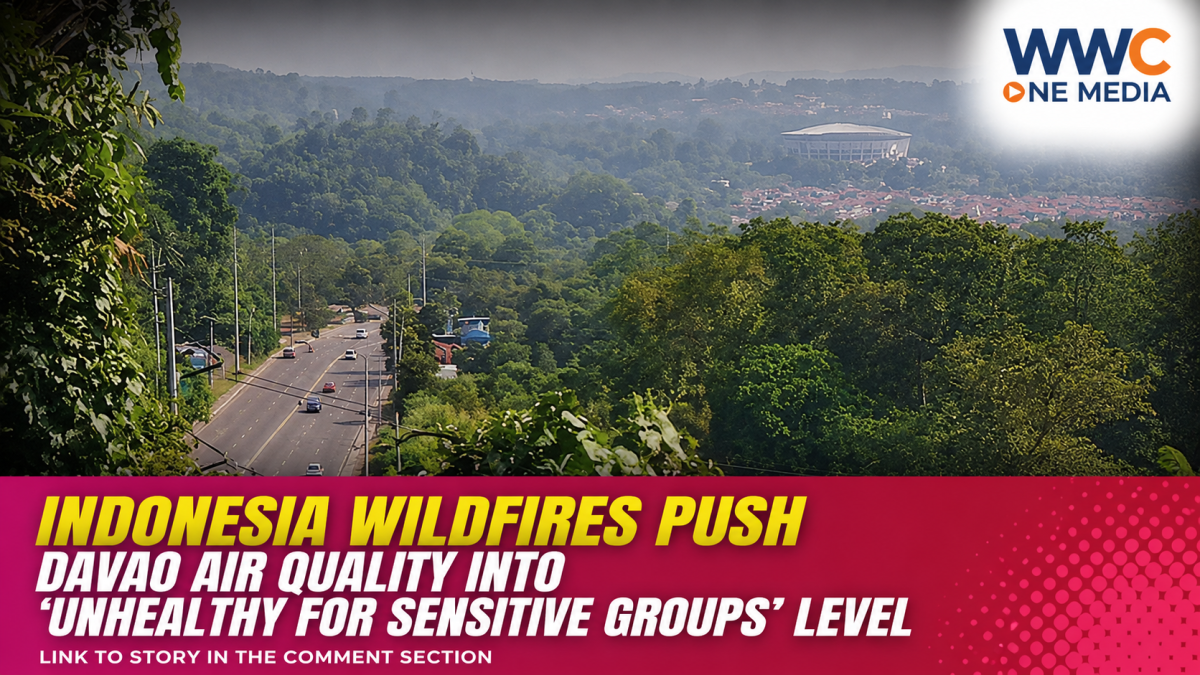
DAVAO CITY, Philippines — A haze linked to forest and peatland fires in Kalimantan, Indonesia has reached parts of Davao, prompting health and environmental authorities to warn residents to limit prolonged exposure as air quality deteriorates in some areas.
The Department of Environment and Natural Resources–Environmental Management Bureau (DENR-EMB) reported that its Calinan air-quality monitoring station in Davao City recorded PM2.5 levels that reached the “Unhealthy for Sensitive Groups” category from August 30 to September 1, 2026.
Importantly, the classification does not mean the entire Davao Region has unhealthy air. As of September 1, the Digos station in Davao del Sur was classified as “Fair,” while the Malita station in Davao Occidental remained “Good.”
Why is Davao seeing haze from Indonesia?
DENR-EMB and PAGASA attributed the haze to ongoing forest and peatland fires in Kalimantan, with prevailing southwest monsoon or Habagat winds transporting fine smoke particles across the region toward parts of the Philippines.
The movement of the haze is not limited to Davao.
DENR monitoring has shown that pollution associated with the Indonesian fires has shifted toward the Visayas and Mindanao, even as air quality in much of Metro Manila improved. Areas including Cebu, Zamboanga, Bacolod, Iloilo, Tacloban and parts of Mindanao have also recorded elevated PM2.5 levels.
Davao residents urged to take precautions
The Department of Health in Davao Region is urging residents to take precautions while the haze persists.
DOH-11 said exposure to polluted haze may cause coughing, difficulty breathing, chest pain and irritation of the eyes and nose, while potentially worsening existing respiratory conditions.
Residents are advised to:
- Limit prolonged outdoor activities when haze is noticeable.
- Stay indoors as much as possible when air quality worsens.
- Keep doors and windows closed when necessary.
- Wear a properly fitted N95 mask when going outside.
- Monitor official air-quality advisories.
- Exercise extra caution when driving because haze can reduce visibility.
DOH-11 also advised motorists to use headlights or fog lights when visibility is poor and to maintain a safe distance from other vehicles.
The situation is changing across the Philippines
The haze has become a moving regional air-quality problem rather than an issue confined to one part of the country.
On September 2, DENR-EMB reported “acutely unhealthy” PM2.5 readings in Talisay City, Cebu and Cagayan de Oro, while Naga City and Zamboanga City reached the “very unhealthy” category. Calinan in Davao City and Koronadal were among areas classified as “unhealthy for sensitive groups.”
By September 3, the situation had become particularly serious in Metro Cebu, where the PM2.5 AQI reached 252, placing it in the “acutely unhealthy” category.
The Philippine News Agency also reported that haze had reached Central Visayas and Negros Oriental, with authorities urging residents to avoid unnecessary exposure.
Indonesia is dealing with an even larger haze crisis
The smoke reaching the Philippines is part of a much broader wildfire problem in Indonesia.
Reuters reported that approximately 1.4 million students across six Indonesian provinces were moved to remote learning because of hazardous air quality caused by forest and land fires.
Scientists and environmental authorities have pointed to seasonal fires, particularly peatland burning in Kalimantan, as a major source of the smoke. Fine particles such as PM2.5 are small enough to penetrate deep into the respiratory system and can pose greater risks to vulnerable groups.
What happens next?
DENR-EMB officials stress that air quality is dynamic and can change depending on wind direction, rainfall and the continuing fires in Indonesia. Rain may temporarily help remove airborne particles, but conditions can deteriorate again if smoke continues to be transported toward the Philippines.
For Davao, the latest readings show that localized unhealthy conditions have already been recorded, particularly in Calinan, even though other monitoring stations remain in the good-to-fair range.
That makes continued monitoring especially important.
The bigger concern now is not simply how hazy Davao becomes — but how long the Indonesian fires and prevailing winds will continue sending fine particles across Philippine communities.
WWC ONE MEDIA J.M.D

Leave a Reply