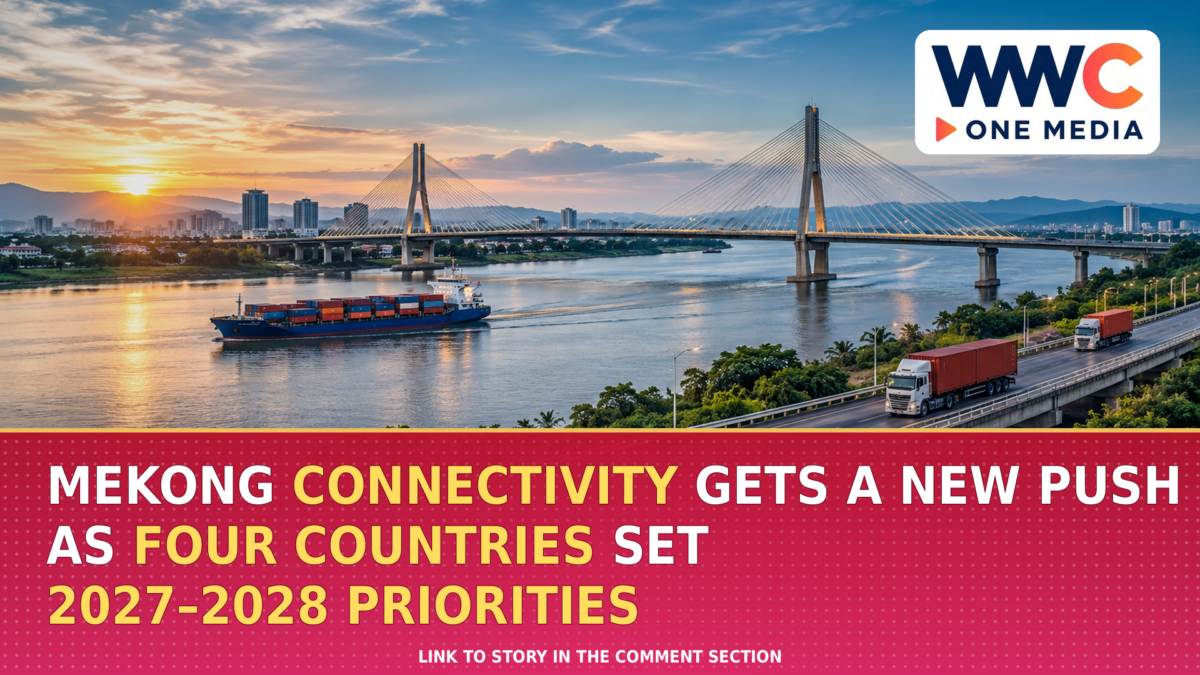
Four Mekong countries have agreed to make connectivity the central priority of their cooperation for 2027–2028, following the 12th Cambodia-Laos-Myanmar-Vietnam (CLMV) Summit in Hanoi on November 28, 2026. The meeting produced a joint statement covering transport corridors, customs procedures, energy links, digital trade, agricultural supply chains and the financing of regional projects.
The commitments give the Mekong region a more detailed cooperation agenda, but they also raise a practical question: how quickly can governments turn regional agreements into functioning infrastructure, smoother border procedures and commercial opportunities for businesses?
The outcome matters beyond the four countries involved. The wider five-member Ayeyawady-Chao Phraya-Mekong Economic Cooperation Strategy (ACMECS) framework also adopted a new declaration, while regional leaders called for stronger infrastructure, digital and institutional connections. Together, the two meetings place implementation and investment mobilisation at the centre of the next phase of Mekong cooperation.
Mekong connectivity becomes the central CLMV priority
The CLMV framework brings together Cambodia, Laos, Myanmar and Vietnam. In their November 28 joint statement, the four countries identified connectivity as a strategic requirement for expanding trade and investment, integrating businesses into global value chains, supporting tourism and strengthening regional development.
The leaders designated connectivity as the central, cross-cutting priority for 2027–2028. They also instructed ministers and senior officials to incorporate the agreed priorities into the next CLMV Action Plan, with clear deliverables, responsible focal points, realistic timelines and identified financing sources.
That instruction is important because it moves the discussion beyond a general declaration of support. It asks participating governments to define who is responsible for each task, when it should be delivered and how it will be financed.
The summit also reaffirmed the wider objective of developing the four-country subregion into a more integrated production and investment hub, with stronger participation in regional and global value chains.
Transport corridors and logistics are central to the plan
The joint statement identifies several transport connections for further development, including highway and railway links along the East-West, North-South and Southern Economic Corridors.
Among the routes specifically mentioned are connections linking Myanmar, Laos and Vietnam, as well as Myanmar, Thailand, Cambodia and Vietnam.
The leaders also highlighted the importance of maritime transport and port connectivity. These links are intended to complement land-based routes and support the movement of goods through different transport systems.
Laos’s access to seaports is another important element. The statement supports improved connections to ports in Vietnam, Cambodia and Myanmar, including through the proposed Vientiane-Hanoi Expressway and Vientiane-Vung Ang Railway projects.
For businesses, the potential benefit is straightforward: more reliable transport links can reduce the time and complexity involved in moving products between production centres, border crossings and export markets.
However, the statement does not mean that all the named infrastructure projects are already completed or fully financed. It calls for resources to be mobilised and implementation to be advanced.
The countries also agreed to develop smart logistics connectivity using digital technologies, standardised port operations and electronic data interchange. Ministers responsible for logistics were tasked with preparing a comprehensive plan for a connected regional logistics ecosystem.
Customs reform could matter as much as new infrastructure
The summit’s economic commitments extend beyond roads, railways and ports.
The four countries agreed to promote smart border-gate models at selected checkpoints and simplify customs procedures. They also committed to expanding electronic customs declarations and clearances, electronic certificates of origin and electronic sanitary and phytosanitary certification.
These measures are designed to make cross-border trade more efficient and reduce administrative obstacles for businesses.
The leaders also encouraged longer and synchronised border-crossing operating hours, alongside arrangements for single-stop and single-window inspections.
This is a significant part of the agenda because infrastructure investment alone cannot guarantee faster trade. A new road or railway may improve physical access, but delays in customs processing, inconsistent documentation and separate inspections can still slow down shipments.
The joint statement also calls for stronger cross-border economic zones along the main corridors, with investment priorities including agro-processing, logistics, warehousing, tourism, trade and digital services.
For companies considering regional expansion, the proposed improvements could make it easier to assess supply-chain routes and operating costs. Actual commercial benefits, however, will depend on how consistently the participating governments apply the agreed procedures.
Energy cooperation adds another regional dimension
The CLMV agreement also gives attention to electricity trade and energy infrastructure.
The leaders encouraged greater cross-border electricity trade, renewable energy development, grid resilience, battery energy storage systems and energy efficiency.
They also supported the gradual development of a Mekong subregional power transmission network through connections between national electricity grids, aligned with the ASEAN Power Grid.
The joint statement provides a concrete example of existing cooperation: Vietnam recorded more than 7 billion kilowatt-hours of electricity exchange through its grid interconnections with Laos in 2025. It also reported bilateral power trade between Cambodia and Vietnam at approximately 250 megawatts through the Chau Doc-Takeo transmission line.
Those figures show that cross-border energy cooperation is already taking place. The next challenge is to strengthen the infrastructure and coordination needed to support a more integrated regional system.
WWC has previously examined the commercial and regulatory exposure of Philippine energy investor ACEN in Vietnam in its report on the ACEN Vietnam tariff dispute and the company’s disclosed financial exposure.
Digital trade, agriculture and tourism enter the implementation agenda
The joint statement also recognises digital infrastructure as a necessary part of regional integration.
The four countries committed to strengthening digital infrastructure resilience, expanding broadband access, improving digital literacy and harmonising digital standards. The aim is to support more interoperable systems for digital trade, electronic payments and other services while improving cooperation on cybersecurity.
Agriculture is another major area of cooperation. Ministers were tasked with studying regional supply chains for higher-value processed products, including improvements in food safety, traceability, cold-chain logistics, branding and access to third markets.
This could help agricultural producers participate in more sophisticated supply chains instead of relying primarily on the sale of unprocessed commodities.
Tourism also features in the plan. The countries tasked their tourism ministers with designing a proposed CLMV Heritage Journey that would connect cultural and natural heritage destinations across the four countries under a shared tourism identity.
The initiative is intended to be supported by joint marketing, improved travel facilitation and better air and land connections.
These plans broaden the meaning of connectivity. Regional cooperation is not limited to moving freight: it also involves services, people, information, skills and tourism.
ACMECS expands the agenda to all five Mekong countries
The separate 11th ACMECS Summit brought together Cambodia, Laos, Myanmar, Thailand and Vietnam.
At the meeting, Vietnamese Prime Minister Le Minh Hung called for stronger links between production centres, cities, seaports, border gates and markets. He also highlighted the development of the North-South, East-West and Southern Economic Corridors and the need to strengthen regional supply chains.
The leaders adopted the Nay Pyi Taw Joint Declaration of the 11th ACMECS Summit. They also backed continued work on a new ACMECS Master Plan and adopted terms of reference for a special working group reviewing priority projects.
The ACMECS discussions covered infrastructure, digital and institutional connectivity, environmental protection, water-resource management and air-pollution control.
Myanmar handed over the ACMECS chairmanship to Thailand at the conclusion of the summit.
The wider Mekong-Japan framework is another part of this regional picture. WWC previously examined its cooperation agenda in Japan and Southeast Asia’s regional economic resilience discussions.
What happens next
The next stage will depend on the preparation of action plans, project selection, financing arrangements and coordination among the participating governments.
The CLMV joint statement calls for a more transparent system for mobilising development assistance, concessional financing, blended finance, public-private partnerships and private-sector investment. It also calls for the business community to take a greater role in designing, financing and implementing regional projects.
The countries tasked their ministers and senior officials with working alongside the ASEAN Secretariat to mobilise resources and monitor implementation. Progress is to be reviewed and reported to the 13th CLMV Summit, which the joint statement says will be chaired by Cambodia in 2028.
For businesses, the most useful indicators will be actual improvements in border processing, infrastructure delivery, electricity connections and access to regional markets.
The agreements provide a clearer framework for cooperation. Their economic value will ultimately depend on whether the projects receive funding, the agencies responsible meet their deadlines and businesses can use the resulting networks.
Frequently Asked Questions
1. What is the CLMV cooperation framework?
CLMV is a regional cooperation mechanism involving Cambodia, Laos, Myanmar and Vietnam. It supports coordination in areas such as trade, investment, transport, energy, agriculture, tourism and human-resource development.
2. What was the main outcome of the November 2026 CLMV Summit?
The four countries designated connectivity as the central, cross-cutting priority of CLMV cooperation for 2027–2028 and agreed on priorities covering infrastructure, logistics, trade, energy, digital systems and environmental cooperation.
3. What is ACMECS?
The Ayeyawady-Chao Phraya-Mekong Economic Cooperation Strategy is a five-country framework involving Cambodia, Laos, Myanmar, Thailand and Vietnam. It provides a platform for cooperation on regional economic and development priorities.
4. Will the agreements immediately create new transport routes?
No. The joint statement sets out priorities and tasks for governments and ministers. Infrastructure projects still require planning, financing, approvals and implementation.
5. How could the agreements affect businesses?
If implemented, the measures could improve customs processing, logistics, transport connections, energy cooperation and access to regional supply chains. The actual benefits will depend on delivery and the operating conditions in each country.