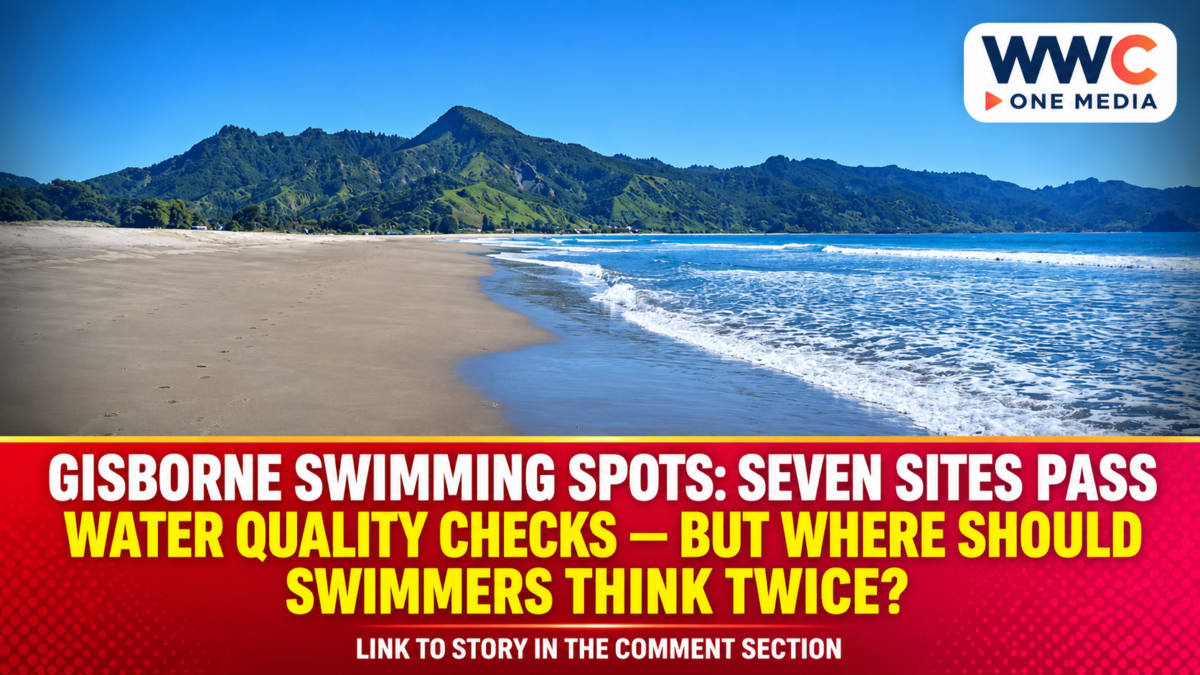
GISBORNE, NEW ZEALAND — Nov. 27, 2026 — Seven popular Gisborne swimming spots recorded satisfactory recreational water quality in monitoring conducted on Nov. 16, offering encouraging news for residents and holidaymakers preparing for New Zealand’s summer season.
The results cover several coastal and freshwater destinations, including Makorori, Rere Falls and Waikanae Beach. However, environmental conditions can change considerably following rainfall, making it important for swimmers to check water quality before entering the sea or rivers.
The difference between an inviting swimming destination and a potential health hazard may not always be visible.
Gisborne Swimming Spots That Recorded Positive Results
Seven monitored recreational locations received a suitable-for-swimming classification based on samples collected on Nov. 16, 2026.
These include:
- Kaiti Yacht Club
- Makorori Settlement
- Midway Surf Club
- Rere Falls
- Rere Rockslide top
- Waikanae Beach at Grey Street
- Waimata River at Anzac Park
The monitoring information also lists the Hangaroa River at Doneraille Park, although no recent sampling result was displayed for that location in the records reviewed.
The seven positive results provide a useful starting point for summer recreation. However, they do not establish a permanent ranking of Gisborne’s cleanest swimming destinations.
A favourable result applies to the conditions assessed during sampling. Subsequent rainfall, pollution or changes in river flow could affect whether a location remains suitable for swimming.
Why Some Gisborne Lagoons Remain a Concern
Not every calm stretch of water along Gisborne’s coastline is recommended for recreational use.
Several lagoons have recurring water-quality problems associated with agricultural runoff, urban drainage and contamination from birds.
Three locations specifically identified as unsuitable choices for swimming are:
Turihaua Lagoon: Contamination can accumulate when a sandbar restricts water exchange.
Hamanatua Stream Lagoon: Agricultural runoff regularly affects the waterway before it reaches Wainui Beach.
Waiotu Lagoon: Pollution from surrounding land and other environmental sources can contribute to elevated bacterial concentrations.
Although these locations may appear attractive, their appearance should not be interpreted as evidence of microbiological safety.
The importance of monitoring waterways also features in WWC ONE MEDIA’s coverage of cross-border river pollution in Thailand and Myanmar, although that environmental issue involves a different type of contamination.
The Two-to-Three-Day Rule After Heavy Rain
Rainfall is one of the most important considerations for people planning to swim in Gisborne.
Local recreational water guidance recommends staying out of the water for two to three days following substantial or sustained rainfall.
Rainwater can transport contaminants from developed areas and farmland into rivers and coastal environments. These pollutants may remain in recreational waterways after the weather improves.
For families planning beach holidays, this means a return to sunny conditions does not necessarily establish that the water is ready for swimming.
Visitors should assess recent weather conditions alongside the available monitoring results and any warning signs displayed at their destination.
Physical ocean hazards must also be considered separately from bacterial contamination. WWC ONE MEDIA’s earlier coverage of New Zealand’s unusual coastal-water activity and tsunami advisory explores another aspect of coastal recreation safety.
Why Water Quality Testing Matters
Gisborne’s recreational water monitoring includes testing for E. coli and enterococci bacteria.
These measurements help assess whether environmental contamination presents a potential health concern for people participating in water-based activities.
Water-quality results are particularly valuable because visual observations alone cannot establish whether bacteria are present at unsafe concentrations.
The wider significance of environmental monitoring is also explored in WWC ONE MEDIA’s report on water-quality management and community safety in Davao.
Although drinking-water standards and recreational swimming standards serve different purposes, both demonstrate the value of testing rather than relying exclusively on the appearance of water.
Rivers, Beaches and Changing Environmental Conditions
Gisborne’s swimming destinations include both marine and freshwater environments.
Conditions at these locations can differ substantially. A favourable assessment at a coastal site does not automatically extend to a nearby river, lagoon or stream.
Swimmers should therefore check the specific monitoring location rather than assuming that an entire coastal area has identical water quality.
Reduced freshwater flows during summer can also increase bacterial concerns in certain waterways.
These differences highlight the importance of repeated environmental monitoring, especially during periods of changing weather.
Separate environmental concerns involving algae and water conditions have also been examined in WWC ONE MEDIA’s coverage of fish mortality and water-quality concerns in Laguna de Bay.
That incident is unrelated to Gisborne’s swimming conditions but illustrates the broader importance of monitoring aquatic environments across the Asia-Pacific region.
What Happens Next for Gisborne’s Summer Swimming Season?
Residents and international visitors should consult updated recreational water-quality information throughout the summer.
The most useful precaution is to combine site-specific monitoring results with recent weather observations and local health warnings.
People should avoid areas affected by drainage outlets, follow contamination warnings and reconsider swimming when conditions have deteriorated following rainfall.
The November sampling results offer an encouraging indication for seven Gisborne destinations. Nevertheless, the most important question is not simply which location recorded a positive result earlier in the month.
It is whether that particular swimming destination remains suitable when visitors arrive.