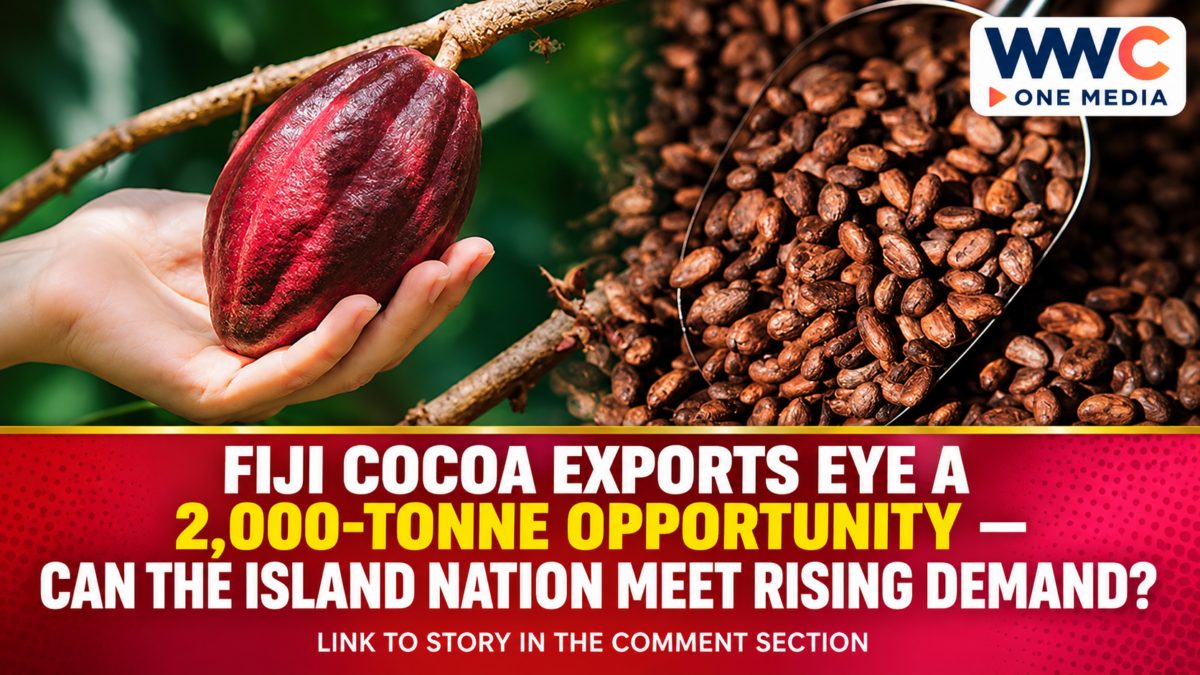
SUVA, Fiji — Fiji cocoa exports could enter a new phase of growth as potential demand from New Caledonia reaches up to 2,000 tonnes, while European market interest and investment in domestic processing create additional opportunities for the Pacific island economy.
The opening of Nord Investment’s cocoa processing facility in Matasawalevu, Dreketi, on Vanua Levu represents a tangible step towards expanding Fiji’s agricultural export capabilities.
However, the opportunity comes with a significant challenge: transforming international buyer interest into reliable production, consistent quality and sustained commercial shipments.
For Fiji, the emerging cocoa opportunity is not simply about supplying raw materials to chocolate manufacturers. It could also support rural entrepreneurship, agricultural diversification and greater domestic value creation.
Fiji cocoa exports target New Caledonia and other overseas markets
New Caledonia has emerged as a prospective destination for Fijian cocoa beans, with potential demand reaching as much as 2,000 tonnes.
The new processing facility on Vanua Levu is also expected to help local producers pursue opportunities in Japan and Australia.
The proposed volume from New Caledonia represents a commercial opportunity rather than a confirmed purchase agreement. Expanding production sufficiently to serve that market remains a separate challenge.
A reliable international buyer could provide growers with greater confidence when investing in plantation rehabilitation and production expansion.
Similar commercial considerations are explored in WWC ONE MEDIA’s coverage of agricultural export diversification and emerging international markets, where market access and supply readiness are central to long-term export growth.
New processing facility strengthens Fiji’s cocoa ambitions
Nord Investment’s facility in Dreketi provides a central location where growers can have cocoa beans prepared for international markets.
The project received a FJ$150,000 government grant through the National Export Strategy Programme, supporting construction, equipment and packaging requirements.
The Ministry of Agriculture’s Commercial Agriculture Development Programme and the Fiji Development Bank also supported the development.
For small agricultural businesses, access to shared processing infrastructure could reduce the need to establish individual facilities.
The commercial objective is to create a more coordinated supply chain connecting rural producers with exporters and overseas manufacturers.
Better coordination could also make it easier to maintain consistent product specifications and organise larger shipments.
Fiji has already reached North American cocoa buyers
Fiji’s ambitions are supported by actual export activity.
In July 2026, Cacao Fiji Limited reported shipments of one metric tonne of cocoa beans to the United States and 400 kilogrammes to Canada.
The company was also pursuing an export opportunity in Australia.
Founded in 2014, Cacao Fiji operates alongside Vanua Chocolate, a business that manufactures chocolate using cocoa obtained directly from Fijian growers.
The two operations illustrate different commercial approaches to the same agricultural commodity: exporting processed beans and manufacturing finished chocolate products.
Across the wider Asia-Pacific region, interest in premium cocoa products also creates opportunities for distinctive local brands, as illustrated by WWC ONE MEDIA’s feature on Auro Chocolate’s innovative cacao-based creations.
Fiji’s ability to develop both export-oriented cocoa processing and domestic chocolate manufacturing could help broaden its participation in the international chocolate supply chain.
European market opportunities add another dimension
Fiji’s export ambitions extend beyond the Pacific and North America.
A government update published on Nov. 25, 2026, highlighted growing European commercial interest in Fijian cocoa, alongside other agricultural and value-added products.
Trade discussions in Geneva also examined improvements in product certification, supply-chain development and domestic processing, with particular attention to smaller enterprises.
These priorities could become increasingly important as Fiji seeks to build lasting commercial relationships rather than relying on occasional export shipments.
The distinction between business discussions and measurable trade outcomes is also examined in WWC ONE MEDIA’s coverage of Canada–Mekong trade and investment opportunities.
For Fiji’s cocoa businesses, future success will depend partly on their ability to satisfy buyer requirements while maintaining commercially viable production costs.
Agricultural expansion faces a climate challenge
The cocoa industry’s development comes during a difficult period for Fiji’s agricultural sector.
On Nov. 18, 2026, the government declared a nationwide state of disaster after the ongoing El Niño drought reached crisis thresholds.
Authorities allocated FJ$20 million from existing ministry budgets to support affected communities, emergency water requirements and agricultural assistance.
WWC ONE MEDIA previously examined the implications of Fiji’s drought emergency and agricultural recovery programme.
Although the drought declaration does not establish specific production losses for cocoa, it highlights the importance of considering agricultural resilience alongside export development.
Farm rehabilitation, reliable production and investment planning will need to account for potential environmental disruptions.
For growers considering expansion, access to prospective buyers alone may not be sufficient to justify additional investment. Production conditions, financing and the reliability of purchasing arrangements will also matter.
What happens next for Fiji’s cocoa industry?
The next stage of Fiji’s cocoa development will require evidence that processing investments and overseas interest can translate into sustained business activity.
Several indicators will help establish whether the industry is progressing:
- Confirmed commercial purchase agreements with overseas manufacturers.
- Growth in the volume of cocoa prepared for export.
- Rehabilitation of existing cocoa plantations.
- Additional investment in agricultural processing and logistics.
- Repeat shipments to international customers.
Fiji’s experience with North American shipments provides a starting point, while the emerging New Caledonian opportunity offers a potential avenue for larger-scale growth.
The broader challenge of turning overseas interest into repeat agricultural orders is also explored in WWC ONE MEDIA’s reporting on the expansion of agricultural shipments into new international markets.
For now, Fiji has an opportunity to establish a stronger position in the international cocoa industry. Whether that opportunity develops into a substantial export business will depend on what its growers, processors and trading partners can deliver.