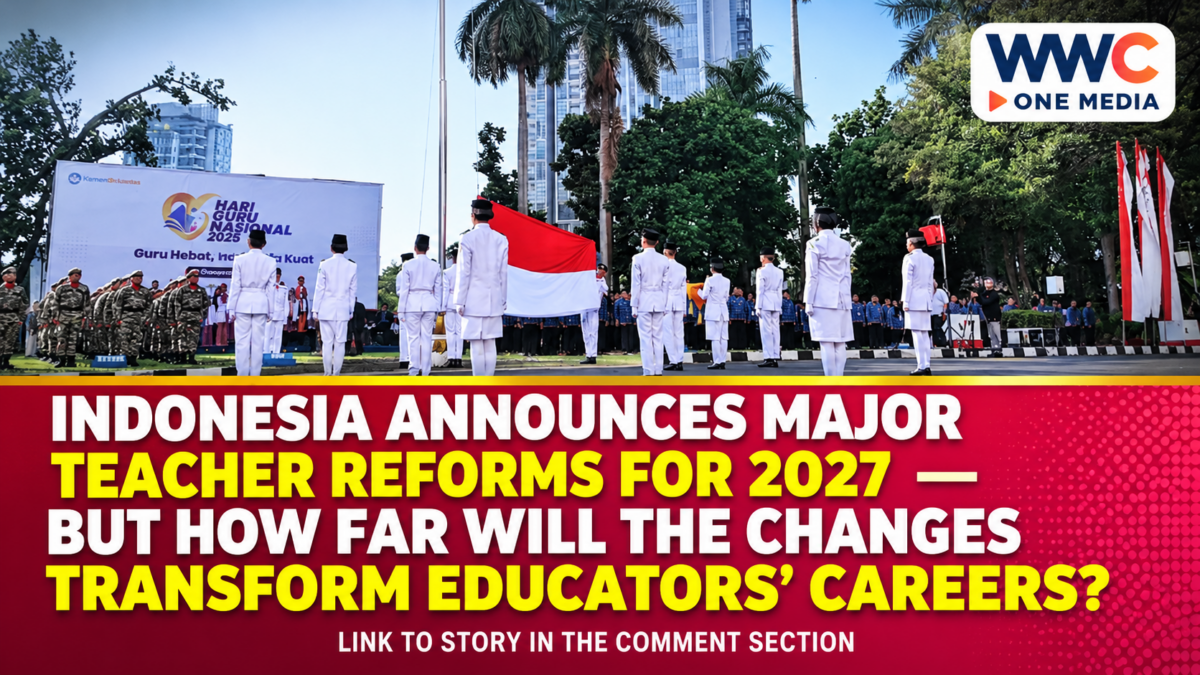
JAKARTA, INDONESIA — Indonesia is preparing to strengthen its education workforce through a series of reforms that will improve employment security, expand career opportunities and enhance the professional qualifications of teachers beginning in 2027.
The Indonesia teacher reforms include the planned conversion of 242,482 part-time government contract teachers into full-time employees without another selection examination, beginning Jan. 1, 2027.
Minister of Primary and Secondary Education Abdul Mu’ti reaffirmed the government’s commitment during the National Teachers’ Day ceremony in Jakarta on Nov. 25, 2026.
Under the theme Guru Hebat, Indonesia Kuat (Great Teachers, Strong Indonesia), the government is placing teacher welfare, academic development and professional competency at the centre of its education agenda.
The reforms extend beyond employment status, covering scholarship assistance, civil service recruitment, artificial intelligence training and the continuity of teaching services in public schools.
More than 242,000 Indonesian teachers set for full-time employment
Indonesia plans to automatically convert part-time teachers employed under the Government Employees with Work Agreements scheme, locally known as PPPK, into full-time PPPK employees.
The transition is scheduled to begin on Jan. 1, 2027, without requiring affected teachers to undergo another selection process.
The government also intends to transfer their employment status to the central government.
The broader employment restructuring covers other public-service professions, including healthcare workers, firefighters and technical personnel.
The employment measures place Indonesia within a wider regional conversation about the working conditions of educators, alongside initiatives such as Taiwan’s expanded parental leave provisions for teachers.
Indonesia opens new civil service opportunities for teachers
The government is preparing another career pathway for PPPK educators through the Civil Servant Candidate selection process, known as CPNS.
Mu’ti announced that PPPK teachers would have the opportunity to participate in the selection without an age restriction.
However, eligibility to participate should not be confused with automatic appointment to the civil service. Candidates will still undergo the applicable selection procedures.
Indonesia is also preparing a phased recruitment programme to address a projected requirement of 464,856 teachers.
The initial recruitment process is scheduled to begin in 2027, with the first assignments anticipated in 2028.
The government has identified underdeveloped, frontier and outermost regions as priority areas for addressing teaching personnel requirements.
Government extends employment for approximately 172,323 teachers
Indonesia has separately decided to extend the employment of approximately 172,323 non-ASN teachers working in public schools.
The measure covers educators registered in the national education database, known as Dapodik, whose existing employment agreements expire in December 2026.
Approximately 2,482 additional teachers under the Ministry of Religious Affairs are also covered by the announced extension.
Mu’ti further stated that non-ASN teachers below the age of 35 would have opportunities to participate in civil service selection.
Those who do not pass the selection may continue teaching until retirement, under the arrangements outlined by the minister.
These measures are intended to maintain continuity in education services while the government reorganises its teaching workforce.
Rp3 million scholarships support teacher qualifications
Professional development remains another component of Indonesia’s education programme.
Since 2025, teachers seeking to meet the country’s academic qualification requirements have been offered opportunities to pursue Diploma IV or undergraduate-level education through the Recognition of Prior Learning programme, known as RPL.
Scholarship assistance amounts to Rp3 million per semester.
The initiative supports the government’s objective of gradually bringing teachers’ academic qualifications into alignment with national requirements.
Teacher development is also a recurring subject in regional education initiatives, including UNESCO-supported classroom innovation and living heritage education.
Artificial intelligence and coding enter teacher development programmes
Indonesia is incorporating technological and professional skills into its teacher development initiatives.
The government has identified six areas of training:
- In-Depth Learning
- Guidance and counselling
- Coding and artificial intelligence
- Science, technology, engineering and mathematics (STEM)
- English language
- School leadership
The programmes complement efforts to develop educators’ professional abilities and improve classroom instruction.
Across the Asia-Pacific region, digital education initiatives have also included investments in teaching equipment, such as government-supported laptop distribution for educators.
Mu’ti also emphasised the importance of teachers adapting to technological developments, pursuing continuous learning and providing meaningful educational experiences for students.
Indonesia allocates additional funding for education priorities
The Ministry of Primary and Secondary Education’s fiscal year 2027 budget ceiling has been set at Rp89.10 trillion, following an increase of Rp28 trillion from the previous ceiling.
The additional allocation includes Rp23 trillion to support salaries and allowances associated with the transition of part-time PPPK teachers to full-time employment.
Another Rp5 trillion is intended to restore funding for the educational institution revitalisation programme, bringing that programme’s allocation to Rp14.28 trillion.
These figures represent announced budget allocations rather than confirmation that the funds have already been disbursed.
National Teachers’ Day receives presidential recognition
Indonesia’s National Teachers’ Month began on Oct. 30, 2026, with activities recognising educators and encouraging professional collaboration.
The programme included workshops, literacy initiatives, professional discussions and opportunities for teachers to exchange educational practices.
President Prabowo Subianto subsequently participated in the main National Teachers’ Day celebration on Nov. 26.
The event included recognition of educators, the inauguration of participants in an academic qualification programme and the introduction of the Studio Guru initiative.
Prabowo highlighted teachers’ responsibilities in developing students’ knowledge, character, national values and resilience, while recognising the dedication of educators serving remote communities.
What happens next?
The next major milestone for Indonesia’s teacher employment restructuring is Jan. 1, 2027, when the planned conversion of part-time PPPK teachers is scheduled to begin.
The government is also preparing further civil service recruitment, employment adjustments and professional development initiatives.
Detailed implementation requirements will be important for determining how individual teachers access the announced opportunities.
For Indonesia’s educators, National Teachers’ Day 2026 has marked a renewed commitment to employment security, professional advancement and educational development, with implementation scheduled to continue into 2027 and beyond.