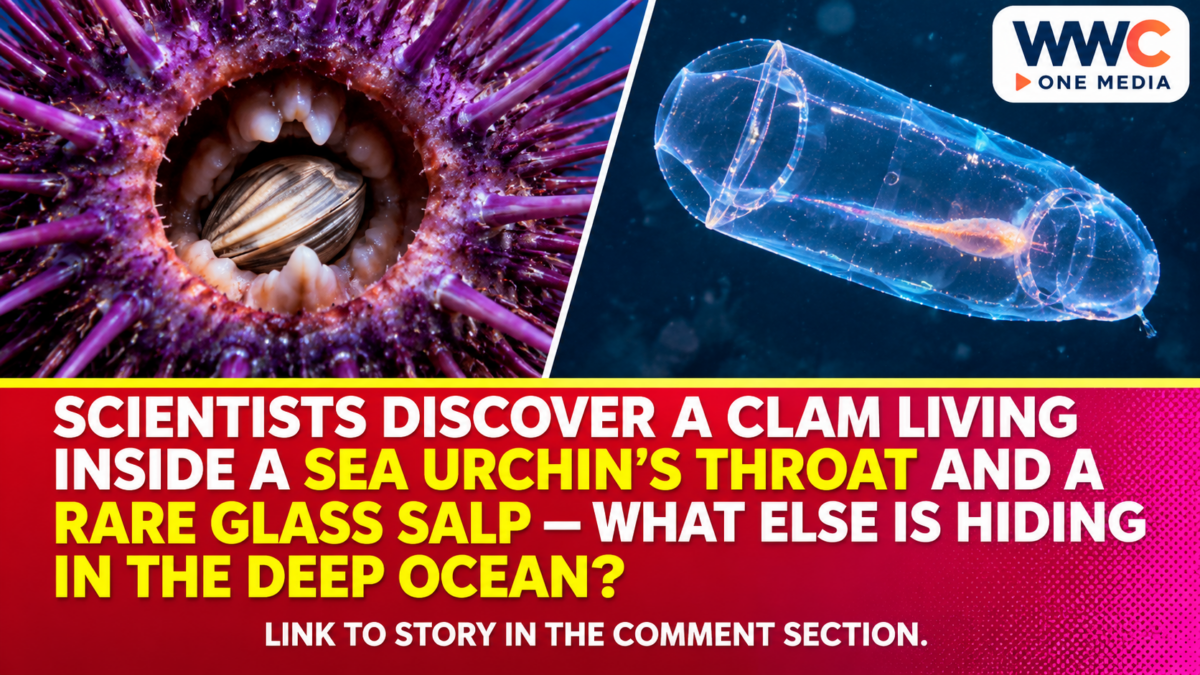
SCIENCE AND ENVIRONMENT DESK — Two extraordinary deep-sea species discoveries are challenging conventional ideas about how marine animals survive in some of Earth’s least explored environments.
Off southern Australia, scientists have identified a previously undescribed clam living inside the oesophagus of a deep-water sea urchin, approximately 4,000 to 5,000 metres beneath the ocean surface.
Meanwhile, researchers studying the waters off western North America have formally described a transparent animal called the glass salp, the first known member of its group to inhabit deep-ocean environments exclusively.
The discoveries reveal two contrasting survival strategies: one animal occupies an unusual biological shelter inside another creature, while the other has adapted to life in the dark waters far below the surface.
Both findings also demonstrate why identifying marine biodiversity requires more than simply collecting unfamiliar specimens.
Deep-sea species discoveries reveal an extraordinary partnership
The newly described Australian clam, scientifically named Vaticinaria gulicola, inhabits the oesophagus of the sea urchin Carnarechinus clypeatus.
The research involved marine scientists Paul Valentich-Scott, Hugh MacIntosh and Ryutaro Goto, representing scientific institutions in the United States, Canada and Japan.
Their investigation followed an extensive survey of the Great Australian Bight that recovered 66,721 marine invertebrates representing 1,267 species.
Approximately one-third of the identified species were considered potentially new to science.
During examinations of material collected from the deepest sampling areas, researchers encountered clams possessing attachment structures but initially could not identify their hosts.
Further investigation and genetic analysis helped establish that other specimens were occupying the digestive passage of a sea urchin.
The discovery introduces an unusual example of endocommensalism, a biological association in which an organism lives inside another animal without necessarily causing significant harm.
However, the precise effects of this arrangement on the host remain an important subject for further investigation.
A marine mystery remained overlooked for around 150 years
One of the most remarkable aspects of the investigation emerged from historical scientific collections rather than a new expedition.
Researchers identified related clams inside a sea urchin specimen obtained during the Challenger Expedition, which took place between 1872 and 1876.
The relationship had escaped recognition for approximately 150 years.
Importantly, the historical clams were identified as a related species. They should not automatically be classified as the newly named Vaticinaria gulicola.
The discovery illustrates how preserved museum specimens can retain scientific information that becomes valuable when new research questions or analytical techniques emerge.
It also demonstrates the importance of maintaining biological collections beyond the conclusion of individual research programmes.
Similar challenges surrounding the identification of unfamiliar marine organisms were explored in WWC ONE MEDIA’s coverage of Singapore’s search for potentially undiscovered species in the deep Indian Ocean.
Discovering an unfamiliar organism is only the beginning. Determining whether it represents a distinct species requires careful comparison with existing scientific records.
How does a clam survive inside another animal?
The Australian clam can reach approximately 19 millimetres in length and possesses a shell capable of closing completely.
Its scientific name refers to its unusual residence inside the sea urchin’s throat.
Despite identifying its habitat, researchers have not conclusively established how the clam obtains food or how it maintains its position without interfering with its host’s biological functions.
One possibility is that it obtains nutrients from material passing through the urchin’s digestive system.
That explanation remains a hypothesis rather than a demonstrated feeding mechanism.
Further research could help determine whether the clam depends entirely on its host, how it reaches the digestive passage and whether the relationship changes during different stages of development.
These unanswered questions make the discovery particularly significant for scientists investigating relationships between marine organisms.
The glass salp represents another deep-ocean mystery
Thousands of kilometres away, marine researchers have documented a different form of underwater adaptation.
The glass salp, Vitreosalpa gemini, was first observed in Monterey Bay more than two decades ago.
Marine scientist Laurence P. Madin formally described the new genus and species in a scientific paper published on Sept. 17, 2026.
A subsequent research announcement on Nov. 24 highlighted the underwater technology that helped scientists investigate the animal.
Salps are gelatinous marine tunicates rather than jellyfish. They inhabit open water and obtain food by filtering suspended particles.
The glass salp has been recorded at depths ranging from approximately 280 to 2,200 metres, with observations extending across Monterey Canyon, the Pacific Northwest and the Gulf of California.
Its transparent appearance, delicate tissues and relatively slow movement distinguish it from many better-known surface-dwelling relatives.
Underwater robotic observations have helped researchers study these fragile animals without relying exclusively on specimens brought to the surface.
Twin embryos reveal an unusual reproductive strategy
The scientific name Vitreosalpa gemini reflects two notable characteristics: its transparent body and its production of twin embryos.
Salps alternate between individual and interconnected reproductive stages.
The individual stage produces genetically identical offspring, which can form chains. The interconnected stage participates in sexual reproduction, producing the next generation.
The glass salp’s production of twin embryos is an unusual characteristic within this animal group.
Scientists have suggested that producing twins could provide a reproductive advantage in environments where individuals are relatively dispersed.
However, that proposed evolutionary advantage requires further investigation.
The animal also presents questions about how marine filter-feeders sustain themselves below the sunlit surface waters, where conventional phytoplankton-based feeding opportunities differ.
Why these discoveries matter for ocean conservation
Documenting marine species provides an essential starting point for understanding how ocean ecosystems function.
Without reliable records of species distribution, behaviour and habitat requirements, researchers may find it difficult to determine whether environmental conditions are changing or whether particular organisms are becoming less common.
The importance of establishing biodiversity records extends across marine environments, from the deep ocean to coastal ecosystems.
WWC ONE MEDIA has previously examined the documentation of mangrove species around Lawak Island and marine wildlife monitoring involving dugongs and green sea turtles.
Although these investigations concern different habitats, they illustrate a shared scientific objective: establishing reliable information before drawing conclusions about ecological change.
For deep-ocean environments, such knowledge could become increasingly valuable when assessing the potential effects of commercial activities, climate-related changes and other environmental pressures.
What happens next in deep-sea exploration?
The Australian clam and glass salp represent separate scientific discoveries, but both demonstrate the value of combining modern technology with long-term research and preserved biological collections.
Future investigations could reveal how the clam establishes its unusual relationship with the sea urchin and whether additional related species occupy similar habitats.
Further observations of the glass salp could improve understanding of its distribution, reproductive biology and ecological significance.
The findings also raise a broader question about the organisms that remain undocumented across the world’s oceans.
The next extraordinary discovery might emerge from a newly explored underwater environment — or from a scientific specimen that has already been sitting inside a museum for generations.
Frequently asked questions
What is the newly discovered clam living inside a sea urchin?
Vaticinaria gulicola is a newly described bivalve mollusc found inside the oesophagus of the deep-sea urchin Carnarechinus clypeatus off southern Australia.
How deep was the Australian clam discovered?
Researchers identified the species at approximately 4,000 to 5,000 metres below the ocean surface in the Great Australian Bight.
What is the glass salp?
Vitreosalpa gemini is a transparent marine tunicate recognised as the first known salp species restricted to deep-ocean environments.
Is the glass salp a jellyfish?
No. Although both animals can have transparent, gelatinous bodies, salps belong to the tunicate group.
What makes the glass salp unusual?
It inhabits deep waters between approximately 280 and 2,200 metres, has a transparent body and produces twin embryos during its reproductive cycle.