
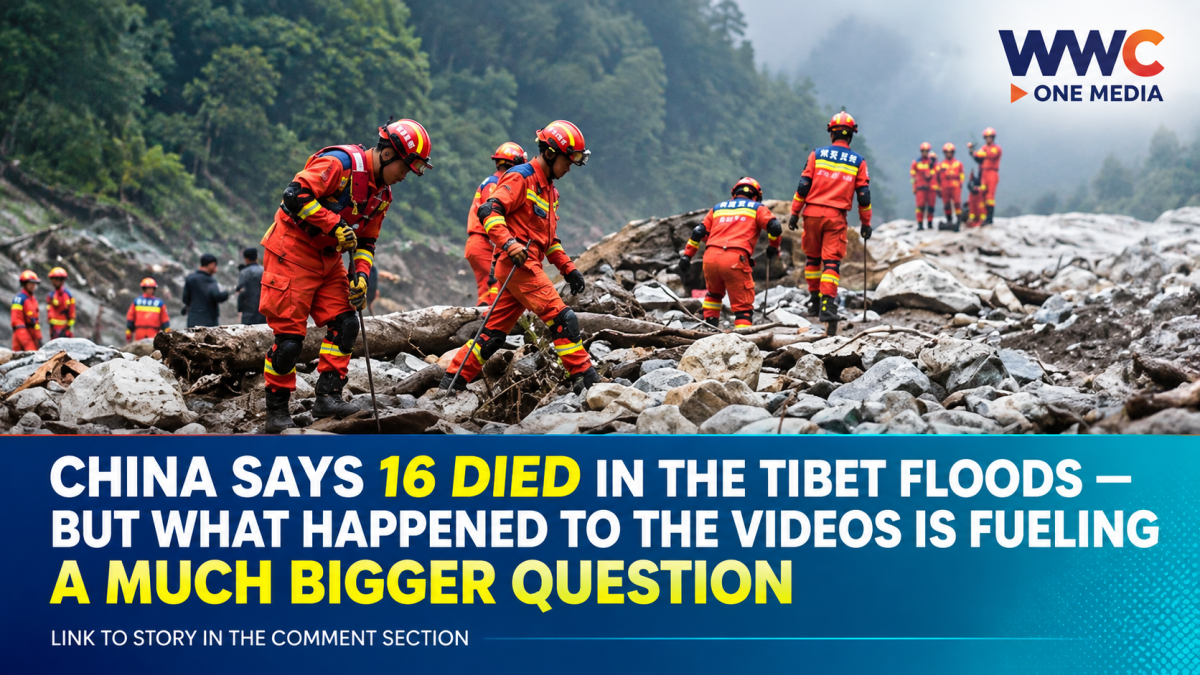
GYIRONG, TIBET — A week after a catastrophic wall of water, mud, ice and rock devastated communities along the Nepal-Tibet border, another battle is unfolding far from the wreckage: a fight over what the world is allowed to see.
The August 26 disaster tore through the Himalayan border region and overwhelmed Gyirong Port, a strategically important crossing between Tibet and Nepal. On the Chinese side, authorities have officially reported 16 deaths and 546 people still missing as rescue crews continue searching through mud, collapsed infrastructure and unstable mountain terrain.
But while Chinese state media have extensively covered rescue operations, road repairs and the deployment of thousands of emergency personnel, foreign journalists and human-rights organizations say independent scrutiny of the disaster has been sharply limited.
And that information gap is now becoming part of the story itself.
Dramatic Flood Videos Appeared — Then Some Disappeared
Some of the most disturbing images emerged almost immediately after the disaster.
Security-camera and mobile-phone footage showed an enormous surge of mud, water and debris crashing through the Gyirong border crossing as people ran for safety.
Asia Times, republishing an analysis from The Conversation, reported that videos initially circulated on Chinese platforms including Weixin and RedNote before users later found some of them inaccessible.
ABC News Australia independently reported a similar pattern, saying dramatic footage circulated in China before disappearing from online platforms.
But the censorship controversy is more complicated than claims of a total blackout.
Some Chinese journalists and social-media users pushed back against Western coverage, pointing out that footage of the disaster had also appeared in Chinese media. Critics accused the BBC and other Western outlets of exaggerating claims that Beijing had completely suppressed images of what happened.
That distinction matters.
China has not prevented all images or reporting about the disaster from appearing. State-run Xinhua, CCTV and other government-controlled outlets have published photographs and video showing rescue workers, damaged roads, search teams and the devastated Gyirong area.
The dispute is instead centered on which information remains available, who is permitted to report independently and whether unofficial accounts contradicting the government narrative are being removed or punished.
Journalists Say They Were Denied Access
One of the clearest obstacles to independent verification has been physical access to Tibet.
ABC China correspondent Allyson Horn reported that she made several formal requests for permission to travel to the affected Tibetan region after the disaster but was repeatedly denied.
According to Horn, Chinese officials cited difficult access and the continuing danger of secondary disasters.
Those risks are real.
Roads were destroyed, communications were disrupted and rescue teams initially had to rely heavily on helicopters, drones and personnel traveling through extremely difficult terrain. The G216 highway leading into Gyirong was only restored to the core disaster area on September 2, allowing more rescue personnel, supplies and heavy equipment to enter.
But foreign correspondents argue that hazardous conditions do not fully explain the restrictions because reporters routinely work around comparable disaster risks elsewhere.
In neighboring Nepal, international journalists have been able to interview survivors, grieving relatives, rescuers and displaced residents much more freely.
That contrast has produced two very different pictures of the same Himalayan catastrophe.
China’s Coverage Focuses on Rescue and Leadership
Chinese state media have emphasized the scale of the government’s emergency response.
Xinhua has reported that more than 2,000 personnel have participated in rescue operations, including members of the People’s Liberation Army, the People’s Armed Police Force and specialist emergency crews.
President Xi Jinping ordered an all-out rescue response, while Premier Li Qiang personally traveled to Gyirong to oversee relief efforts.
Li also publicly called for information about the disaster and rescue operations to be released in an “open and transparent” manner.
Coverage has highlighted rescuers searching through debris, restoring communications and power, reopening roads and delivering supplies to isolated communities.
There is substantially less independent reporting, however, about individual Tibetan families, destroyed villages, criticism of the response or questions surrounding the official casualty figures.
That imbalance is driving suspicion.
At Least 10 People Reportedly Punished Over Flood Posts
Human Rights Watch says the restrictions have extended beyond professional journalists.
The organization reported that Chinese authorities had punished at least 10 people accused of spreading “rumors” connected to the flood disaster.
Some online posts reportedly challenged the official casualty figures or claimed that entire settlements had suffered far greater losses than authorities acknowledged.
Those claims should be treated cautiously.
There is currently no reliable independent evidence proving that China’s official death toll is deliberately understated, and foreign reporters have not been able to conduct the type of unrestricted investigation necessary to establish a different number.
That is precisely why the access issue has become so significant.
Without independent journalists freely interviewing residents, visiting affected villages and reviewing casualty records, neither Beijing’s official numbers nor the much higher figures circulated by some activists and social-media users can easily be independently tested.
Beijing Faces Claims It Is Controlling the Narrative
Human Rights Watch argues that Chinese disaster reporting frequently follows a familiar pattern: limit unauthorized information while emphasizing government leadership, successful rescues and social stability.
The Guardian has similarly reported that Chinese coverage of the Tibet disaster has concentrated heavily on rescue operations while providing fewer accounts from ordinary villagers than journalists have been able to obtain in Nepal.
That does not mean China’s rescue effort is fabricated.
Thousands of emergency workers have genuinely been deployed. Roads and communications genuinely have been damaged. Search teams continue operating under dangerous conditions, and Beijing has also sent assistance to neighboring Nepal.
The issue is whether those genuine rescue efforts are being presented inside a tightly controlled information environment where alternative narratives receive far less space.
The Disaster Is Still Unfolding
The humanitarian crisis is enormous on both sides of the border.
Reuters reported on September 2 that at least 1,114 people had died in Nepal, with thousands more still missing. In Tibet, China’s latest official count remains 16 dead and 546 missing.
The numbers may continue changing as search teams reach previously inaccessible areas.
Scientists are also examining the precise chain of events behind the catastrophe. Evidence indicates that a huge collapse involving ice and rock in the Himalayan region triggered the destructive surge that swept into downstream communities.
The disaster has renewed warnings about the growing vulnerability of the Hindu Kush-Himalayan region as temperatures rise, glaciers retreat and unstable mountain slopes threaten increasingly populated valleys.
But in Tibet, one question extends beyond climate science and disaster preparedness.
It is about information.
Chinese authorities insist they are carrying out a massive rescue operation and have publicly called for transparency. Their media have provided extensive footage demonstrating that the disaster itself has not simply been erased from public view.
Yet reports of disappearing social-media footage, punishment over unauthorized claims and restrictions preventing independent journalists from reaching the affected region leave a fundamental problem unresolved.
The world can see that Gyirong was devastated.
What it still cannot independently establish is whether it is seeing the full story of what happened there — or only the version Beijing has chosen to let through.
WWC ONE MEDIA MJE


Leave a Reply