
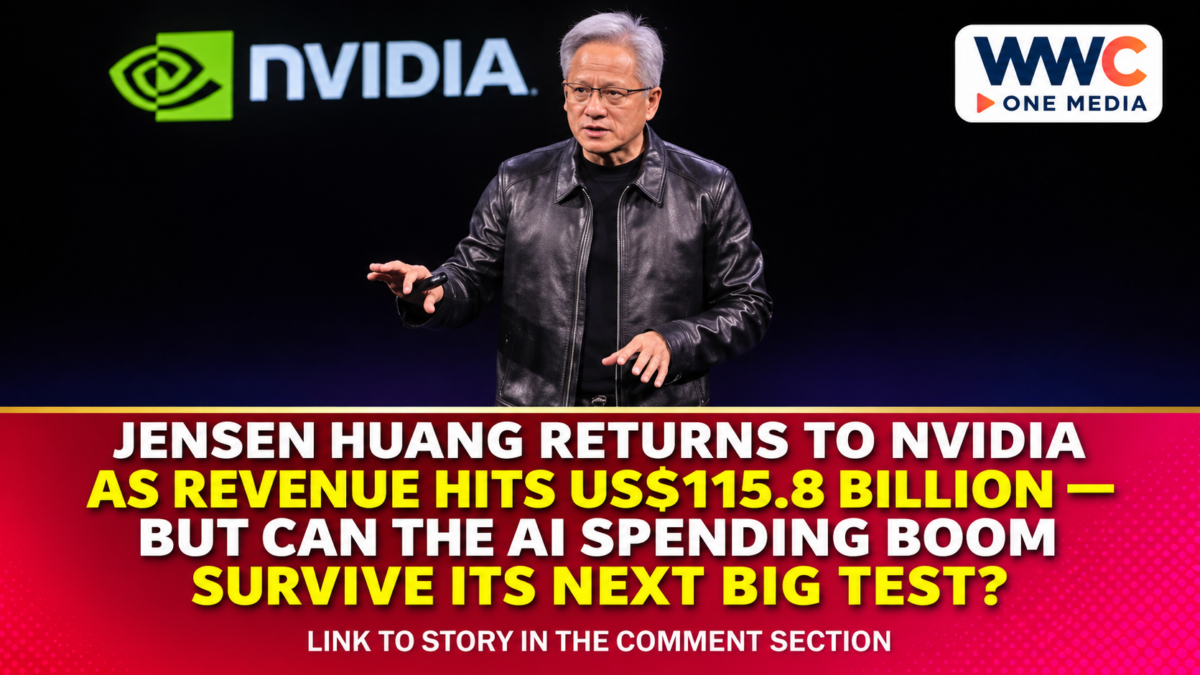
SANTA CLARA, California — Jensen Huang’s return to Nvidia has restored the company’s co-founder to the centre of the global artificial intelligence industry, following a brief leadership transition that raised questions about corporate governance and the sustainability of AI infrastructure investment.
Nvidia’s board reinstated Huang on November 22, 2026, following a unanimous decision announced publicly the next day.
His return comes after the semiconductor giant reported quarterly revenue of US$115.8 billion, more than double its revenue during the corresponding period a year earlier.
However, Nvidia’s financial disclosures reveal another dimension to the AI revolution: US$518 billion in future commitments involving supply procurement, computing infrastructure, investments and capital expenditure.
For investors, the fundamental question is no longer simply whether demand for artificial intelligence is growing.
It is whether the companies financing that expansion can generate sufficient commercial returns to sustain it.
Jensen Huang Returns to Nvidia After an 11-Day Leadership Transition
Nvidia’s regulatory filings establish that its board accepted Huang’s resignation as president, chief executive officer and director on November 11.
The company subsequently appointed Chief Financial Officer Colette Kress as interim chief executive while directors considered permanent leadership candidates.
Harvey C. Jones was appointed chairman of the board.
Huang’s reinstatement became effective on November 22, ending the interim leadership arrangement. Kress remains executive vice president and chief financial officer, while Jones continues as board chairman.
The company confirmed that its independent investigation concerning previously reported national security issues would continue despite Huang’s reinstatement.
The board expressed confidence in its decision following discussions with Huang and input from senior US government officials.
Nevertheless, that assessment should not be confused with a completed independent investigation.
The distinction has also been examined in WWC ONE MEDIA’s coverage of Nvidia’s reinstatement of Jensen Huang and its continuing compliance responsibilities.
For shareholders, leadership continuity may reduce one source of uncertainty, but effective corporate oversight remains a separate responsibility.
Nvidia Revenue More Than Doubles to US$115.8 Billion
Nvidia’s November 17 financial results demonstrate the substantial commercial expansion underpinning its position in the AI industry.
For the third quarter of fiscal 2027, which ended October 25, the company reported revenue of US$115.8 billion, increasing 103% year on year and 20% from the preceding quarter.
| Financial indicator | Q3 FY2027 | Q3 FY2026 |
|---|---|---|
| Revenue | US$115.8 billion | US$57.0 billion |
| GAAP operating income | US$77.52 billion | US$36.01 billion |
| GAAP net income | US$65.29 billion | US$31.91 billion |
| GAAP diluted earnings per share | US$2.70 | US$1.30 |
| Operating cash flow | US$48.25 billion | US$23.75 billion |
The data centre business generated US$107.6 billion in quarterly revenue, increasing 110% year on year.
That segment accounted for approximately 93% of Nvidia’s consolidated revenue.
The concentration demonstrates both the strength of AI infrastructure demand and the company’s exposure to investment decisions made by organisations purchasing advanced computing systems.
If infrastructure investment remains strong, Nvidia could continue benefiting from the expansion.
If customers reduce or postpone capital expenditure, the company’s dependence on data centre demand could become more consequential.
Nvidia’s US$518 Billion Commitments Reveal the Scale of the AI Boom
Nvidia’s official chief financial officer commentary provides a detailed breakdown of future commitments as of October 25, 2026.
| Commitment category | Amount |
|---|---|
| Supply and production capacity | US$390 billion |
| Cloud service agreements | US$28 billion |
| Data centre leases not commenced | US$74 billion |
| Equity investments | US$20 billion |
| Capital expenditure | US$6 billion |
| Total | US$518 billion |
The figures illustrate how Nvidia’s business increasingly extends beyond designing and selling semiconductor products.
The company must secure production capacity, obtain computing infrastructure for research and support selected investments across the wider technology industry.
However, these commitments should not be interpreted as US$518 billion in outstanding financial debt or money already spent.
They represent future obligations and investment commitments distributed across different categories and time periods.
Some are also subject to applicable commercial conditions.
For investors, understanding the composition and timing of these commitments is more important than examining their combined value alone.
Why AI Circular Financing Is Attracting Attention
One of the more complicated questions surrounding the artificial intelligence industry involves the financial relationships connecting chip suppliers, infrastructure operators, investors and technology developers.
An AI infrastructure provider may require substantial external financing to purchase semiconductor equipment and construct computing facilities.
When a semiconductor supplier also invests in businesses developing or purchasing that infrastructure, commercial relationships can become increasingly interconnected.
Such arrangements are not inherently improper. They may help new companies obtain computing capacity, accelerate infrastructure development and overcome financing barriers.
However, they can create questions concerning counterparty exposure, customer financial strength and the independence of future demand.
Nvidia’s earlier quarterly filing acknowledges its involvement in arrangements supporting customer and partner data centre expansion, including financial guarantees and other forms of credit support.
The potential financial consequences have previously been examined in Nvidia’s AI financing guarantees and infrastructure risk exposure.
The key distinction is between genuine commercial demand supported by sustainable customer revenue and demand that remains dependent on continuing external financing.
The existence of interconnected financing arrangements does not independently establish fictitious sales, accounting misconduct or fraud.
Taiwan and Asia-Pacific Remain Exposed to AI Investment Decisions
Nvidia’s commercial performance has implications extending beyond the United States.
The wider Asian technology ecosystem includes semiconductor manufacturers, electronic component suppliers, equipment producers and businesses involved in data centre development.
Changes in AI infrastructure investment could therefore influence commercial expectations across several Asia-Pacific industries.
The sensitivity of regional financial markets to Nvidia-related developments has also been examined in Taiwan’s stock market rebound following Huang’s return.
However, rising share prices do not independently establish improvements in underlying corporate cash flow.
Likewise, falling technology valuations do not necessarily mean that demand for AI computing has disappeared.
The long-term commercial significance of artificial intelligence will depend on how effectively businesses convert technological capabilities into revenue, productivity improvements and sustainable earnings.
Congressional Scrutiny Remains Another Test
Huang’s return also places him back in charge of Nvidia during a period of continuing congressional scrutiny concerning advanced semiconductor export controls.
The US Senate Banking Committee has scheduled a hearing for December 3, 2026, concerning oversight of American AI technology export restrictions.
The official hearing notice identifies Huang as a scheduled witness.
Nvidia has separately established a board committee comprising independent directors to oversee national security and export-control risks.
These arrangements provide additional mechanisms for examining compliance matters.
Nevertheless, the effectiveness of such safeguards will depend on their implementation and the company’s subsequent actions.
The commercial importance of regulatory oversight has previously been explored in Nvidia’s expanded congressional scrutiny and the questions surrounding its scheduled Senate hearing.
For international semiconductor businesses, regulatory uncertainty can influence customer access, investment planning and supply-chain decisions.
What Happens Next for Nvidia and the AI Industry?
Nvidia’s next major tests will include maintaining revenue growth, delivering next-generation computing products and managing its substantial financial commitments.
Investors may also examine whether infrastructure customers can generate sufficient revenue to meet their obligations without becoming excessively dependent on additional borrowing or investment.
The independent investigation and continuing congressional scrutiny represent separate governance and regulatory considerations.
Huang’s reinstatement restores leadership continuity at one of the world’s most influential technology companies.
However, the future of the AI industry cannot depend exclusively on the return of a prominent executive or the continued expansion of semiconductor sales.
Its more enduring measure of success will be whether the enormous investment in artificial intelligence produces commercially sustainable services and measurable economic benefits.
Frequently Asked Questions
When did Jensen Huang return to Nvidia?
Nvidia’s board reinstated Huang on November 22, 2026. The company publicly announced the decision on November 23.
How much revenue did Nvidia generate in its latest reported quarter?
Nvidia reported US$115.8 billion in third-quarter fiscal 2027 revenue, increasing 103% year on year.
What are Nvidia’s US$518 billion commitments?
They comprise future commitments involving supply capacity, cloud services, data centre leases, equity investments and capital expenditure. They do not represent US$518 billion in outstanding debt.
Has Nvidia’s independent investigation concluded?
No. Nvidia’s November 23 announcement confirms that the investigation will continue despite Huang’s reinstatement.
Is the AI investment boom a financial bubble?
The available financial disclosures demonstrate substantial infrastructure demand and investment commitments. They do not conclusively establish that the industry is experiencing a bubble. Future profitability and financing conditions remain important considerations.










