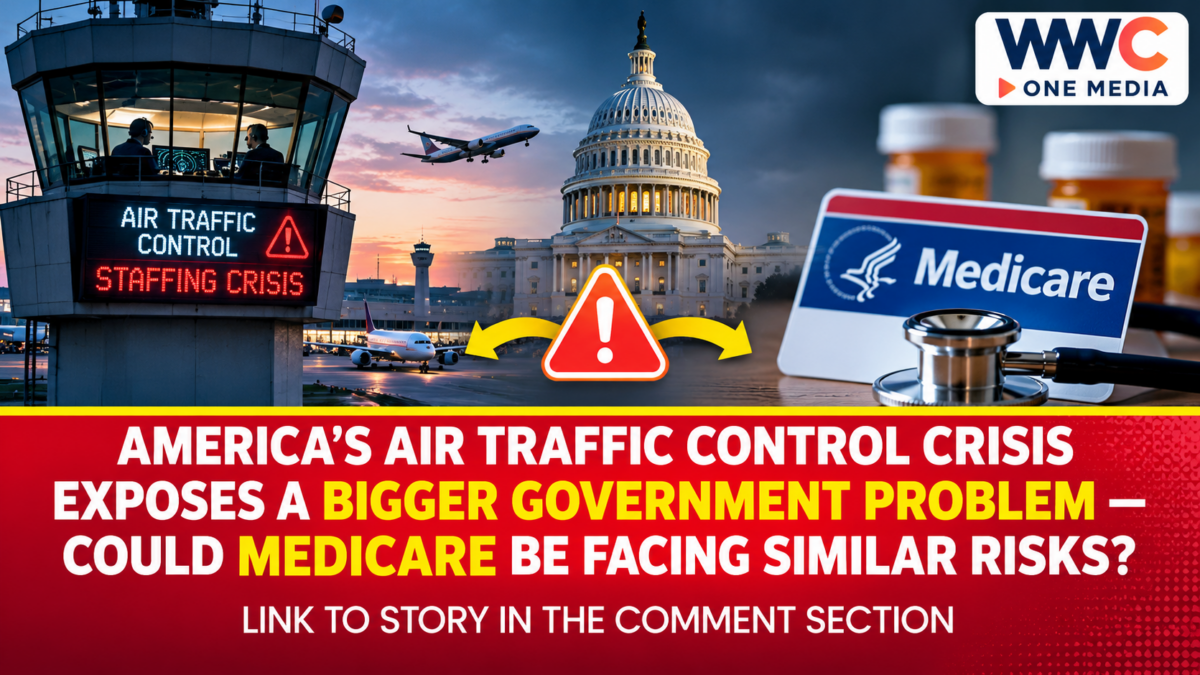
WASHINGTON, United States — The urgent need for US public service modernisation has returned to the national spotlight following a nationwide air traffic control disruption that exposed the operational challenges facing America’s critical infrastructure.
On November 13, telecommunications instability affected 17 of the Federal Aviation Administration’s 22 Air Route Traffic Control Centers, prompting a precautionary nationwide ground stop.
Approximately 12,462 flights were cancelled that day, including 9,082 cancellations by major airlines, although not all were directly caused by the restriction.
The disruption raises a broader public policy question extending beyond aviation: Can government institutions modernise essential services without compromising reliability, accessibility and public safety?
That question is particularly relevant to Medicare, where federal authorities are testing advanced technologies to improve healthcare spending decisions and reduce inappropriate medical expenditure.
US Public Service Modernisation: What the FAA Crisis Revealed
The November aviation disruption was not a complete loss of radar and radio communications. Some systems remained operational, allowing controllers to continue monitoring aircraft and communicating with pilots.
Nevertheless, the widespread instability required authorities to restrict departures across the country as a precaution.
The incident demonstrates how technical problems in interconnected infrastructure can create consequences extending far beyond the original point of failure.
The operational circumstances have been examined in WWC ONE MEDIA’s coverage of the FAA’s investigation into the nationwide flight ground stop.
For government institutions, the challenge involves maintaining existing services while introducing new technology.
Replacing outdated infrastructure is necessary, but implementation must also account for system dependencies, operational continuity and the consequences of unexpected failures.
The same governance principle applies to healthcare administration, even though the two industries have substantially different operational requirements.
America’s US$12.5 Billion Aviation Modernisation Programme
Congress appropriated US$12.5 billion in July 2025 to support the FAA’s Brand New Air Traffic Control System initiative.
The first phase targets improvements involving communications, surveillance, weather systems and training infrastructure, with completion planned for December 2028.
The second phase focuses on new aircraft-tracking and traffic-management automation systems.
Federal auditors reported in September 2026 that the FAA estimated the second phase would require approximately US$10.2 billion, excluding facilities.
However, auditors also identified deficiencies in comprehensive cost estimates and integrated scheduling.
| Aviation modernisation indicator | Official position |
|---|---|
| Initial congressional appropriation | US$12.5 billion |
| Phase one completion target | December 2028 |
| Estimated phase two funding | US$10.2 billion, excluding facilities |
| Phase two completion date | Not established in the September audit |
These figures demonstrate why funding announcements should not be confused with completed infrastructure improvements.
For taxpayers, the meaningful measure of success is whether investments produce reliable services and measurable operational benefits.
Medicare Faces Its Own US$23.7 Billion Financial Challenge
The healthcare sector presents another example of the difficulties involved in managing large public programmes.
A July 21, 2026, Government Accountability Office (GAO) report identifies an estimated US$23.7 billion in improper Medicare Advantage payments during fiscal year 2025, equivalent to 6.1% of programme expenditure.
Improper payments are not necessarily fraudulent payments. They can also involve incorrect amounts, insufficient documentation and other failures to satisfy applicable payment requirements.
Federal auditors identified weaknesses in corrective action planning, audit administration and comprehensive fraud risk assessment.
These findings suggest that improving public financial management requires more than introducing additional technology.
Government agencies must also establish clear objectives, monitor corrective measures and ensure that accountability mechanisms function effectively.
The aviation and healthcare findings do not establish that Medicare is experiencing an infrastructure failure equivalent to the FAA ground stop.
Instead, they demonstrate a shared challenge: modernising complex institutions while maintaining effective oversight.
Medicare Tests Advanced Technology Across Six States
On January 1, 2026, CMS launched the Wasteful and Inappropriate Service Reduction (WISeR) Model.
The initiative runs through December 31, 2031, across Arizona, New Jersey, Ohio, Oklahoma, Texas and Washington.
It uses enhanced technology to improve medical necessity reviews for selected services under Original Medicare.
Healthcare providers may submit prior authorisation requests for covered services selected by the programme or undergo medical review after providing the service but before receiving payment.
| WISeR programme feature | Current framework |
|---|---|
| Programme duration | 2026–2031 |
| Participating states | Six |
| Applicable programme | Original Medicare |
| Medicare Advantage included | No |
| Existing Medicare coverage policy | Unchanged |
| Existing payment policy | Unchanged |
The distinction between Original Medicare and Medicare Advantage is important.
The WISeR initiative does not directly address the Medicare Advantage payment estimate identified in the separate July audit.
For policymakers, combining unrelated spending figures and technology initiatives could create misleading expectations about the financial benefits of healthcare reform.
Could Technology Create New Administrative Bottlenecks?
Advanced technology offers opportunities to improve efficiency, identify inappropriate payments and accelerate administrative decisions.
However, the implementation of new digital systems can also create risks if organisations fail to establish appropriate oversight.
In healthcare administration, poorly designed processes could potentially produce unnecessary documentation requirements or delays in reviewing legitimate requests.
These are prospective risks, not established findings that the WISeR programme has caused widespread treatment delays.
Appropriate safeguards could include clear decision-making standards, accessible review procedures and monitoring of patient and healthcare provider experiences.
The importance of system reliability has also been examined in the broader technological risks exposed when critical backup systems fail.
The objective should not simply be reducing government expenditure or increasing automation.
It should be delivering reliable services while ensuring that efficiency improvements do not create disproportionate difficulties for legitimate users.
Public and Private Sector Cooperation Requires Accountability
Technology contractors can provide specialised expertise, infrastructure and software that government institutions may find difficult to develop independently.
However, contracting out particular services does not eliminate the government’s responsibility to establish appropriate standards and protect public interests.
Effective procurement should consider service reliability, contractual accountability, information security and contingency arrangements.
In aviation, these considerations can influence operational continuity.
In healthcare, they may affect administrative decisions, sensitive medical information and financial obligations.
The experience of travellers affected by aviation disruptions, including questions surrounding refunds and assistance following the FAA ground stop, also demonstrates why clear consumer-facing procedures matter when essential systems encounter difficulties.
For Medicare beneficiaries, similarly clear communication and accessible administrative processes should remain priorities.
What Happens Next for American Public Service Reform?
The effectiveness of America’s modernisation efforts will depend on whether government institutions can demonstrate measurable improvements.
For aviation, important indicators include project delivery milestones, system reliability, operational disruptions and infrastructure expenditure.
For Medicare, relevant measures include the accuracy of administrative decisions, processing times, patient access, provider experience and properly documented financial savings.
Neither private sector participation nor increased government spending guarantees better public services.
Their value depends on implementation, institutional oversight and independently evaluated outcomes.
The November aviation disruption provides a compelling reminder that critical infrastructure requires continuous investment and maintenance.
Medicare’s technology initiatives present a separate opportunity to improve healthcare administration.
The broader test for Washington is whether it can pursue innovation while preserving the reliability, fairness and accountability that essential public services require.
Frequently Asked Questions
What caused the November 2026 FAA ground stop?
Telecommunications instability affected 17 of the FAA’s 22 Air Route Traffic Control Centers, prompting a precautionary nationwide departure restriction.
How much has Congress allocated for air traffic control modernisation?
Congress appropriated US$12.5 billion in July 2025 to support the FAA’s Brand New Air Traffic Control System initiative.
What is Medicare’s WISeR Model?
It is a six-state initiative testing enhanced technology to improve medical necessity reviews and reduce inappropriate expenditure under Original Medicare.
Does WISeR change Medicare coverage?
No. The programme does not change existing Medicare coverage or payment policies and does not apply to Medicare Advantage beneficiaries.
Does US$23.7 billion in improper Medicare Advantage payments represent confirmed fraud?
No. Improper payments can include administrative errors, incorrect payment amounts and insufficient documentation. Fraud is a separate determination.