
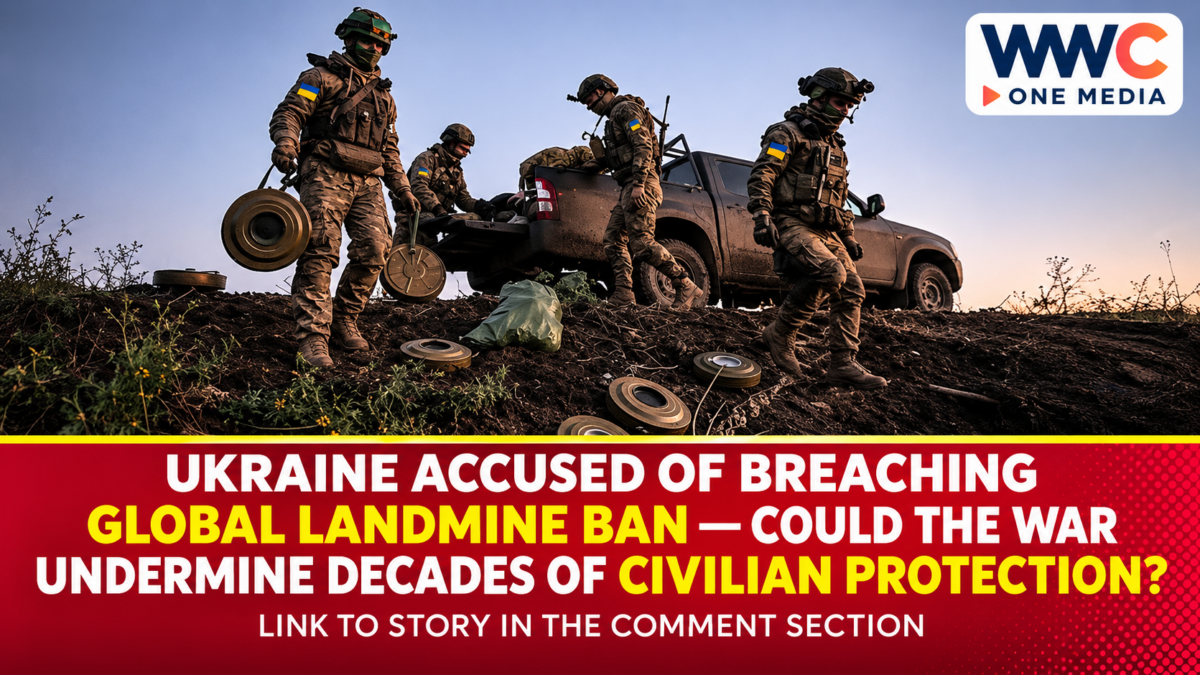
GENEVA, Switzerland — Ukraine’s landmine treaty commitments have come under renewed international scrutiny after a global humanitarian monitoring organisation documented the production and use of prohibited antipersonnel mines during the country’s continuing war with Russia.
The International Campaign to Ban Landmines (ICBL) released its Landmine Monitor 2026 report on November 24, finding that Ukraine’s reported activities violate its obligations under the 1997 Ottawa Convention.
The findings come amid a worsening global humanitarian situation, with at least 6,929 people killed or injured by landmines and explosive remnants of war in 2025.
Russia, which is not a party to the convention, was also identified among countries using antipersonnel mines.
The developments highlight a growing conflict between national security priorities and international commitments designed to protect civilians.
For communities affected by armed conflict, the consequences of weakening these protections could persist long after fighting ends.
Ukraine Landmine Treaty Obligations Remain in Effect
Ukraine signed the Ottawa Convention on February 24, 1999, ratified it on December 27, 2005, and became legally bound by its provisions on June 1, 2006.
However, the Ukrainian government subsequently sought to suspend its participation during the continuing armed conflict with Russia.
A United Nations depositary notification dated July 21, 2025, formally records Ukraine’s communication of its decision to suspend the treaty’s operation, effective from July 17.
Ukraine invoked the 1969 Vienna Convention on the Law of Treaties as the basis for its decision.
The legal difficulty is that the Ottawa Convention contains specific restrictions concerning withdrawal during armed conflict.
Article 20 establishes a six-month period before withdrawal can become effective. If the withdrawing country remains engaged in armed conflict when that period expires, withdrawal cannot take effect until the conflict ends.
The ICBL maintains that Ukraine’s attempted suspension is not legally permissible and that the country remains subject to its existing obligations.
The convention’s November 2026 membership records continue to include Ukraine.
The monitoring organisation’s latest findings therefore raise questions about treaty compliance rather than merely documenting a change in national defence policy.
What Does the Ottawa Convention Prohibit?
The Ottawa Convention entered into force on March 1, 1999, establishing international obligations intended to eliminate antipersonnel landmines and address their humanitarian consequences.
Its principal provisions establish restrictions on the use, production, acquisition, stockpiling and transfer of antipersonnel mines.
The agreement also requires participating countries to undertake stockpile destruction and mine clearance, subject to applicable provisions and deadlines.
Limited exceptions exist for activities involving humanitarian clearance training and related purposes.
| Treaty provision | Principal obligation |
|---|---|
| Article 1 | General prohibition on antipersonnel mines |
| Article 3 | Limited permitted exceptions |
| Article 4 | Destruction of prohibited stockpiles |
| Article 5 | Clearance of contaminated areas |
| Article 6 | International cooperation and assistance |
| Article 7 | Transparency reporting |
| Article 8 | Clarification of compliance concerns |
| Article 20 | Conditions governing withdrawal |
These requirements establish a legal framework extending beyond immediate battlefield conduct.
The broader objective involves reducing persistent dangers that can prevent communities from safely returning to their homes and restoring their livelihoods.
Russia’s Landmine Use Remains Part of the Wider Conflict
Ukraine’s reported treaty violations must also be examined within the broader context of Russia’s full-scale invasion and the continuing humanitarian consequences of the war.
Russia is not a state party to the Ottawa Convention.
Nevertheless, the absence of treaty membership does not remove a country’s obligations under other applicable rules of international humanitarian law.
The latest monitoring findings identify Russia among countries using antipersonnel mines during the reporting period.
The two countries’ different treaty positions should not obscure the dangers that mine contamination creates for civilians.
WWC ONE MEDIA has previously examined the wider humanitarian consequences of the conflict in its coverage of Russia’s mounting war losses and the continuing civilian toll in Ukraine.
Scrutiny of Ukraine’s treaty compliance should not be interpreted as justification for Russia’s invasion or for conduct that violates applicable humanitarian law.
Similarly, Russia’s actions do not independently remove Ukraine’s existing international legal commitments.
Global Landmine Casualties Reach a Five-Year High
The latest global monitoring data reveal a humanitarian challenge extending well beyond Eastern Europe.
At least 6,929 people were killed or injured by landmines and explosive remnants of war during 2025, an increase of 10% compared with 2024.
Among casualties whose civilian or military status was established, civilians accounted for 84%.
Children represented half of civilian casualties for whom age information was available.
These percentages have specific statistical denominators and should not be interpreted as applying automatically to every recorded casualty.
The figures also combine incidents involving landmines with those involving other explosive remnants of armed conflict.
They do not represent casualties caused exclusively by antipersonnel mines or weapons used by Ukrainian forces.
The importance of civilian protection during ongoing hostilities has also been examined in the humanitarian challenges facing Ukrainian communities following the Dymer apartment attack.
For displaced families, the end of active fighting does not necessarily mean that returning home will be safe.
Five European Countries Leave the Global Mine Ban Treaty
The international agreement is also experiencing an unprecedented change in membership.
Estonia, Finland, Latvia, Lithuania and Poland have withdrawn from the Ottawa Convention amid growing regional security concerns.
These developments represent the first effective withdrawals in the treaty’s history.
However, the agreement continues to attract new participants. Lebanon, the Marshall Islands and Tonga have joined during the latest reporting period.
As of November 24, 2026, 162 countries remained bound by the convention.
The competing developments illustrate how governments are reassessing the relationship between national defence strategies and international humanitarian commitments.
Regional security concerns deserve serious consideration, but the long-term risks to civilians must also form part of those assessments.
The wider challenges surrounding international security cooperation have previously been examined in the four-point declaration issued by Trump, Xi and Putin following their Shenzhen summit.
Diplomatic commitments to international stability become more meaningful when accompanied by practical measures to protect affected populations.
Mine Clearance and Reconstruction Face Financial Challenges
The 2026 monitoring report identifies at least 65 countries and other territories with confirmed or suspected antipersonnel mine contamination.
Thirty-two participating countries still have contaminated areas requiring clearance.
Ukraine received 28% of international mine-action funding in 2025, reflecting the substantial humanitarian challenges associated with the continuing conflict.
However, concentrating assistance in a limited number of countries can create additional funding difficulties for other affected communities.
For governments and international development institutions, humanitarian mine clearance is connected to broader reconstruction priorities.
Agricultural recovery, housing redevelopment, transportation access and the restoration of public infrastructure may all depend on professional assessments establishing that contaminated areas are safe.
Survivors may also require medical treatment, physical rehabilitation and long-term economic support.
These responsibilities can continue for years after an armed conflict concludes.
What Happens Next for the Global Landmine Ban?
The November report was released ahead of the Twenty-Third Meeting of States Parties to the Ottawa Convention.
Future discussions could address treaty compliance, mine clearance commitments, humanitarian funding and the implications of recent withdrawals.
Article 8 provides mechanisms through which participating countries can seek clarification concerning another state’s compliance.
The monitoring report itself is not a criminal judgment and does not establish the individual criminal liability of particular officials or military personnel.
Nevertheless, its findings provide a documented basis for further international scrutiny.
For Ukraine, the immediate legal question concerns compliance with obligations that remain applicable despite its attempted suspension.
For the wider international community, the challenge is maintaining credible humanitarian protections during periods of heightened security uncertainty.
The long-term effectiveness of the Ottawa Convention will ultimately depend not only on the number of participating countries but also on their willingness to honour its provisions when those commitments become most difficult to maintain.
Frequently Asked Questions
Has Ukraine withdrawn from the Ottawa Convention?
Ukraine attempted to suspend the treaty’s operation in July 2025. International treaty monitors maintain that the suspension is legally ineffective, and Ukraine remains listed as a state party.
What did Landmine Monitor 2026 find about Ukraine?
The report documented the production and use of antipersonnel mines by Ukraine, which the monitoring organisation assesses as violations of its treaty commitments.
Is Russia a member of the Ottawa Convention?
No. Russia is not a state party, although other applicable international humanitarian law obligations remain relevant.
How many people were killed or injured by landmines in 2025?
At least 6,929 people worldwide were killed or injured by landmines and explosive remnants of war during 2025.
How many countries remain bound by the Ottawa Convention?
As of November 24, 2026, 162 countries remained bound by the treaty.










