
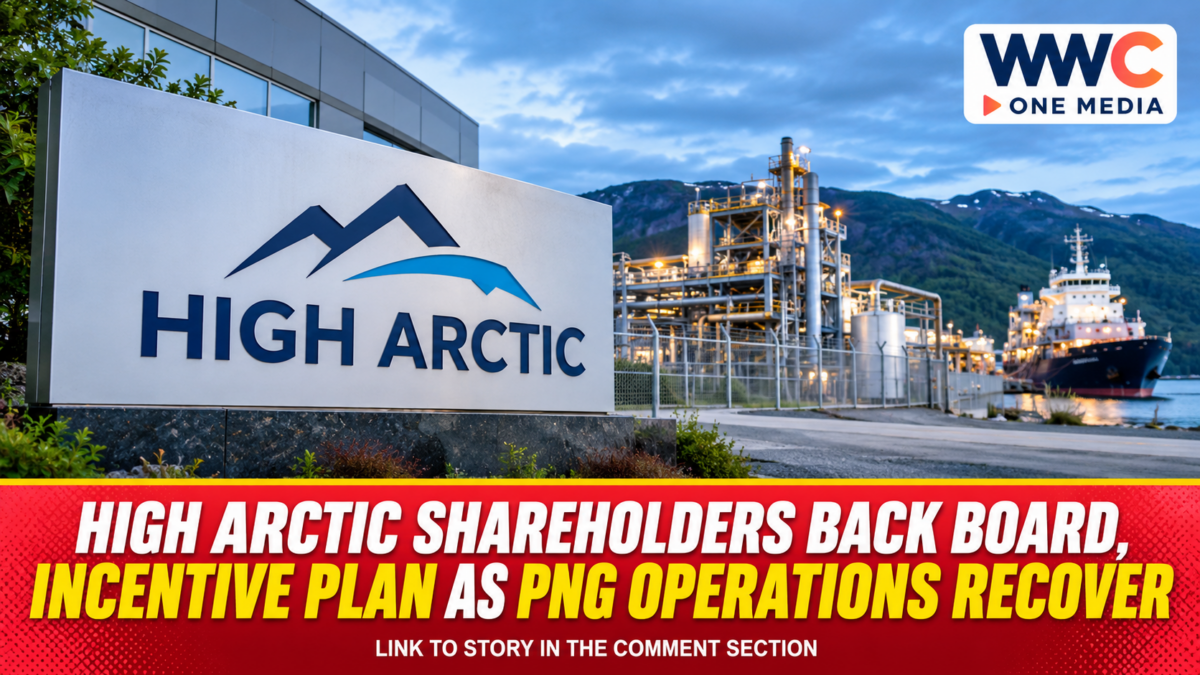
CALGARY, Canada — High Arctic Overseas Holdings Corp. shareholders approved all matters presented at the company’s annual general and special meeting on November 23, 2026, including the election of three directors, the appointment of MNP LLP as auditor and an amended equity incentive plan.
The company’s November 25 announcement reported that 28 shareholders represented 6,818,514 common shares at the meeting, equivalent to approximately 54.91% of the votes attached to issued and outstanding shares. The results provide a snapshot of shareholder support as the Canadian-listed company works to expand its Papua New Guinea operations beyond drilling services.
The meeting did not announce a new project award or a change in control. Its significance is governance-related: shareholders endorsed the existing three-person board and approved a revised framework for share-based incentives, while the company’s latest operating update points to renewed activity in drilling and equipment rentals.
High Arctic shareholders endorse three director nominees
The three candidates standing for election were Michael R. Binnion, Michael J. (Mike) Maguire and Bruce Apana. All received more than 97% of votes cast in their favour.
Binnion received 6,501,686 votes, or 97.184%, while 188,370 votes, or 2.816%, were withheld. Maguire received 6,630,386 votes, equal to 99.108%, with 59,670 votes, or 0.892%, withheld.
Apana received 6,628,586 votes, representing 99.081%. A total of 61,470 votes, or 0.919%, were withheld.
Shareholders also approved fixing the board at three directors. The figures indicate strong support among the shares represented in the election, although the results should not be interpreted as a measure of every investor’s views. Shareholders who did not participate or whose shares were not represented are not reflected in the ballots.
The company’s management information circular identifies Binnion as chairman and president and chief executive officer of Questerre Energy Corporation. Maguire is High Arctic’s chief executive officer, while Apana is a director with legal and energy-sector experience in Papua New Guinea.
Equity incentive plan receives shareholder approval
Another significant item was the approval of an amended and restated omnibus equity incentive plan.
The meeting circular describes a plan under which the maximum number of common shares reserved for issuance may not exceed 10% of the aggregate number of common shares issued and outstanding from time to time.
In practical terms, an equity incentive plan can allow a company to compensate eligible participants through share-based awards. Depending on the plan’s terms and the awards issued, this can help align employees’ or executives’ interests with longer-term company performance. It can also dilute existing shareholders when additional shares are issued.
The 10% ceiling is therefore an important part of the framework. It is a maximum reserve limit under the plan, not a statement that 10% of the company’s shares have already been issued as incentives. The actual effect on shareholders depends on awards granted, vesting conditions and eventual share issuance.
The approval gives the company an authorised compensation mechanism. It does not, by itself, establish that new awards have been granted or that any particular executive has received shares.
Auditor appointment and shareholder participation
Shareholders also approved the appointment of MNP LLP, Chartered Professional Accountants, as the company’s auditor. The resolution authorises the board to fix the auditor’s remuneration, as set out in the meeting materials.
Auditor appointment is a standard but important part of shareholder oversight. An external auditor examines the company’s financial statements and provides an opinion on whether they are fairly presented under the applicable reporting framework. The appointment does not guarantee future business performance or remove the need for investors to review financial disclosures.
The 28 shareholders represented at the meeting held 6,818,514 common shares. The company reported this as approximately 54.91% of the votes attached to issued and outstanding common shares.
That level of representation means more than half of the voting shares were represented, either in person or by proxy. It does not mean that 54.91% of individual shareholders attended, because the percentage is based on voting shares rather than the number of investors.
The meeting circular had set out the matters for consideration, including the board election, auditor appointment and incentive-plan resolution. The company’s results announcement confirmed that all matters put forward were approved.
Papua New Guinea operations provide the business backdrop
Although the shareholder announcement was about governance, the company’s operating position helps explain why its direction matters.
High Arctic Overseas Holdings Corp. is a Canadian corporation listed on the TSX Venture Exchange under the symbol HOH. Its corporate structure was established in 2024 through a reorganisation of High Arctic Energy Services Inc., transferring the legacy Papua New Guinea business into the new corporation. Its management circular records that the arrangement was completed on August 12, 2024, with common shares beginning trading on August 16, 2024.
The company provides drilling and specialised well-completion services, equipment rentals, workforce solutions and fire-protection services in Papua New Guinea. Those activities place it within a market linked to the country’s energy, mining and infrastructure projects.
That regional business environment is also relevant to Philippine companies examining opportunities across the Pacific. WWC has reported on the potential investment areas discussed by Philippine and Papua New Guinea leaders, including fisheries, ports and possible participation in state-owned enterprises. Such discussions are not evidence of a direct commercial relationship with High Arctic, but they illustrate the broader interest in PNG’s investment landscape.
Recent financial results show a stronger quarter, with risks still present
High Arctic’s third-quarter 2026 disclosure reported revenue of US$5.467 million for the three months ended September 30, compared with US$1.983 million in the same period of 2025. The company reported net income of US$411,000, compared with a net loss of US$1.330 million a year earlier.
The company also reported operating cash used of US$283,000 during the quarter. Its cash and cash equivalents stood at US$7.939 million at September 30, while working capital was US$15.265 million.
These figures show why revenue growth should not be considered in isolation. A company can report higher sales and a return to quarterly profit while still using cash in operating activities or committing funds to equipment and expansion.
High Arctic said most of its third-quarter revenue came from activities associated with the reactivation of Rig 103. Drilling began in October, following remobilisation work during the quarter. The company also reported a US$1 million investment in rental-equipment growth and expansion.
The wider energy investment cycle in Papua New Guinea is being watched by other industry participants as well. WWC’s coverage of Santos and the upcoming PNG Investment Week examines the country’s effort to attract capital for resource and infrastructure development. Separately, INPEX’s regional leadership transition and energy strategy provides wider context on the companies operating across Asia’s energy sector.
What happens next
The shareholder vote settles the matters put before the November 23 meeting, but it does not remove the need to monitor how the company executes its operating strategy.
Investors will be watching whether drilling activity continues, whether equipment rentals and fire services contribute more consistently to revenue, and how capital spending affects cash resources. The company’s stated strategy includes deploying idle assets, expanding equipment rentals and fire services, and pursuing opportunities linked to major Papua New Guinea projects.
For shareholders, the next meaningful evidence will come from subsequent financial statements, material company announcements and disclosures on any equity awards issued under the approved plan.
The AGM results show that the resolutions received shareholder approval. Whether the company can translate its renewed operating activity into sustained financial performance remains a separate question.
FAQ
What did High Arctic shareholders approve at the November 2026 meeting?
Shareholders approved the election of three directors, the appointment of MNP LLP as auditor and the amended and restated omnibus equity incentive plan. The company said all matters presented were approved.
Who was elected to the High Arctic board?
Michael R. Binnion, Michael J. (Mike) Maguire and Bruce Apana were elected. Each received more than 97% of votes cast in favour.
How many shares were represented at the meeting?
The company reported that 28 shareholders represented 6,818,514 common shares, approximately 54.91% of the votes attached to issued and outstanding shares.
What is the 10% limit in High Arctic’s equity incentive plan?
The meeting circular says the maximum number of common shares reserved for issuance under the plan may not exceed 10% of the aggregate number of common shares issued and outstanding from time to time. It does not mean that 10% has already been issued.
What does High Arctic Overseas do in Papua New Guinea?
The company provides drilling and specialised well-completion services, equipment rentals, workforce solutions and fire-protection services in Papua New Guinea.










