
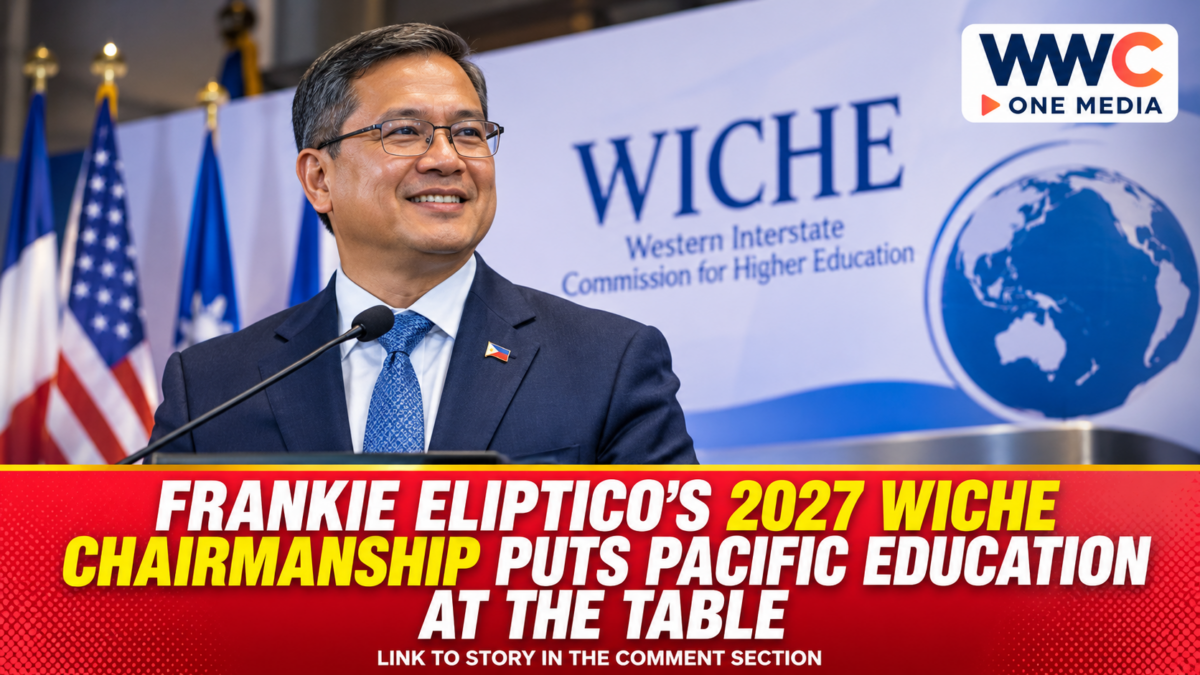
Frankie Eliptico, a senior leader at Northern Marianas College in the Commonwealth of the Northern Mariana Islands, has been elected chair of the Western Interstate Commission for Higher Education (WICHE) for 2027. The appointment places a representative of the Pacific region at the head of a 48-member commission that works on higher-education access, cooperation and workforce development across the western United States and Pacific jurisdictions.
The leadership change is significant because WICHE is not simply an academic association. It is an interstate higher-education compact whose decisions and programs affect how institutions cooperate, how students access participating programs and how regional education systems address shared challenges. Eliptico’s chairmanship gives the Pacific region a prominent leadership role in those discussions.
What the WICHE chairmanship means
WICHE announced Eliptico’s election in November, identifying him as its 2027 chair. He succeeds Utah Sen. F. Ann Millner, who served as the commission’s 2026 chair and moves into the immediate past chair position. Fred Lokken, a professor at Truckee Meadows Community College in Nevada, was named vice chair.
The commission’s November 5–6, 2026 meeting agenda explains the leadership process. Under WICHE’s bylaws, the chair and vice chair are elected at the commission’s fall meeting and serve for one year or until their successors are elected. The Nominating and Governance Committee recommended the officer slate for approval during the meeting.
Eliptico’s election is therefore a formal governance appointment within an established annual leadership process, not a newly created position.
For the public, the distinction matters. The chair leads the commission’s work and helps guide its regional priorities, but the role does not make Eliptico the head of a federal education department or give him authority over every college in the United States.
Why the Pacific representation matters
WICHE describes itself as a regional interstate higher-education compact established in 1953. Its membership covers 15 western states and the U.S. Pacific Territories and Freely Associated States.
The commission has 48 members appointed through the governments represented in the compact. The Pacific membership is shared by six jurisdictions: American Samoa, the Commonwealth of the Northern Mariana Islands, Guam, the Federated States of Micronesia, the Republic of the Marshall Islands and the Republic of Palau.
WICHE identifies Eliptico as the first commissioner representing the U.S. Pacific Territories and Freely Associated States to be elected as a commission officer.
That milestone has practical significance beyond representation. Pacific communities often face geographic barriers that differ from those experienced by institutions in large mainland population centers. Distance, limited local program choices and the cost of delivering services across islands can shape access to higher education and professional training.
A chair who represents the Pacific region can help ensure that these conditions remain part of wider discussions about educational opportunity. That does not guarantee new funding or immediate policy changes, but it gives the region a direct leadership presence in the commission’s work.
Eliptico’s experience at Northern Marianas College
Eliptico’s professional background is closely connected to the institution he represents. Northern Marianas College records identify him as a senior college leader responsible for administrative and advancement functions, including personnel, marketing, capital improvement, finance and workforce development.
The college’s institutional biography also records his earlier three-year period as interim president. During that period, he helped lead the institution’s response to Super Typhoon Yutu and the COVID-19 pandemic.
In July 2026, the college’s Board of Regents appointed him interim president again, effective July 27, following the announced leave of absence of President Galvin Deleon Guerrero. The college said the leadership transition would not interrupt its academic programs, student services or institutional operations.
His experience includes institutional recovery, fundraising, facilities planning and administration. WICHE’s announcement says he helped lead efforts to secure more than $100 million for campus rebuilding. The college’s own profile provides further context on its capital development responsibilities and his role in overseeing those efforts.
This background is relevant to the commission because higher education leadership involves more than academic policy. Institutions also have to manage facilities, finances, staffing, student services and partnerships with employers and public agencies.
WICHE programs give the chairmanship practical context
WICHE’s work is reflected in programs designed to make higher education more accessible across participating jurisdictions.
One example is the Western Undergraduate Exchange, which allows eligible students to attend participating institutions at reduced out-of-state tuition rates. WICHE’s November meeting materials report that approximately 49,125 students used the program in academic year 2025–26 and saved a combined $642 million in tuition costs. The reported average saving was $13,060 per student.
The Western Regional Graduate Program provides a similar tuition benefit for participating graduate programs. WICHE’s Professional Student Exchange Program also supports access to professional education in fields including healthcare.
These programs show why the commission’s regional role matters. Students may want to study in another state or jurisdiction but face tuition costs that make the choice difficult. Cooperative arrangements can reduce some of those financial barriers while giving institutions a framework for sharing educational opportunities.
For Pacific jurisdictions, access to these arrangements can be particularly important because students may have fewer nearby institutions offering specialized programs.
The election of a Pacific representative as chair does not automatically change eligibility rules, tuition arrangements or program funding. Those matters remain subject to the commission’s governance, program requirements and decisions by participating institutions and jurisdictions.
A wider conversation about Filipino and Pacific education
Eliptico’s appointment also provides an opportunity to examine how education leadership connects communities across borders. Students, institutions and workers increasingly navigate educational and professional systems that extend beyond one island, state or country.
WWC has previously covered the experience of a Filipino degree holder who pursued overseas work in Singapore, illustrating how education and employment decisions can intersect across national borders. Its report on a Filipina entrepreneur who returned to college while building a career in Japan also explored the continuing importance of education beyond the traditional student years.
These stories are different from Eliptico’s institutional appointment, but they reflect a shared issue: access to education and professional opportunity can shape individual careers as well as the development of communities.
The broader Filipino diaspora has its own education questions, including how families maintain connections with Philippine institutions and opportunities while living overseas. WWC has examined part of that discussion in its coverage of Filipino families abroad and efforts to maintain links with the next generation.
For WICHE, the immediate responsibility remains regional higher-education cooperation, not Philippine education policy. Still, leadership from the Pacific can help bring the needs of island communities into a commission whose work crosses geographic boundaries.
What happens next
Eliptico’s chairmanship is for 2027. The next phase will be measured by the commission’s priorities, decisions and continued work with member jurisdictions and institutions.
Key areas to watch include student access programs, regional cooperation, workforce development and whether the needs of remote and island communities are reflected in commission discussions and initiatives.
His election establishes a new leadership arrangement, but it does not by itself announce a new scholarship, tuition policy or funding commitment. Those developments would need to be confirmed through separate official decisions.
For the Northern Mariana Islands and the wider Pacific membership, the significance is clear: a regional representative will lead the commission during 2027. The value of that position will ultimately depend on how effectively the commission turns its shared priorities into opportunities for students and institutions.
Frequently asked questions
Who is Frankie Eliptico?
Frankie Eliptico is a senior leader at Northern Marianas College in the Commonwealth of the Northern Mariana Islands and a commissioner representing the Pacific region at WICHE.
What position will Frankie Eliptico hold in 2027?
He has been elected chair of the Western Interstate Commission for Higher Education for 2027.
What is WICHE?
WICHE is the Western Interstate Commission for Higher Education, a regional interstate compact established in 1953 to support higher-education access, cooperation and policy across 15 western states and Pacific jurisdictions.
How many members does the WICHE Commission have?
WICHE says its commission consists of 48 commissioners representing its member states and Pacific jurisdictions.
Does WICHE provide tuition assistance?
WICHE administers programs including the Western Undergraduate Exchange and Western Regional Graduate Program, which can reduce eligible students’ tuition costs at participating institutions. Eligibility and benefits depend on program rules and participating institutions.










