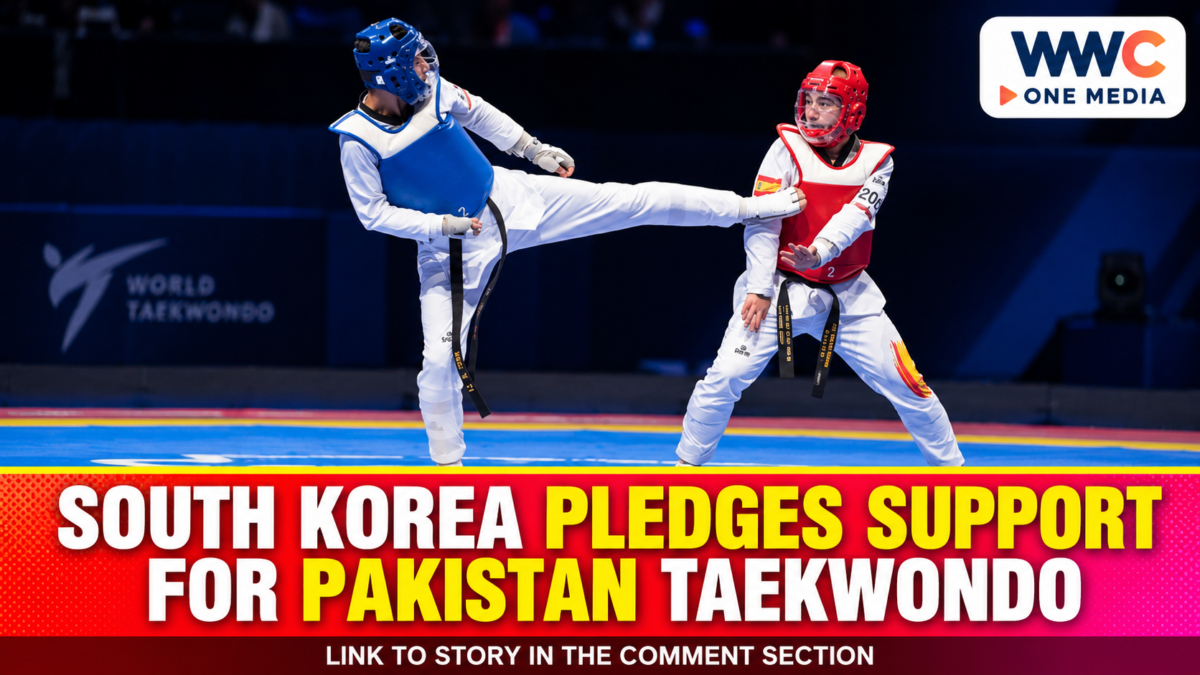
ISLAMABAD, Pakistan — November 25, 2026 — Pakistan’s push to strengthen its taekwondo programme has received a fresh show of support from South Korea, with Korean Ambassador Han Sung-ho expressing readiness to assist the Pakistan Taekwondo Federation as athletes gather for the 19th Korean Ambassador Combaxx National Taekwondo Championships.
The competition opened on November 24 at Liaquat Gymnasium, Pakistan Sports Complex, in Islamabad. It is scheduled to run through November 28, bringing together athletes representing Pakistan’s provinces and territories, as well as military and public-sector organisations.
The event places the spotlight on more than national competition. It also highlights the role that international partnerships, access to equipment and better training opportunities can play in developing athletes capable of competing at higher levels.
The ambassador’s reported offer of support is significant for a sport whose international development depends on sustained investment in coaching, competition experience, athlete preparation and access to recognised sporting standards.
Korean support puts athlete development in the spotlight
Han Sung-ho, South Korea’s ambassador to Pakistan, attended the championship’s opening ceremony as chief guest.
He expressed Korea’s readiness to extend assistance to the Pakistan Taekwondo Federation, with the stated aim of promoting the sport and strengthening cooperation between the two countries.
The opening ceremony also included a reported donation of taekwondo equipment to participating units. Equipment support can help improve access to training and competition resources, although the public information reviewed does not specify the equipment inventory, its value or the number of athletes and institutions expected to benefit.
That distinction matters. A donation can address an immediate equipment need, but long-term sporting progress requires a broader development system that includes qualified coaches, regular training, medical support, competition exposure and opportunities for young athletes to advance.
Islamabad championship brings together athletes from across Pakistan
The 19th Korean Ambassador Combaxx National Taekwondo Championships is being held at Liaquat Gymnasium inside the Pakistan Sports Complex.
The reported participants represent all four provinces, Islamabad, Gilgit-Baltistan and Azad Jammu and Kashmir. The competition also includes athletes associated with the Pakistan Army, Pakistan Air Force, Pakistan Navy, Higher Education Commission and Police.
The broad representation gives the event a national dimension, bringing athletes from different regions and institutions into one competitive setting.
For emerging competitors, national championships can provide a pathway to test their technical ability, gain experience under pressure and compete for recognition. They can also help coaches and federation officials identify athletes who may be ready for more demanding competitions.
Pakistan’s federation has previously placed emphasis on expanding opportunities for athletes through national and international events. Its January 2026 record of the 18th Korean Ambassador National Junior, Cadet, Kyorugi and Poomsae Taekwondo Championship identified youth development, competitive excellence and international sporting values as central objectives.
Pakistan has been building its international taekwondo profile
The Islamabad championship follows a year of international activity for the Pakistan Taekwondo Federation.
In August 2026, Pakistan hosted the 8th World Taekwondo President’s Cup – Asian Region in Lahore. The federation’s event record identifies the Multipurpose Indoor Arena at Jinnah Sports Complex as the venue and describes the tournament as bringing together athletes, coaches, officials and teams from different countries.
The federation also documented a joint training camp with an Iranian delegation in Islamabad in November 2025. That programme brought four Iranian athletes and one coach together with Pakistan’s national team for shared training focused on technical improvement, strategy and preparation for international competition.
These initiatives illustrate how international exposure can complement domestic championships. Athletes need opportunities to compete against unfamiliar opponents, adapt to different styles and develop the experience required for international events.
The federation’s own constitution identifies the promotion and administration of taekwondo across Pakistan, including the organisation of national and international competitions, as part of its responsibilities.
Why international partnerships matter in taekwondo
South Korea has a central place in taekwondo’s history and international sporting structure. The country is home to the Korea Taekwondo Association, while the global sport is administered through World Taekwondo.
World Taekwondo’s development programmes also demonstrate why support for national federations can extend beyond hosting competitions. Its published annual reporting describes initiatives involving coach education, technical development, grassroots participation and assistance to member national associations.
The organisation’s 2023–2024 annual report recorded 92 online courses and 26 on-site courses in 2023, involving 4,383 participants from 157 member national associations. The courses covered coaching, refereeing and other technical roles.
That broader development framework is relevant to Pakistan’s ambitions. Equipment and high-profile tournaments can create opportunities, but the ability to turn those opportunities into sustained results depends on the quality of the people and institutions supporting athletes.
Across Asia, taekwondo is also evolving as athletes adapt to new competition formats. WWC ONE MEDIA previously examined Singapore’s Darren Yap and his preparation for virtual taekwondo at the Asian Games, highlighting how established skills must be adjusted when the competition environment changes.
The sport’s wider reach is also reflected in the journey of Syrian refugee taekwondo athlete Talah Al Hassan Al Hinide, whose participation at the 2026 Asian Games illustrated how sporting pathways can create opportunities for athletes facing extraordinary barriers.
Other martial arts have demonstrated similar regional growth. South Korea’s first Asian Games kurash gold medal showed how athletes and national programmes can build recognition in disciplines beyond the traditional Olympic spotlight.
The next challenge is turning promises into measurable progress
The reported Korean offer gives Pakistan’s taekwondo community a positive development to build on. But the real test will be whether support translates into practical and lasting improvements for athletes.
That means clearer access to quality equipment, regular technical training, more opportunities for international competition and stronger pathways for junior athletes moving into senior divisions.
It also means ensuring that opportunities reach athletes beyond the most established centres and institutions. A national programme can only develop its full potential when talent from different provinces and communities has a realistic route into high-level competition.
The 19th Korean Ambassador Combaxx National Taekwondo Championships provides a platform for athletes to demonstrate their abilities and compete for recognition. The reported equipment donation and support pledge add an international dimension to the event.
For Pakistan, the bigger objective is not simply to stage another championship. It is to build a development system that can turn participation into performance and domestic promise into international competitiveness.
For South Korea, continued cooperation offers a way to deepen sporting and people-to-people ties through a discipline with strong cultural and international roots.
The coming years will show whether the latest expression of support develops into sustained coaching, equipment and competition opportunities for Pakistan’s next generation of taekwondo athletes.