
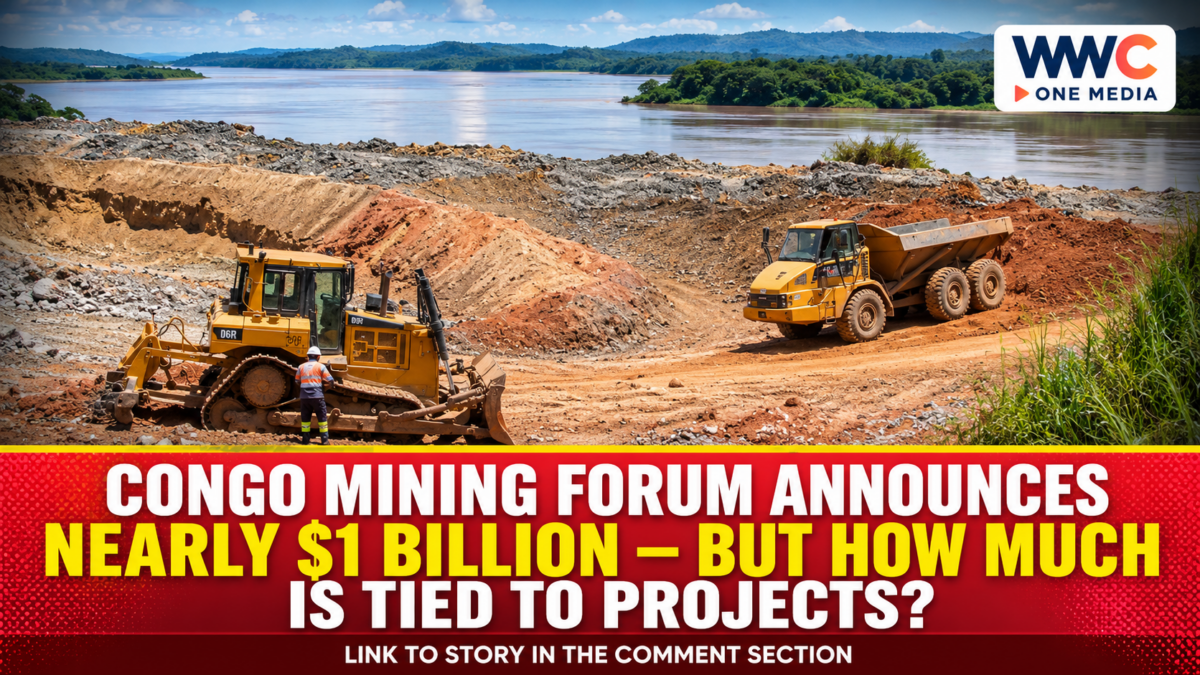
Kinshasa’s Makutano Mining Forum has announced a combined US$966 million in financing associated with the Democratic Republic of Congo’s mining sector and wider business value chain, placing access to capital at the centre of the country’s industrial ambitions. The announcement was made through the forum’s DRC Deal Announcement Room on November 23, 2026, as the event opened its first mining-focused edition.
The figure is significant, but it needs context: the announced total combines US$700 million in financing presented through participating financial institutions with a US$265 million International Finance Corporation (IFC) package for Rawbank that had already been announced in March. The distinction matters because an announced financing amount is not automatically new money, a completed loan, or cash already invested in mining projects.
For the DRC, the larger question is not simply how much financing can be announced at an industry gathering. It is whether those facilities reach local businesses, support productive projects and help the country retain more value from its mineral resources.
Congo mining finance: what the Makutano announcement includes
The organizer’s announcement described a total of approximately US$966 million, comprising US$700 million in financing announced through participating institutions and US$265 million associated with the IFC’s financing framework.
The forum’s official programme identifies the DRC Deal Announcement Room as a closed-door platform for negotiating, structuring and accelerating partnerships. It was scheduled as part of the November 23 programme in Kinshasa, under the event’s investment and structured-financing agenda. Makutano Mining 2026+1
The announced financing is intended to support businesses across the mining value chain, including small and medium-sized enterprises, mining subcontractors, local processing and trade finance. That scope is broader than financing mine construction alone. It includes companies that supply equipment, provide services, process materials or facilitate the movement of goods.
However, the organizer’s headline total should not be read as proof that US$966 million was transferred to mining companies during the forum. Financing can take different forms, including loans, credit facilities, guarantees and risk-sharing arrangements. Each has different conditions and implications for the borrower.
The IFC component predates the November forum
The US$265 million portion requires particular care. The IFC announced this financing package for Rawbank on March 4, 2026, months before Makutano Mining took place.
The IFC disclosure describes a US$165 million senior loan facility arranged by IFC, alongside a separate US$100 million risk-sharing agreement between IFC and Rawbank. The senior facility included US$50 million from IFC and US$115 million mobilized from partners. The risk-sharing arrangement was designed to help Rawbank extend more credit to businesses in the DRC. IFC
The March announcement said the financing would help Rawbank expand lending to small and medium-sized enterprises and strategic industries. It also identified an ambition to reach at least 1,500 additional SMEs over four years.
This timing changes how the November total should be understood. The IFC package was already publicly documented before the forum. Its inclusion in the Makutano total may reflect financing being presented or counted within the event’s wider financing framework, but it should not be described as a new November commitment without further documentation.
That is an important distinction for investors and the public. A financing package can be relevant to a sector without being newly created at the event where it is discussed.
Why local businesses matter to the mining investment story
The DRC’s challenge is not limited to attracting capital for extraction. A mining economy also depends on contractors, transport providers, equipment suppliers, processors, power infrastructure and financial institutions able to support businesses operating around major projects.
The Makutano programme reflects that broader focus. Its stated themes include structured investment, local transformation, strategic infrastructure and energy, alongside governance and the development of critical-mineral value chains. Makutano Mining 2026+1
If financing reaches domestic subcontractors and processors, it could help Congolese firms participate in more stages of the industry instead of limiting their role to supplying basic services. But the potential benefit depends on the terms of the facilities, the ability of local companies to qualify, and whether projects can operate commercially.
This is not a guaranteed outcome of an announcement. Businesses still need contracts, equipment, skilled workers, reliable electricity and predictable payment arrangements.
The same issue appears in other mining jurisdictions. WWC has examined how mining-concession partnerships can divide project rights, financing responsibilities and ownership. The structure of a deal often matters as much as its headline value.
The project-level details will determine the real impact
A large financing figure can attract attention, but it tells readers relatively little about the distribution of capital unless the underlying transactions are disclosed.
For each facility, the questions include: Who is the lender? Who receives the financing? Is it a loan, guarantee, credit line or risk-sharing agreement? What project or business activity does it support? What conditions must be met before funds can be drawn?
Those details are particularly important where the stated objective is to expand local processing. A financing line for working capital is different from funding for a processing plant, and a letter of credit is different from cash transferred directly to a company.
The distinction also matters when assessing local participation. Financing may support a large mining operator, a subcontractor, a bank’s lending portfolio or a supplier several steps removed from mineral production. Each can contribute to the sector, but the economic effects are not identical.
WWC’s reporting on Chile’s mining partnerships and the role of private capital highlights a related point: partnerships can bring financing and technical capacity, but their ownership and funding arrangements need to be understood before their impact can be assessed.
Why the announcement matters beyond the mining industry
The DRC is seeking to move further along the mineral value chain, where more processing and supporting services take place within the country. That ambition is tied to infrastructure, electricity, financing and the ability of domestic businesses to compete for contracts.
The approach also reflects a wider African financing challenge. Capital must reach companies capable of turning investment into operating capacity, rather than remaining at the level of broad commitments or financial-sector announcements.
WWC has also examined how African businesses and governments are navigating new financing channels. The central issue is not simply the volume of capital available, but its cost, terms, recipients and measurable economic results.
For the DRC, the test will be whether financing helps local enterprises grow, strengthens supply chains and supports productive capacity beyond the announcement stage.
What happens next
The next step is transaction-level disclosure and follow-up. The organizer’s announcement provides a headline total, while the IFC’s earlier release gives a more detailed description of its Rawbank facility. A complete public accounting would need to identify the institutions behind the US$700 million, the recipient businesses, the instruments used and the status of each transaction.
The forum’s own programme places financing and industrial development among its central themes. But the success of that agenda will ultimately be measured by implementation: credit reaching businesses, projects moving forward, local firms winning contracts and processing capacity becoming operational.
For now, the US$966 million figure signals the scale of financing presented around Makutano Mining. It should be treated as an announced financing total—not proof that the full amount is new, disbursed or already producing results.
Frequently asked questions
1. How much mining-related financing was announced at Makutano Mining 2026?
The organizer’s announcement put the combined amount at approximately US$966 million, comprising US$700 million in financing announced through participating institutions and a US$265 million IFC-related package.
2. Was the entire US$966 million newly committed in November 2026?
The available records do not establish that. The IFC’s US$265 million Rawbank package was announced on March 4, 2026, before the November forum.
3. What is the IFC’s US$265 million package for?
It supports Rawbank’s capacity to expand lending to SMEs and businesses in the DRC. The IFC disclosure describes a US$165 million senior loan facility and a separate US$100 million risk-sharing agreement.
4. Which parts of the mining industry could benefit?
The organizer identified SMEs, mining subcontracting, local processing and trade finance as intended areas of support.
5. Does the announcement mean the money has already been disbursed?
No. An announced financing package may include facilities or guarantees that are subject to conditions. The public records reviewed do not establish that the entire amount has been disbursed.










