
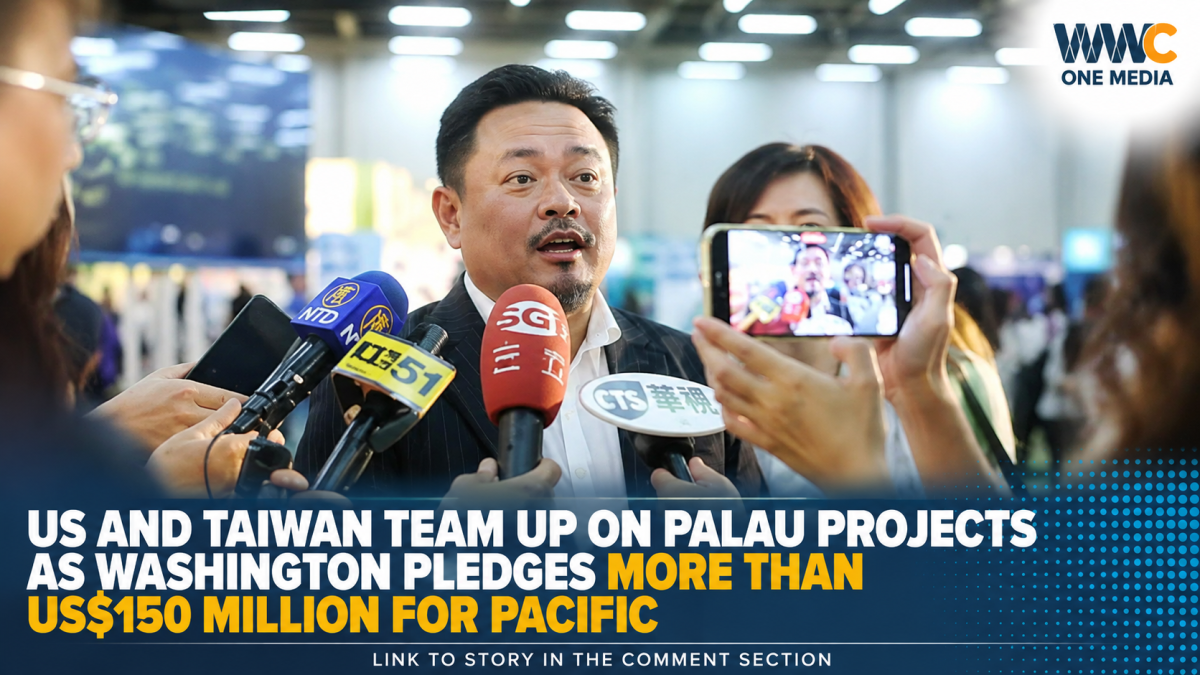
The United States and Taiwan are expanding cooperation in the Pacific through two projects in Palau, as Washington announces more than US$150 million in new support for Pacific island nations amid intensifying competition for influence across the region.
The initiatives were announced during the 55th Pacific Islands Forum in Palau, where US Deputy Secretary of State Christopher Landau unveiled Washington’s new funding package on Sept. 1. The broader US program covers energy, infrastructure, digital connectivity, maritime security and other areas.
Two Taiwan-linked projects in Palau
One of the most significant initiatives is the Palau Hospital Relocation project, involving the United States, Taiwan, Australia, Japan, New Zealand and South Korea.
The partners are expected to support development and operation of a modern hospital facility, although the project remains subject to the outcome of a feasibility study.
The proposed hospital is intended to replace Palau’s existing Belau National Hospital. A US Trade and Development Agency-backed feasibility study is examining issues including the facility’s location, conceptual design, financing and implementation. The planned facility is expected to have approximately 120 to 150 beds.
The second Taiwan-linked initiative focuses on drinking-water safety.
The US Environmental Protection Agency, working with Taiwan, will assist Palau with comprehensive sampling of drinking-water sources and wells. The project will also provide training for Palau’s water operators and environmental laboratory personnel.
Washington’s bigger Pacific push
The Palau projects are part of a much broader US package.
The United States plans to provide more than US$150 million in support across the Pacific, including a proposed US$60 million Regional Energy Security Initiative designed to help countries expand fuel storage and strengthen electrical-grid stability.
Washington is also backing projects involving ports, airports, telecommunications, government data infrastructure, illegal fishing enforcement and maritime security.
For example, the US Trade and Development Agency plans technical assistance for modernization of ports and airport infrastructure in the Marshall Islands, while other initiatives are aimed at strengthening digital networks and secure cloud services in Pacific countries.
Why Taiwan is part of the equation
The announcement comes at a particularly sensitive moment for Taiwan’s role in the Pacific.
Taiwan maintains diplomatic relations with Palau, one of the few Pacific states that officially recognizes Taipei. Taiwan participates in the Pacific Islands Forum as a development partner, while China participates as a dialogue partner.
Taiwan’s presence at this year’s forum has triggered strong objections from Beijing.
China warned of unspecified “consequences” over Taiwan’s participation, while Taiwanese Foreign Minister Lin Chia-lung defended Taipei’s involvement. Palau, meanwhile, has emphasized that Pacific countries should have control over their own regional agenda.
The dispute highlights how development projects in the Pacific are increasingly intertwined with wider geopolitical competition.
China is also expanding its influence
The United States’ new commitments come as China has strengthened its engagement across the Pacific through infrastructure projects, financial assistance and security cooperation.
Reuters reported that China’s growing presence was one factor behind the latest US and Australian funding announcements. Australia separately announced A$600 million in measures focused on combating drug smuggling, including enhanced surveillance and police training. Together, the US and Australian commitments amount to about US$580 million.
For Pacific governments, however, the competition presents both opportunities and challenges.
More outside investment can bring badly needed hospitals, energy infrastructure, digital systems and economic development. At the same time, Pacific leaders have repeatedly emphasized that regional priorities should be determined by Pacific nations themselves rather than by competing major powers.
Palau sits at a strategic crossroads
Palau’s location makes the country particularly important to the United States and its allies.
The island nation has a longstanding security relationship with Washington under the Compact of Free Association, while maintaining diplomatic relations with Taiwan. Its position in the western Pacific also places it close to major sea lanes and an increasingly contested strategic environment.
That makes the new hospital and water projects more than development initiatives.
They are also examples of how infrastructure, healthcare and environmental cooperation are becoming tools of international diplomacy in the Pacific.
Taiwan’s Foreign Minister Lin welcomed the US support and said Taipei hoped to expand concrete cooperation with Washington in the Pacific and other regions.
The bigger story is therefore not simply about a hospital or water testing.
It is about who will shape the future of the Pacific — and whether island nations can turn growing great-power competition into tangible benefits for their people.
WWC ONE MEDIA J.M.D



Leave a Reply