
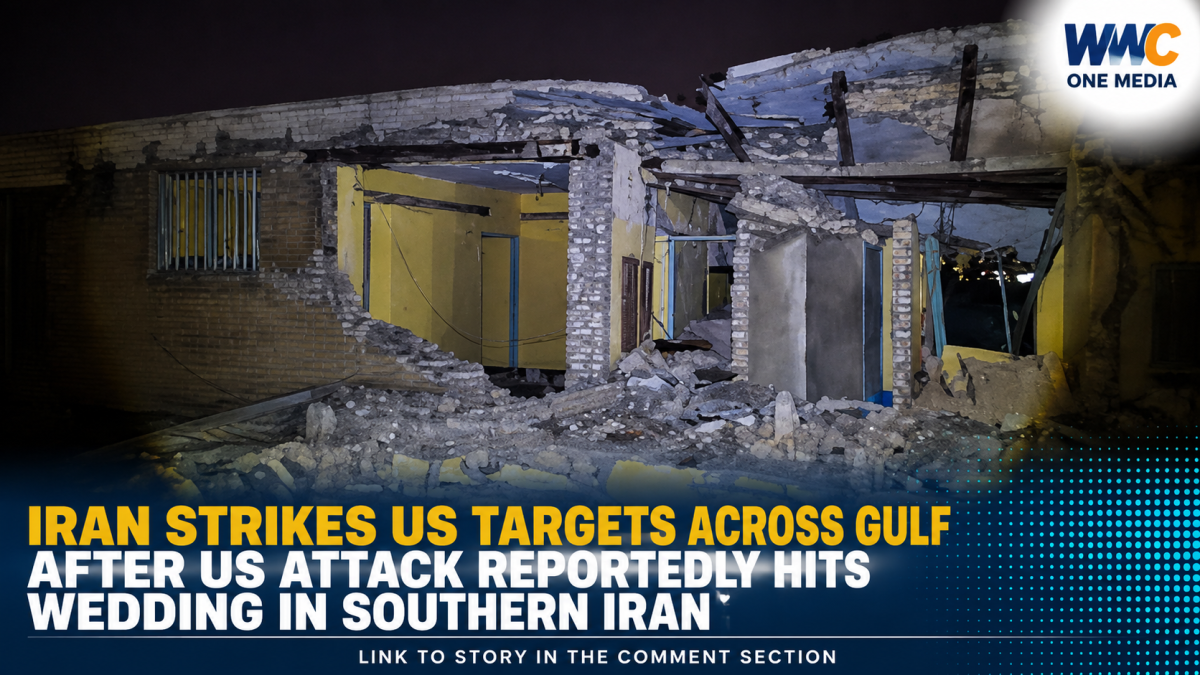
Iran has launched a wave of missile and drone attacks against US-linked targets across the Middle East after a new round of American strikes on Iran, dramatically escalating a conflict that had shown signs of easing.
The latest confrontation came after US forces carried out strikes against Iranian military targets, including air-defense systems, radar installations, maritime assets and facilities linked to Iran’s ability to operate around the Strait of Hormuz, according to the US military.
Iran subsequently announced attacks against US interests in several countries, including Jordan, Bahrain, Kuwait and Iraq.
Wedding hit during US strikes
One of the most disturbing developments was the reported strike on a residential building in Kuhestak, in Iran’s southern Hormozgan province, where a wedding celebration was taking place.
Iranian authorities said the attack killed four people, including a four-year-old child, and wounded at least 68 others. Earlier Iranian officials had reported a higher death toll, but state media later revised the figure to four.
The Associated Press reported that images and video from the area showed damage to a residential property and injured children being treated at a nearby hospital. However, the incident has not been independently verified by Reuters, and US Central Command said it was aware of reports originating from Iranian state media and was looking into them. The US military maintains that it does not target civilians.
Iranian officials have condemned the incident and vowed retaliation.
Tehran strikes back across the region
Iranian forces and Iran-aligned groups then launched attacks against US-linked positions and American allies.
Jordan said its air defenses intercepted 10 Iranian missiles, while other projectiles landed in unpopulated areas, according to AP. Kuwait and Bahrain also reported attacks or attempted attacks, while authorities said their air defenses intercepted incoming threats.
In Iraq’s Kurdistan region, Kurdish authorities reported intercepting drones near Erbil, while Iran said US military facilities there had been targeted.
The escalation has effectively ended a month-long lull in major fighting and raised fears that the conflict could again expand across the Middle East.
Strait of Hormuz becomes the critical flashpoint
At the center of the confrontation is the Strait of Hormuz, one of the world’s most important energy routes.
Before the war, roughly one-fifth of global oil shipments passed through the waterway. The conflict has severely disrupted shipping, with Iran attempting to restrict passage while Washington says it is working to keep the route open.
The renewed fighting has already affected energy markets. Reuters reported that Brent crude moved toward about US$95 a barrel as investors reacted to the escalation, while Asian and European stocks also came under pressure.
Iran has also blacklisted additional vessels attempting to transit the strait, potentially exposing them to fines, seizure or detention under Tehran’s stated rules.
Trump warns of more attacks
US President Donald Trump has warned that Iran could face even stronger US military action if it retaliates.
At the same time, Iranian officials have threatened what they describe as broader and more severe responses against American forces and countries supporting Washington.
The confrontation therefore risks becoming a widening regional conflict rather than a limited exchange between Washington and Tehran.
The latest escalation also comes despite previous efforts to maintain an interim ceasefire. Iranian President Masoud Pezeshkian had said Tehran was prepared to return to the arrangement if Washington did the same.
For now, those diplomatic openings appear increasingly fragile.
Why this matters globally
The consequences extend well beyond Iran and the United States.
Any prolonged disruption around the Strait of Hormuz could affect global oil and gas supplies, shipping costs, inflation and financial markets. The waterway’s importance means even the threat of prolonged disruption can send energy prices higher.
With American forces spread across the region and Iran capable of striking US-linked targets beyond its borders, the latest exchange has also increased the risk of additional countries being drawn directly into the conflict.
The key question now is whether Washington and Tehran can prevent this latest exchange from turning into a much larger regional war.
WWC ONE MEDIA J.M.D




Leave a Reply