
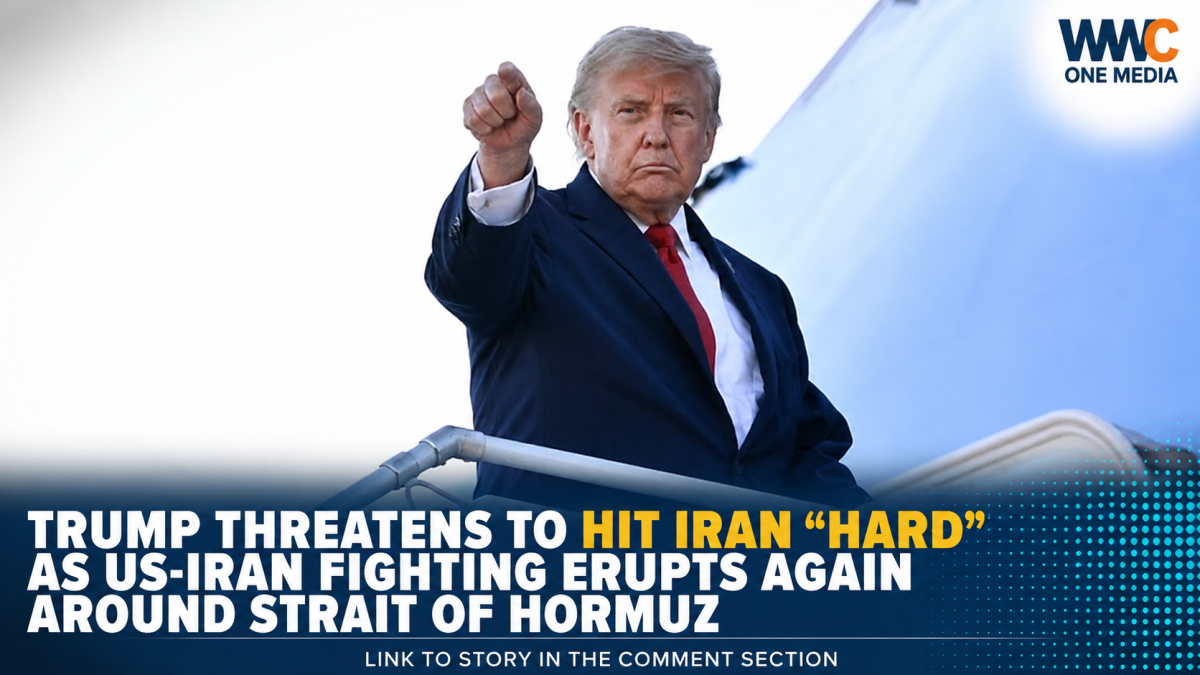
WASHINGTON — US President Donald Trump has threatened further military action against Iran after American and Iranian forces exchanged fire for the first time in weeks, raising fresh fears that the six-month conflict could spiral into a wider regional war.
The latest escalation began when US forces struck Iranian rocket launchers on Larak Island in the Strait of Hormuz, with Washington saying the weapons were being prepared for use in laying sea mines in one of the world’s most important shipping corridors. Iran responded by launching missiles toward US military positions in Jordan and reporting attacks against US-linked assets in the United Arab Emirates.
Trump subsequently warned that Iran would face another US response if Tehran retaliated.
“We’re going to hit them hard,” Trump said, according to Reuters.
The president later indicated that the renewed US campaign would not necessarily continue indefinitely, saying Washington had destroyed newly rebuilt Iranian military equipment near the Strait of Hormuz and remained prepared to strike again if necessary.
Why Larak Island matters
The US says its strikes on Larak targeted Iranian forces preparing to deploy rockets carrying sea mines into the Strait of Hormuz.
US Central Command described the operation as a “limited, precise action” against what it considered an imminent threat to commercial shipping and civilian mariners. Iran, however, described the attack as aggression and said military personnel and civilians were killed or wounded.
The Strait of Hormuz has become a central battlefield in the conflict because of its importance to global energy supplies. Before the war, roughly a fifth of the world’s seaborne oil trade passed through the waterway.
Iran launches retaliation
Iran’s Revolutionary Guard said it launched ballistic missiles at US military facilities in Jordan, identifying King Hussein and Al-Azraq air bases as targets.
Jordan said its air defenses intercepted eight missiles that entered its airspace. The United Arab Emirates also said it intercepted an Iranian drone over its territorial waters, while rejecting Iranian claims that the Al-Minhad Air Base had been attacked.
The exchange marks the first significant direct military confrontation between the United States and Iran in roughly a month, breaking a period in which Washington had increasingly emphasized sanctions and economic pressure rather than new strikes.
Another danger: commercial shipping
The fighting is also creating renewed concerns for international shipping.
The UK Maritime Trade Operations agency said a tanker was struck by three unidentified projectiles while leaving the Strait of Hormuz near Oman. No casualties or environmental damage were reported, and authorities were investigating the incident.
The tanker incident came despite the US saying it had cleared sea mines from internationally recognized shipping lanes.
The international shipping industry has warned that mine clearance alone may not be enough to restore normal traffic, with individual operators continuing to make decisions based on security assessments and crew safety.
Iran signals it still wants a way out
Despite the military escalation, Iranian President Masoud Pezeshkian said Tehran was not seeking an endless war.
Speaking at a summit in Bishkek, he said Iran was prepared to return to dialogue and would reciprocate if Washington returned to commitments under an interim agreement reached in June.
That creates a striking contrast: Washington is threatening additional military action while Tehran is simultaneously signaling an opening for negotiations.
But the renewed attacks could make diplomacy considerably harder.
Oil markets are watching closely
Any prolonged disruption in the Strait of Hormuz could have consequences far beyond the battlefield.
The waterway connects the Persian Gulf with the Gulf of Oman and is a critical route for global energy shipments. Renewed fighting, threats against shipping and uncertainty over mine clearance have already pushed oil prices higher and increased concerns about fuel costs, inflation and global trade.
The central question now is whether this exchange remains a limited military confrontation — or becomes the beginning of another major escalation between Washington and Tehran.
WWC ONE MEDIA J.M.D


Leave a Reply