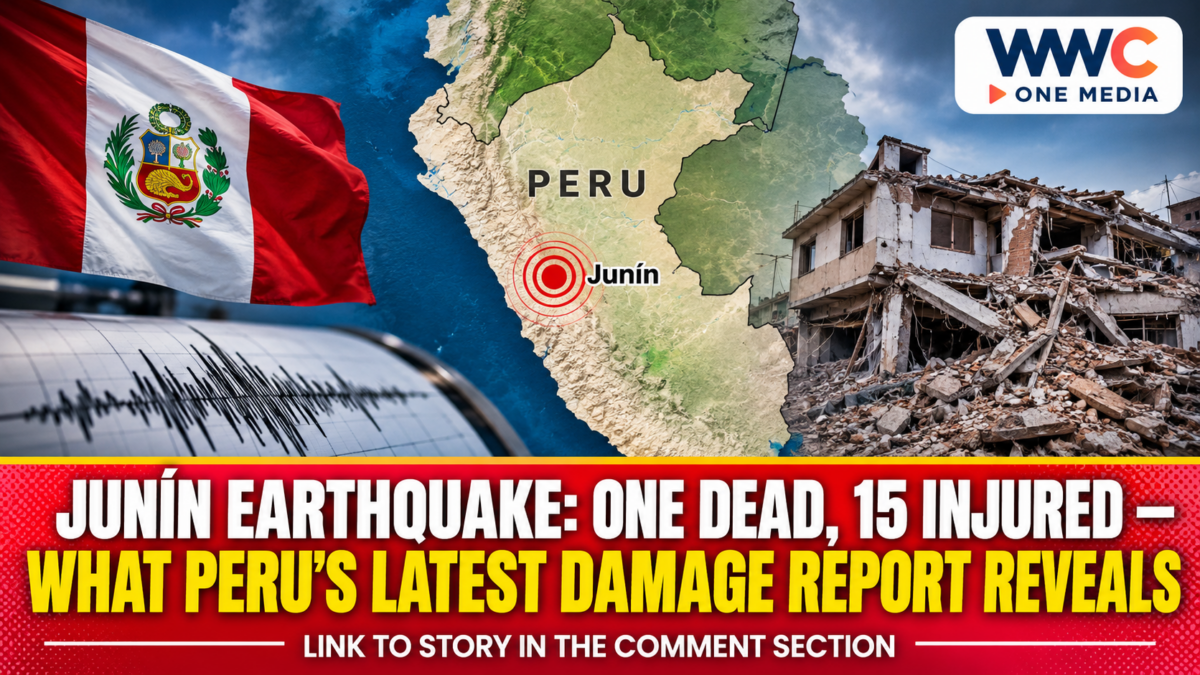
A magnitude-6.7 earthquake struck Peru’s central region on November 20, 2026, with the epicentre referenced approximately 30 kilometres northwest of Junín. The latest national emergency assessment recorded one death, 15 injured people, 193 affected homes and 152 homes classified as uninhabitable.
The figures show that the emergency extended beyond the earthquake’s epicentral area. Government assessments covered communities in Junín, Huánuco, Pasco, Lima and Callao, while authorities continued checking residential buildings, public facilities and essential services.
The central issue now is the difference between the initial effects of the earthquake and the work still required to establish which communities and buildings need further assistance.
Junín earthquake: What the seismic record establishes
The Instituto Geofísico del Perú recorded the main earthquake at 7:09:19 p.m. local time on November 20. The reported magnitude was 6.7, the focal depth was 129 kilometres and the maximum reported intensity was V in Junín.
The epicentre was referenced 30 kilometres northwest of Junín, at latitude -10.97 and longitude -76.19.
Magnitude and intensity describe different aspects of an earthquake. Magnitude measures the size of the seismic event, while intensity describes the shaking experienced or observed in particular locations. A magnitude reading alone cannot establish the condition of every building across a wide affected area.
A separate magnitude-5.0 earthquake was recorded at 12:12:03 a.m. on November 21. It was listed as another seismic event, with a reported depth of 127 kilometres and intensity III in Junín. It should not be described as a revised magnitude for the original earthquake.
The distinction is important in earthquake reporting elsewhere in the region as well. WWC’s coverage of the Surigao del Sur earthquake and its recorded shaking intensity illustrates why seismic measurements and local impact assessments must be treated separately. The Philippine event was unrelated to Peru’s earthquake.
One death and 15 injured people in the updated count
The November 22 consolidated emergency report recorded one fatality and 15 injured people. The fatality was listed in Huánuco, at the Regional Hospital Hermilio Valdizán.
The casualty information also shows why the date and time of an official assessment matter. An earlier health-sector update had included a person whose injury status was subsequently removed after validation. The consolidated report therefore recorded 15 injured people, rather than the earlier figure of 16.
The injury table identified treatment locations including the Paucartambo health centre, Pichanaki Hospital, La Merced Hospital, Félix Mayorca Soto Hospital, the Regional Hospital of Tropical Medicine Julio César Demarini Caro and Puerto Yurinaki health centre.
The table classified the recorded injuries as mild and showed 11 people discharged at the stated reporting cut-off. These figures describe the report’s recorded status; they should not be used to infer the later medical condition of any individual.
The casualty count is significant, but it is only one part of the emergency assessment. The government’s report also tracks housing, health facilities, schools, roads and electricity services.
Housing damage reaches five departments
The consolidated assessment listed 193 affected homes and 152 homes classified as uninhabitable. Those are separate classifications, not figures that should be added together as though they represented 345 distinct damaged properties.
The report also listed 853 people as disaster-affected and 628 as affected. These are administrative categories used in the damage assessment. They should not be casually described as the number of people who lost their homes.
The geographic breakdown included communities in Junín, Huánuco, Pasco, Lima and Callao. This wider coverage demonstrates why the location of the epicentre should not be mistaken for the full geographic reach of the emergency.
Some local assessments were still awaiting review, signatures or submission to municipal authorities. That means the published figures are a dated snapshot, rather than a final declaration that every affected community has been inspected.
For a separate example of why earthquake impact reports need to be read alongside local assessments, WWC has also examined the West Sumatra earthquake and its revised seismic measurement. That event was unrelated to the Peru earthquake.
Public facilities and roads require separate safety checks
The emergency report contains damage information from several government sectors. It records affected health establishments and educational facilities, as well as religious and communal buildings.
The facility entries include reports of cracks, damaged walls, ceiling damage and other building conditions. Such entries do not automatically mean that every listed facility was destroyed or closed. They identify reported effects that may require inspection, repair or restrictions on the use of particular areas.
Transport information provides another important distinction. The report recorded affected road sections and landslide-related interruptions, but the transport sector later reported that traffic had been restored on all roads in Huánuco, Junín and Lima.
A road can therefore appear in a damage assessment even after the obstruction has been cleared. Reporting a damaged section without explaining its restored status could give readers an inaccurate picture of current access.
The same principle applies to public buildings: a report of damage is not equivalent to a technical declaration that an entire facility is unsafe.
Electricity disruption shows the scale of the initial response
The energy-sector information recorded 92,906 electricity users affected across Junín, Pasco and Huánuco during the initial disruption. It also listed 13 disconnected electrical feeders. A separate entry recorded 3,500 affected users in Lima.
The report’s time series shows that the number of users without electricity in Junín, Pasco and Huánuco had fallen to 1,604 by 9 a.m. on November 21. The Lima entry showed that its recorded 3,500 affected users had returned to zero by the same reporting time.
These figures must be read as service-user counts, not as a direct count of individual residents. They also describe different reporting times: the initial interruption and the later restoration are not simultaneous totals.
The report said monitoring of possible damage to electricity infrastructure continued. That is important because restoration of service does not by itself establish that every component of the network has completed its technical inspection.
WWC’s report on the Leyte earthquake and its official seismic measurements offers another example of why each event needs its own verified seismic and impact records. The Philippine earthquake was separate from the Peruvian emergency.
What happens next
Local and regional authorities must complete outstanding damage evaluations and submit validated information to the national emergency system. The November 22 report still listed district-level assessments and registration procedures awaiting completion or review.
Further assessments may change the number of affected homes, the classification of buildings and the list of facilities requiring repair or restrictions. Readers should therefore treat the figures as the position recorded at the report’s November 22, 2026, 8:20 a.m. cut-off.
The immediate picture is clear: the earthquake caused one recorded death and 15 injuries, affected hundreds of homes and disrupted essential services across several departments. The next measure of recovery will be the completion of inspections and confirmation that affected homes and public facilities can be used safely.
Frequently asked questions
What was the magnitude of the Junín earthquake?
The Instituto Geofísico del Perú recorded the November 20 earthquake at magnitude 6.7, with a focal depth of 129 kilometres.
How many people died or were injured?
The November 22 consolidated assessment recorded one death and 15 injured people.
How many homes were affected?
The report listed 193 affected homes and 152 homes classified as uninhabitable. These are separate categories.
Which areas were included in the damage assessment?
The report covered affected communities in Junín, Huánuco, Pasco, Lima and Callao.
Were electricity services restored?
The report recorded a reduction in affected electricity users. By 9 a.m. on November 21, 1,604 users remained without service in Junín, Pasco and Huánuco, while the separate Lima entry had returned to zero.
Is the damage assessment final?
No. The November 22 report identified local assessments that were still pending review or submission. The figures may change as authorities complete their checks.