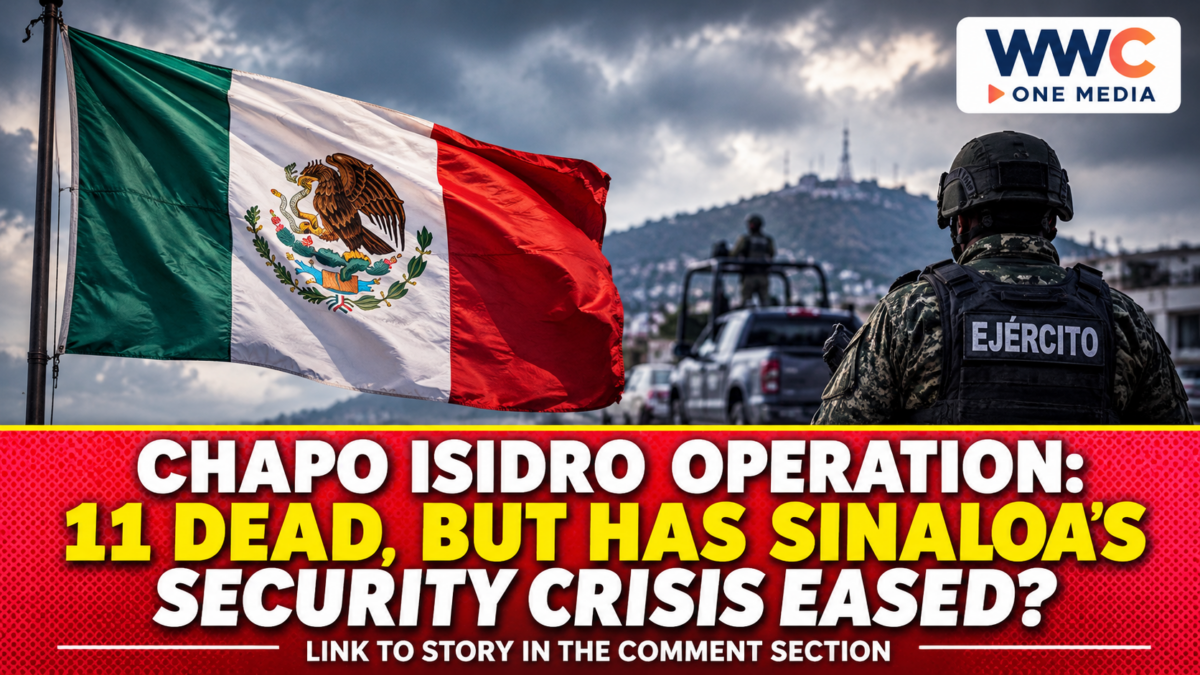
Mexican military forces detained Fausto Isidro Meza Flores, known as “Chapo Isidro”, in Guasave, Sinaloa, on November 20, in an operation involving Mexican security forces and intelligence cooperation with the United States. The operation was followed by a wider security response, with Mexico’s Defence Ministry reporting seven alleged aggressors killed, four Army infantry personnel dead and eight suspected offenders detained.
The figures reveal the scale of the operation, but they also require careful interpretation. The 11 deaths were not reported as 11 members of one criminal organisation: the military identified seven people as aggressors and separately reported that four Army infantry personnel died while travelling to reinforce security in Guasave.
The arrest is a major enforcement development involving a fugitive wanted by US authorities. Its longer-term significance, however, will depend on what happens to the organisation, the remaining suspects and the communities affected by the security disruption.
Chapo Isidro arrest: What Mexico confirmed
Mexico’s Defence Ministry announced on November 21 that special forces from the National Guard and Army detained Meza Flores in the municipality of Guasave on November 20.
Two other men were detained during the operation. The ministry identified Germán N, known as “Serafín”, as the organisation’s alleged second-in-command, while José N was described as a financial operator.
The ministry characterised Meza Flores as the head of the Beltrán Leyva criminal organisation and an ally of the “Mayos” faction of the Pacific Cartel. It also said he was subject to a Mexican arrest warrant involving organised crime and drug-related offences, as well as an extradition order to the United States.
The operation was described as a three-stage process: reaching the target area, securing the location and making the arrests, then evacuating the detainees.
The ministry said the three principal detainees were transported to Mexico City aboard a Mexican Air Force aircraft and delivered to the relevant federal authorities.
Why the official death toll needs context
A follow-up military statement provided a more detailed account of the casualties and arrests.
It reported that seven aggressors died during the operation. Separately, four regular Army infantry personnel who were travelling to reinforce security in Guasave were killed.
The same statement recorded eight suspected offenders detained in total. That figure included the three men transferred to Mexico City and five others placed before the federal prosecutor’s office in Culiacán.
The distinction is important for readers. Reporting only that 11 people died risks giving the impression that all 11 were members of the same armed group or that all died in the same confrontation. The official account separates the seven aggressors from the four military personnel who were travelling to reinforce security.
The ministry also reported the seizure of a Barrett .50-calibre rifle, 10 other firearms of different calibres, a grenade launcher, two hand grenades, ammunition, tactical equipment, drugs and cash.
It said there had been no report at that time of harm to people unrelated to the events. That statement should be treated as the ministry’s reported assessment, not as a comprehensive independent civilian-impact investigation.
Road blockades put public movement at the centre of the response
The arrests were followed by road blockades in Ahome, Guamúchil, Guasave and Navolato, according to the Defence Ministry.
Authorities said they activated an anti-blockade plan with local officials and deployed security personnel to restore traffic and protect residents.
This part of the response matters because an operation’s impact cannot be measured only by whether a wanted suspect is detained. Road access, the ability of residents to travel and the continuity of ordinary services are also important indicators of public safety.
The broader regional challenge of disrupting cross-border criminal networks has also featured in WWC’s coverage of US security cooperation with Ecuador and regional anti-cartel efforts. That diplomatic discussion is separate from the Guasave operation, but it illustrates why intelligence-sharing and cooperation between governments have become important parts of regional security policy.
The US case involves six counts, but no conviction has been established
The US Department of Justice announced Meza Flores’ capture on November 21 and identified him as an alleged leader of the Sinaloa Cartel.
The department said a federal grand jury in the District of Columbia returned a second superseding indictment on September 25, 2026. The six-count case includes allegations involving leadership of a continuing criminal enterprise, drug-trafficking conspiracies, international money laundering, material support to a terrorist organisation, narcoterrorism and firearms offences.
These are criminal allegations, not findings of guilt. The department said Meza Flores could face the death penalty or a mandatory life term if convicted. That describes potential penalties under the charges; it is not a sentence imposed by a court.
The difference between the Mexican and US descriptions of the organisation also deserves attention. Mexico’s military statement described Meza Flores as head of the Beltrán Leyva organisation and an ally of the Mayos faction. The US Justice Department described him as an alleged Sinaloa Cartel leader. Those descriptions come from separate government records and should not be casually treated as identical organisational labels.
The FBI had placed Meza Flores on its Ten Most Wanted Fugitives list in February 2025. Its public update records his capture on November 20, 2026. The US State Department had offered a reward of up to US$5 million for information leading to his arrest or conviction.
Why the arrest may not end the organisation’s influence
Removing a senior figure can disrupt leadership, communications and financial coordination. It does not automatically establish that the wider organisation has been dismantled.
The Mexican military’s own follow-up illustrates that the operation involved more than one individual. It recorded eight detainees, including people described as holding operational and financial roles, alongside the seizure of weapons, equipment, drugs and cash.
The next test is whether investigators can establish the roles of the detained suspects through the legal process and whether authorities can maintain security after the immediate operation.
The international dimension is also significant. The US Justice Department said the investigation involved a Homeland Security Task Force, while Mexican authorities described intelligence coordination with US counterparts. The operation therefore provides a concrete example of cross-border law-enforcement cooperation, rather than simply a domestic arrest.
The challenge of identifying and interrupting international drug routes is also relevant to readers in the Philippines. WWC has reported on the PDEA seizure of a suspected international drug shipment at Manila port. That case has no established operational connection to the Mexican investigation, but both demonstrate why authorities focus on intelligence, transport routes and the networks behind suspected drug trafficking.
What happens next
The immediate questions concern the legal status of the eight detainees, the handling of the US charges and the security situation in Sinaloa.
Mexico’s Defence Ministry said the three principal detainees were placed before federal ministerial authorities in Mexico City, while five others were presented to prosecutors in Culiacán. The public statements reviewed for this report do not establish a confirmed extradition date or a timetable for US court proceedings.
Authorities will also need to demonstrate that road access and public security can be maintained beyond the initial deployment. The arrest is a significant development, but the wider measure of success will be whether criminal operations are disrupted and residents can return to normal daily activity without renewed threats.
Frequently asked questions
Who is Chapo Isidro?
Chapo Isidro is the alias of Fausto Isidro Meza Flores. Mexico’s Defence Ministry described him as the head of the Beltrán Leyva criminal organisation and an ally of the Mayos faction. US authorities described him as an alleged Sinaloa Cartel leader.
When was Chapo Isidro arrested?
Mexico’s Defence Ministry said he was detained in Guasave, Sinaloa, on November 20, 2026.
How many people died in the operation?
The Defence Ministry reported seven aggressors killed and four Army infantry personnel who died while travelling to reinforce security in Guasave, for 11 deaths in the official account.
How many people were detained?
Mexico’s Defence Ministry reported eight suspected offenders detained in total. Three were transported to Mexico City and five were placed before federal prosecutors in Culiacán.
Has Chapo Isidro been convicted in the United States?
No conviction is established by the arrest announcement. The US Justice Department said he faces a six-count superseding indictment. The allegations must be resolved through the judicial process.