
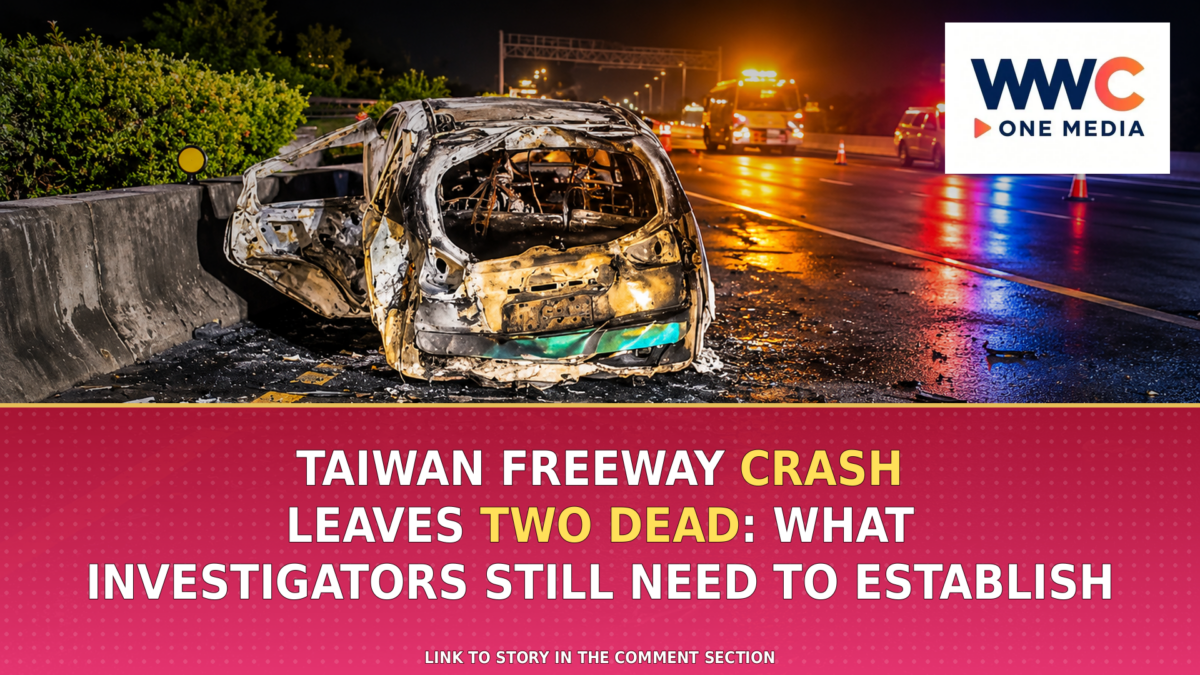
A chain collision on Taiwan’s National Freeway No. 1 in Tainan’s Madou District killed two people and injured another in the early hours of Nov. 22, 2026. The incident involved several passenger cars and small trucks, with one car catching fire before authorities cleared the affected road section and restored traffic.
The immediate disruption ended before dawn, but the investigation did not. Police have yet to establish the final cause of the collision, leaving important questions about the sequence of impacts, vehicle movements and the circumstances surrounding the first crash.
The official traffic record places the collision near Madou
The Taiwan Freeway Bureau reported an incident at about 1:01 a.m. on the southbound section of National Freeway No. 1 near kilometre 305.4. Its initial notice said the mainline and the Madou entrance were closed while motorists were directed to alternative routes.
A separate traffic entry from Taiwan’s Police Broadcasting Service recorded four passenger cars and two small trucks involved in the collision. It also reported that one passenger car caught fire and that the incident occupied the middle and inner lanes, as well as the outer shoulder.
Those details establish the scale of the disruption recorded by traffic authorities. They do not, by themselves, provide a complete reconstruction of every vehicle movement or establish which driver was legally responsible.
The distinction is important. An initial road-incident log is designed to communicate hazards and traffic conditions quickly. It is not the same as a completed police investigation report.
What the police account says happened
At a public briefing, National Highway Police Bureau Sinying Branch Chief Chen Chen-tsung described a sequence that began with a passenger car driven by a woman surnamed Huang.
The police account said the vehicle struck a roadside guardrail before moving into another lane and colliding with a car driven by a woman surnamed Wen. Huang’s vehicle then overturned, leaving Huang and a male passenger surnamed Chiang on the roadway.
A following car driven by a man surnamed Wang struck the overturned vehicle, which caught fire. The account also described subsequent collisions involving other vehicles, including a small truck and a car that struck a tyre or debris on the road.
Police identified Huang and Chiang as the two people who died. A driver surnamed Ruan was injured and taken to hospital.
These details are an account of the incident presented by the police branch chief, not a final judicial finding. The investigation must still establish the precise sequence, the actions of each driver and the evidence relevant to any potential liability.
Why the cause cannot yet be treated as settled
A multi-vehicle collision can involve several separate events occurring within seconds. The first impact may create a hazard that forces other motorists to brake, change lanes or steer around debris. Those reactions can then produce additional collisions.
That is why investigators need to distinguish the initiating event from the later impacts. The fact that a vehicle was involved in a subsequent collision does not automatically establish that its driver caused the original incident.
The police account identified the first vehicle’s contact with the guardrail and the later impacts. However, the available public traffic records do not provide a final technical explanation for why the first vehicle left its intended path.
A complete reconstruction would ordinarily require investigators to examine vehicle damage, final resting positions, road markings, debris distribution, available camera footage and statements from drivers or witnesses. Any technical assessment would also need to consider road and visibility conditions at the time.
The same caution applies to alcohol testing. The police chief’s public account said drivers other than Huang were not under the influence of alcohol, while Huang was awaiting a postmortem examination and further testing. That preliminary information should not be turned into a final finding about the cause of the crash.
The wider road-safety lesson is about evidence and reaction time
The collision is a reminder of how quickly a single incident can create danger for motorists who approach the scene moments later. A vehicle that overturns, a fire or debris left across multiple lanes can leave following drivers with little time to respond.
WWC has previously examined a fatal pedestrian collision in Taiwan, where investigators also had to establish the circumstances of a road incident before responsibility could be determined. The cases are different, but both demonstrate why an early account should not be confused with a final finding.
A similar distinction arose in WWC’s coverage of a deadly truck crash in Mountain Province: changing early information made it necessary to separate confirmed casualty figures from unresolved details about the cause.
For motorists, the practical lesson is to maintain a safe following distance, remain alert to sudden changes ahead and avoid abrupt manoeuvres where possible. When a crash occurs, drivers should follow traffic-control instructions and avoid entering an affected area unless directed by responders.
What happens next
The National Highway Police Bureau’s investigation remains the key outstanding step. Investigators will need to reconcile the initial traffic record with the physical evidence and the accounts of those involved before determining the cause and any legal responsibility.
The Freeway Bureau reported that the incident had been cleared and normal traffic restored at 3:02 a.m. That update closed the immediate road disruption; it did not mean the investigation had concluded.
The available public records do not announce a final finding on fault, a completed technical reconstruction or the outcome of the pending examination and testing involving Huang. Those details should be reported only when the responsible authorities release verified findings.
Frequently asked questions
Where did the Taiwan freeway crash happen?
It happened on the southbound lanes of National Freeway No. 1 near kilometre 305.4 in the Madou area of Tainan.
When did the collision occur?
The incident was reported in the early hours of Nov. 22, 2026. The Freeway Bureau’s notice placed the initial incident at about 1:01 a.m.
How many people died and were injured?
The police branch chief’s public account identified two fatalities and one injured driver.
How many vehicles were recorded in the traffic incident?
The Police Broadcasting Service traffic entry listed four passenger cars and two small trucks. It also reported that one passenger car caught fire.
Has the cause of the collision been determined?
No final cause had been announced in the public records reviewed for this report. Police said the circumstances remained under investigation.










