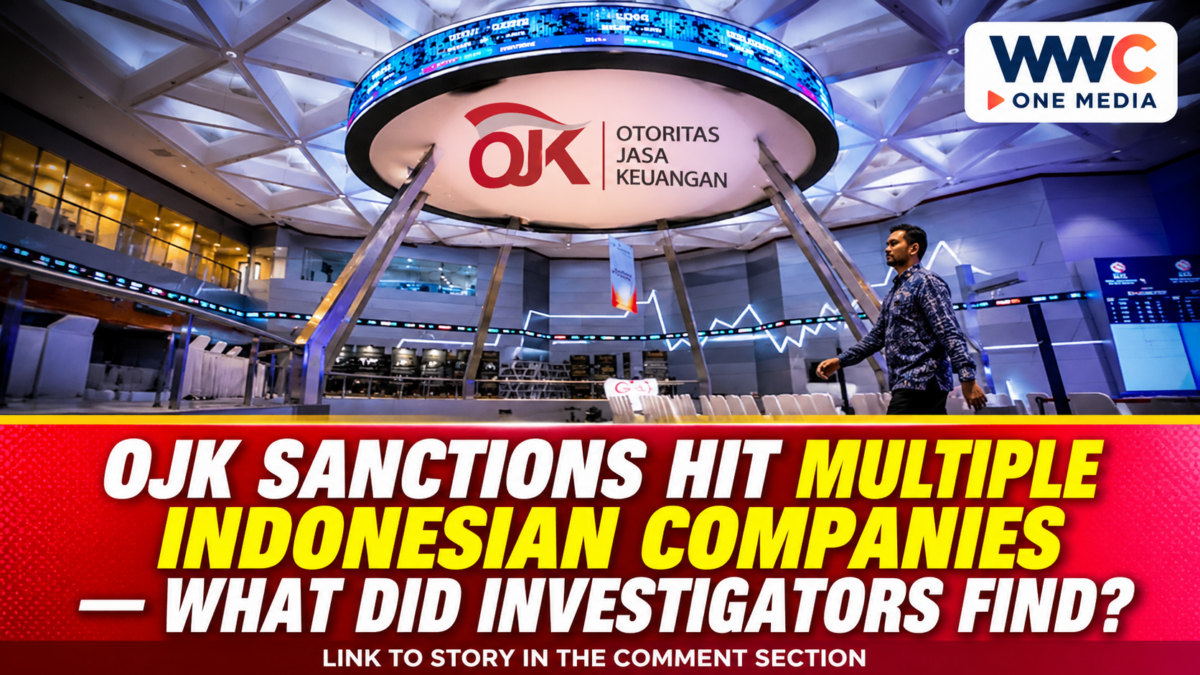
Indonesia’s Financial Services Authority (OJK) announced a new series of capital-market enforcement actions on Nov. 21, 2026, targeting listed companies, corporate officers and individuals over separate regulatory violations. The measures include orders to return gains from stock transactions, administrative fines, restrictions on market participation and requirements involving securities accounts and company shares. OJK+3
The decisions cover different periods and types of conduct. They range from transactions that OJK said created misleading impressions of share trading to failures involving corporate disclosures, related-party transactions and the treatment of financial information.
The latest notices offer a useful picture of what market supervision involves beyond headline fines: regulators are also seeking to address how shares are traded, how companies report transactions and whether investors receive reliable information.
OJK sanctions address more than stock-price manipulation
Two of the Nov. 21 notices concern trading in PT Grand House Mulia Tbk (HOMI) and PT Saraswanti Anugerah Makmur Tbk (SAMF).
In the HOMI case, OJK examined trading between March 20 and July 21, 2023. Its findings identified PT Sakti Maju Berdikari, Teddi Budiman, Hermanto and Indra S. as having conducted indirect transactions through 15 nominee securities accounts.
OJK said the transactions created a false or misleading impression of trading activity, market conditions or HOMI’s share price. It ordered the parties to return Rp6,893,961,022 in gains it identified as improperly obtained. OJK+1
The regulator also imposed restrictions on market activities: five years for Teddi Budiman, 10 years for Hermanto and three years for Indra S. OJK ordered the closure of the 15 nominee securities accounts used in the transactions.
The SAMF case involved trading from May 4 to 19, 2021. OJK identified two groups of parties and said their transactions created a misleading picture of trading activity and prices that was not based on genuine buying and selling demand.
The notice ordered Ir. JK. Kristiyono and PT Surapon Berkah Makmur to return Rp10,836,819,367. A separate group involving Andre Parlindungan, Muhamad Yusuf Riang Hepat, Rudi Riang Hepat and Mohammad Naufal Akmal Riang Hepat was ordered to return Rp1,717,032,907. OJK+1
These are separate cases, with different trading periods and parties. They should not be treated as one coordinated incident.
Six listed companies face different compliance penalties
A separate Nov. 21 announcement named six listed companies: PT Karya Bersama Anugerah Tbk, PT Steel Pipe Industry of Indonesia Tbk, PT Garudafood Putra Putri Jaya Tbk, PT Semen Indonesia (Persero) Tbk, PT Mark Dynamics Indonesia Tbk and PT Anugerah Kagum Karya Utama Tbk.
The findings involve several types of compliance failures.
PT Karya Bersama Anugerah Tbk received an Rp800 million fine over procedures for a material transaction involving a land sale-and-purchase agreement in Kalimantan. Two of its directors were also fined Rp400 million jointly for their responsibilities in the company’s management.
PT Steel Pipe Industry of Indonesia Tbk was fined Rp550 million for failing to transfer 114,068,100 treasury shares by the applicable deadline. OJK also ordered the company to transfer those shares within six months from Oct. 12, 2026. OJK+1
Garudafood Putra Putri Jaya received a Rp325 million fine over procedures for an affiliated transaction involving an additional capital investment in PT Sinarniaga Sejahtera.
Semen Indonesia was fined Rp550 million for failing to transfer a required portion of shares in PT Solusi Bangun Indonesia Tbk to the public within the prescribed period. The regulator directed the company to transfer at least 2.62% of the target company’s paid-up capital, equivalent to approximately 236,738,922 shares, by Dec. 31, 2026.
Mark Dynamics Indonesia received a Rp75 million fine over procedures for an affiliated transaction involving the acquisition of PT Anugrah Gloria Mas by PT Agro Dynamics Indo. OJK+1
The announcement also imposed a Rp300 million fine and a written warning on Anugerah Kagum Karya Utama over financial-statement presentation and disclosure issues, among other findings. OJK+1
The cases illustrate why corporate compliance cannot be reduced to whether a company reports a profit. Material transactions, ownership changes, treasury shares and related-party dealings also require appropriate procedures and disclosure.
Indosterling case raises questions about corporate reporting
OJK separately announced administrative sanctions involving PT Indosterling Technomedia Tbk and several people connected to the company.
The listed company received a Rp250 million fine over a breach involving disclosure of material information or facts. Sean William Henley, identified as the company’s president commissioner during 2022, received a Rp200 million fine concerning annual-report requirements.
Nunu Nugraha, Billy Andrian and Yoas were each fined Rp80 million in connection with annual-report violations during the same period. OJK
The distinction between these penalties matters. The company’s sanction concerned material-information disclosure, while the individual penalties concerned annual-report obligations.
For investors, timely and accurate reporting provides the information needed to assess a listed company’s financial condition, governance and material developments.
WWC has previously examined similar market-integrity concerns in its coverage of a securities firm’s response to allegations involving RLCO trading. That is a separate matter, but it highlights why allegations, regulatory findings and company responses must be kept distinct.
Why the enforcement matters to ordinary investors
Stock prices depend on the interaction of genuine buying and selling interest. If trading activity creates an artificial impression of demand or supply, investors may have difficulty interpreting the information reflected in market prices.
Nominee accounts can complicate the picture because the registered account holder may not be the person making the underlying investment decisions. OJK’s HOMI findings show why identifying account use and the parties behind transactions can form part of regulatory enforcement.
Disclosure failures create a different risk. Investors rely on company announcements and financial statements to understand material transactions, ownership arrangements and the use of corporate funds.
These issues have become particularly relevant amid broader questions about transparency and market accessibility in Indonesia. WWC’s earlier reporting on Indonesia’s stock-market decline and the proposed global index review examined the wider importance of market transparency to investor confidence.
Analysis: Fines and restrictions can demonstrate that regulators are taking action, but the longer-term test is whether enforcement improves market behaviour. Investors need to see consistent supervision, accurate company reporting and clear accountability—not simply a high number of penalties.
What happens next
The next important developments include compliance with OJK’s orders, particularly the required share transfers and the closure of securities accounts identified in the trading investigations.
Semen Indonesia’s required transfer of shares by Dec. 31, 2026, is one specific deadline. Other parties must comply with the restrictions and repayment requirements imposed in their respective cases.
OJK’s Nov. 21 announcements also sit alongside its earlier enforcement actions. On Nov. 16, the regulator announced the detention of three suspects in a separate investigation involving alleged manipulation of structured warrants and warrants traded on the Indonesia Stock Exchange. OJK WWC covered that separate investigation in its report on the Indonesian warrant-trading probe.
The latest notices do not establish that every listed company named was involved in stock manipulation. They describe separate regulatory findings and penalties, and each case should be assessed on its own facts.
For investors, the central issue is whether the enforcement measures translate into more reliable disclosures, fairer trading conditions and stronger protection for market participants.
Frequently asked questions
What is OJK in Indonesia?
OJK is Indonesia’s Financial Services Authority. It regulates and supervises financial services, including the country’s capital market.
Why did OJK order money returned in the HOMI case?
OJK said transactions involving PT Grand House Mulia shares created a misleading impression of trading activity and share prices. It ordered the identified parties to return Rp6.89 billion in gains.
Which companies were named in OJK’s Nov. 21 sanctions?
The listed companies included Karya Bersama Anugerah, Steel Pipe Industry of Indonesia, Garudafood Putra Putri Jaya, Semen Indonesia, Mark Dynamics Indonesia and Anugerah Kagum Karya Utama.
Did all the companies face stock-manipulation allegations?
No. The published findings covered different issues, including material transactions, affiliated transactions, treasury-share transfers, financial reporting and disclosure requirements.
What should investors watch after the announcements?
Investors can monitor compliance with OJK’s orders, future company disclosures, required share transfers and further regulatory announcements.