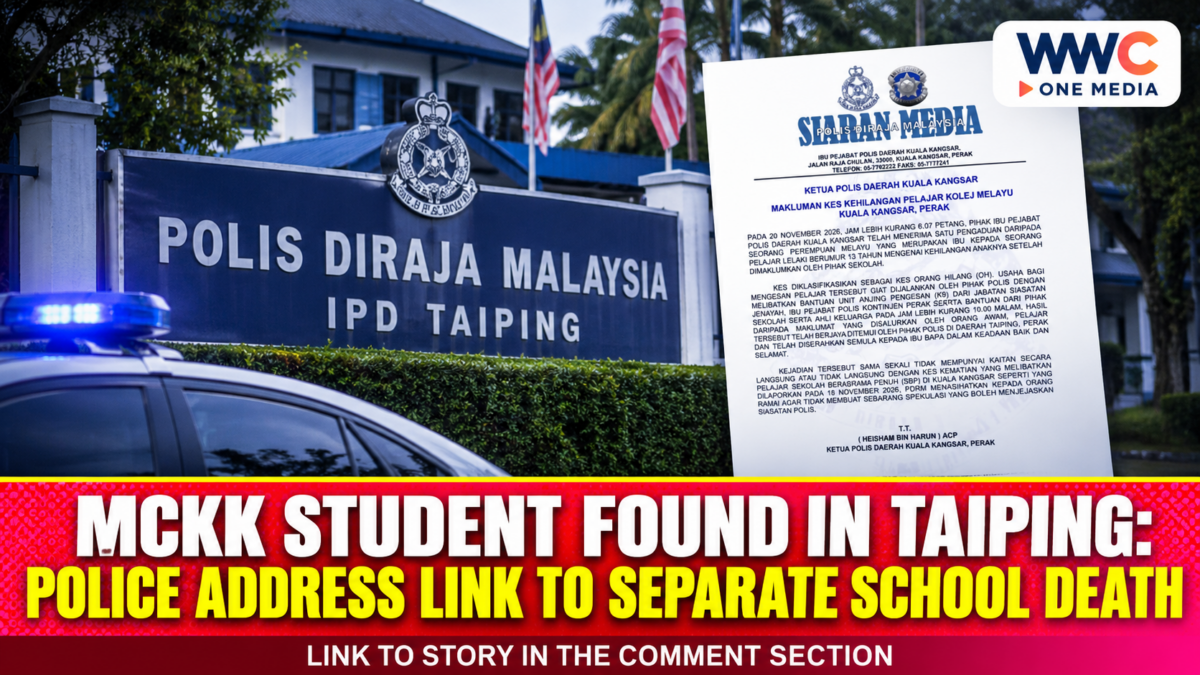
A 13-year-old student from Malay College Kuala Kangsar (MCKK) was found in Taiping on the night of November 20, 2026, after his mother reported him missing, Kuala Kangsar police chief ACP Heisham Harun said. The student was returned to his parents in a safe condition, according to a statement published the following day.
The case drew particular attention because it emerged in the same district as a separate student death reported on November 18. Police have explicitly said the two incidents are not connected, making that distinction important as the public follows developments involving schools in Kuala Kangsar. Portal Berita RTM
The available police account describes a search involving officers, a police K9 unit, school representatives and family members. It also credits information from members of the public with helping officers locate the student.
What the police account confirms
Heisham said the student’s mother made a police report at approximately 6.07 p.m. on November 20, after the school informed her that her son was missing.
The report prompted a search operation involving the police and the K9 unit of the Perak Police Contingent Criminal Investigation Department. School representatives and members of the student’s family also assisted.
The student was located in Taiping at approximately 10 p.m., according to the police chief’s account. He was then handed over to his parents in a condition described as good and safe. Portal Berita RTM
Those details establish the reported sequence of the alert, search and reunion. They do not provide a complete account of where the student had been before he was found or why he became separated from the school.
No explanation for the student’s absence was included in the published police account reviewed for this report. Without an official explanation, it would be inappropriate to speculate about his movements, personal circumstances or reasons for being away.
Why police clarified the separate school death
One of the most consequential parts of the police chief’s statement was his clarification that the missing-student incident had no direct or indirect connection with the death of another student at a fully residential school in Kuala Kangsar, which was reported on November 18.
The clarification matters because two separate incidents involving students in the same district can easily be conflated in online discussions. The police statement expressly rejects a connection between them. Portal Berita RTM
WWC ONE MEDIA has separately covered the investigation into the November 18 Perak school death. That report concerns a different incident. It should not be treated as evidence about the missing MCKK student’s case.
The distinction is more than a matter of wording. Linking unrelated incidents without evidence can create a false impression about the circumstances at a school or the people involved. It can also draw students and families into speculation that the official account does not support.
Public information helped the search
The police chief said information provided by members of the public helped officers locate the student in Taiping.
That detail illustrates one way community information can assist a missing-person search. People who notice relevant information may be able to direct authorities towards a location or a possible lead.
However, the statement does not identify the individuals who provided information, explain what they reported or describe the precise steps officers took after receiving it. Those details should not be filled in through assumptions.
The police account also does not say that the public independently located the student. It states that police found him following information supplied by members of the public.
For readers, the practical distinction is important: information should be passed to authorities, while the identity and private circumstances of a missing child should not become material for online speculation.
Protecting a minor’s identity remains essential
The student is 13, and the public account does not identify him by name. WWC is also withholding identifying details that are not necessary to explain the confirmed development.
Malaysia’s child-protection framework and the responsible handling of information involving minors are subjects covered in WWC’s separate explanation of Malaysia’s child-protection rules for schools. The broader editorial principle is straightforward: reporting a child’s safe return does not require exposing the child’s identity, photographs, family details or private circumstances.
The available statement gives readers the essential outcome — the student was found and returned to his parents safely — without disclosing those personal details. There is no public-interest need to add unverified personal information.
This approach also helps keep attention on the confirmed facts rather than turning a child’s experience into a subject of public scrutiny.
What the case does — and does not — tell the public
The published police account provides a clear outcome, but it is not a full investigative chronology. It confirms the time the mother reported the disappearance, the agencies and people involved in the search, the approximate time and location where the student was found, and his safe return to his parents.
It does not explain why the student was reported missing, how long he was away from the school before the report, or whether any further inquiry or school review followed. None of those details should be inferred from the fact that a search took place.
In a separate Malaysian school-safety matter, WWC has examined the Education Ministry’s review after a student’s death in Johor. That case involved different circumstances and is not connected to the MCKK incident. It provides broader context on why school-related incidents require careful distinctions between confirmed police information and separate administrative questions.
For this case, the immediate confirmed development is that the student was found and reunited with his family. The police chief’s warning against speculation should guide how the incident is discussed while further details remain unavailable.
What happens next
The public account reviewed for this report does not announce further police action, disciplinary proceedings or an additional school investigation. It also does not provide a reason for the student’s absence.
Any further update should be based on a direct statement from the Royal Malaysia Police, the school or the relevant education authority. Until then, the confirmed outcome should remain the focus: the 13-year-old was located in Taiping and returned to his parents safely.
Police have urged the public not to speculate in ways that could affect the investigation. Respecting that request also means avoiding attempts to identify the student or circulate unverified explanations.
Frequently asked questions
Was the missing MCKK student found?
Yes. Kuala Kangsar police chief ACP Heisham Harun said the 13-year-old student was found in Taiping at approximately 10 p.m. on November 20, 2026.
How old was the student?
The police account published by RTM identified the student as 13 years old.
Who reported the student missing?
The student’s mother made a police report at approximately 6.07 p.m. on November 20, after being informed by the school that he was missing.
Was the incident connected to the recent student death in Kuala Kangsar?
No. Heisham said the missing-student incident had no direct or indirect connection to the separate death of a student at a fully residential school in Kuala Kangsar.
Where was the student found?
Police located the student in Taiping, Perak, and returned him to his parents in a safe condition.