
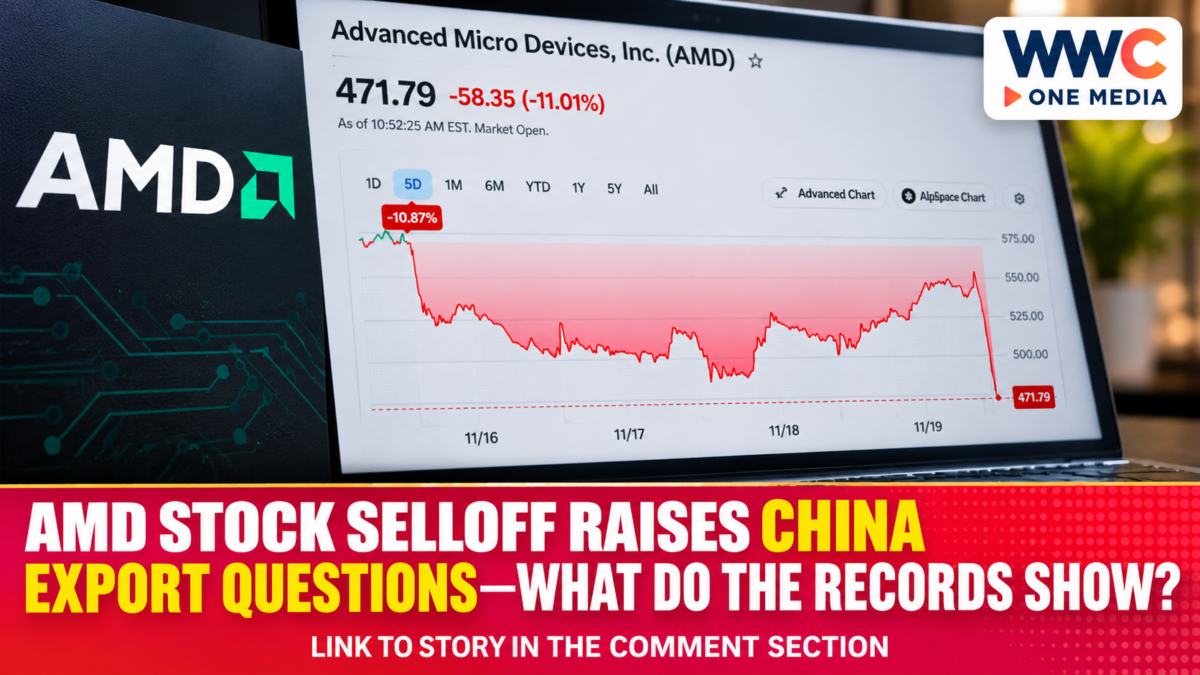
MANILA, Philippines — Nov. 22, 2026. Shares of Advanced Micro Devices faced heavy selling during the latest US trading week, while official records highlighted a separate, longstanding risk: restrictions on exporting advanced chips and technology to China. A Nasdaq-affiliated market database listed AMD at US$424.39 on Nov. 20, but that figure alone does not establish the cause of the share-price decline.
The key distinction is between a stock-market reaction, a company’s disclosed regulatory exposure and proof of any violation. AMD’s latest quarterly filing confirms export-licensing requirements and the government’s restrictions on identified Chinese entities. Neither the filing nor the restricted-entity listing, on its own, proves that AMD supplied prohibited software to a restricted customer.
AMD Stock Selloff: What the Market Record Establishes
A Nasdaq Dorsey Wright database report dated Nov. 20 listed AMD at US$424.39, with volume of 69,320,001 shares. It provides a documented end-of-week reference point for the stock but is not a substitute for a full exchange-verified series of daily closing prices.
Consequently, this report does not present the headline claim of an 11% decline as a verified full-session return. Market prices change during trading, and a percentage quoted in an early report may differ from the final close. A careful account must distinguish an intraday move from a completed session.
The distinction also matters for causation. The fact that a restricted-entity issue and a selloff occurred in the same period does not prove the first was the sole cause of the second. Investor positioning, valuations and wider semiconductor-market conditions can also matter, but their contribution cannot be quantified from AMD’s filings alone.
What US Restrictions Actually Say About IEIT Systems
A US Commerce Department rule published on March 28, 2025, lists IEIT Systems Co. Ltd. as an alias of Inspur Electronic Information Industry Co., Ltd. on the Entity List. The listing covers all items subject to the Export Administration Regulations and specifies a licence-review policy of denial.
That is a concrete regulatory fact. It means covered transactions require close scrutiny under US export rules. It is not, however, an official finding that AMD committed a breach, nor does the listing identify particular AMD shipments, updates or software deliveries.
This distinction is essential when evaluating claims involving firmware. A technical file appearing on a website or being associated with a computer system is not sufficient, by itself, to determine who transferred it, when a covered export occurred, what authorisation applied or whether an exception was available.
For readers following the wider policy shift, WWC previously examined US AI chip curbs affecting Nvidia and AMD. The regulatory framework is broader than a single manufacturer’s sales.
AMD’s Filing Confirms Real China Export Exposure
AMD’s Form 10-Q filed on Nov. 4 describes a licensing requirement introduced in April 2025 affecting certain Instinct MI308 products. It says the company obtained some licences for China-based customers and began shipping covered MI308 products at the end of fiscal 2025.
The filing also says US authorities granted some licences for Instinct MI325 products during the first half of 2026. Under those licences, covered products shipped to China must first undergo inspection in the United States, with a 25% tariff applying when they are imported into the country for inspection.
AMD warns that export controls can reduce its addressable market, increase compliance costs and limit transactions outside China as well. These are disclosed commercial risks, not admissions that the company made an unlawful transfer.
The broader challenge is familiar across the industry. WWC’s coverage of Nvidia’s China chip-sales outlook explains why permission to export and the ability to complete a profitable sale are different questions.
Record Data Centre Growth Complicates the Picture
AMD’s Nov. 3 earnings announcement reported third-quarter revenue of US$13.377 billion, up 45% year on year. Data Center segment revenue reached approximately US$8.5 billion, an increase of 97% from the comparable period.
The company reported GAAP net income of US$2.428 billion and diluted earnings per share of US$1.46. Its Client and Gaming segment, however, recorded revenue of US$3.7 billion, down 8% year on year. The segment mix shows that strong data-centre demand does not mean every business line is growing at the same pace.
AMD projected approximately US$17 billion in fourth-quarter revenue, plus or minus 3%, and an expected non-GAAP gross margin of roughly 55%. Those figures are management guidance, not completed results, and they remain subject to demand, supply and regulatory developments.
WWC earlier examined AMD’s planned 2027 chip-supply expansion. The latest financial results put that capacity ambition in context: growth opportunities and compliance obligations can increase simultaneously.
Why the Two Stories Must Not Be Confused
Analysis: Investors need two separate assessments. The first concerns business performance: sales growth, margins, product demand and whether management achieves its forecast. The second concerns regulatory exposure: what items are controlled, who receives them and whether a transaction has the necessary authorisation.
An Entity List designation is evidence of restrictions on the designated entity, not automatic proof of misconduct by every supplier whose products might appear in that entity’s equipment. Equally, strong quarterly earnings cannot resolve an unresolved compliance question.
For Philippine readers, the implications are indirect but significant. Local businesses that depend on global cloud capacity, computing hardware or international technology supply chains may face changing pricing or availability as manufacturers adapt to export rules. No reviewed primary document establishes a specific Philippine shortage or price increase caused by this episode.
What Happens Next
Future AMD filings, formal Commerce Department enforcement announcements and reliable exchange closing-price data can clarify different parts of the story. A verified enforcement document would be needed before treating allegations of prohibited transfers as established violations.
Until then, the defensible conclusion is narrower: AMD has documented rapid data-centre growth and substantial exposure to export controls, while the government maintains restrictions covering IEIT Systems. Market volatility makes those questions relevant, but it does not answer them.
Frequently Asked Questions
Did AMD shares fall because of a proven China export violation?
The official records reviewed do not establish a proven AMD export violation or demonstrate that a single regulatory issue caused the market decline.
Is IEIT Systems on the US Entity List?
Yes. A March 2025 Commerce Department rule names IEIT Systems Co. Ltd. as an alias of Inspur Electronic Information Industry Co., Ltd.
Can AMD legally export some AI chips to China?
AMD says it has received some licences covering specified MI308 and MI325 products and customers. Authorisations are conditional and should not be interpreted as approval for all transactions.
How fast is AMD’s data-centre business growing?
AMD reported approximately US$8.5 billion of Data Center segment revenue in the third quarter of 2026, up 97% year on year.
Has AMD confirmed its fourth-quarter results?
Not in the records reviewed. Its Nov. 3 announcement provided a forecast of approximately US$17 billion in revenue, plus or minus 3%, rather than actual fourth-quarter results.










