
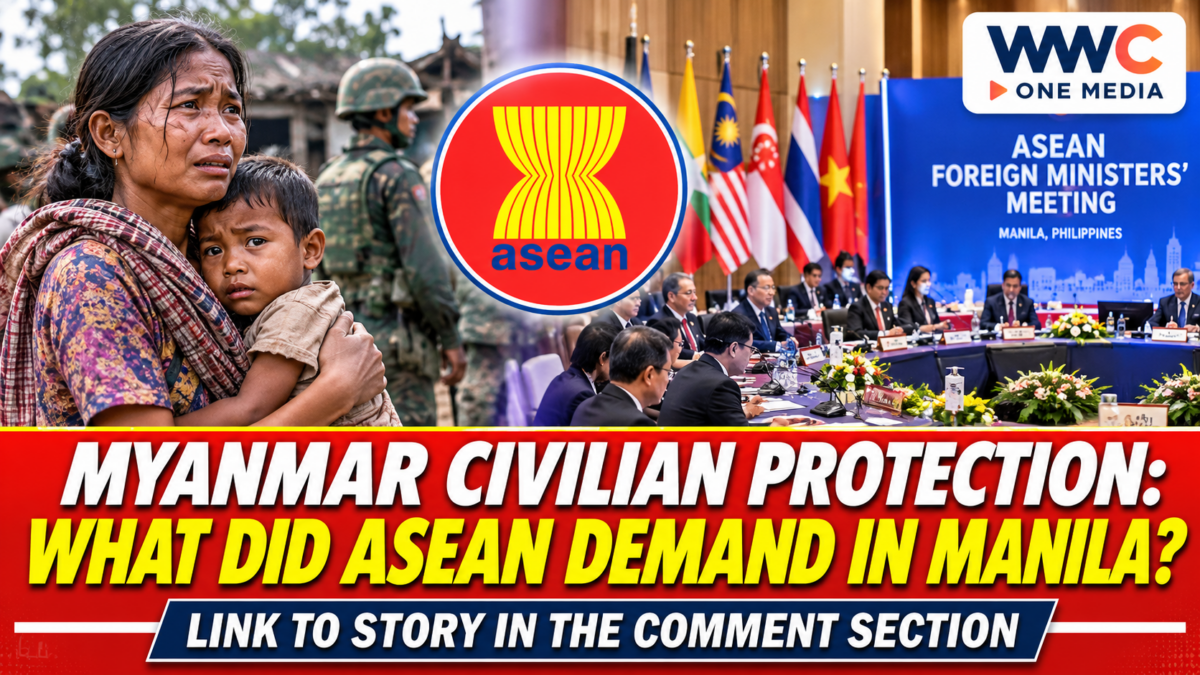
MYANMAR — Nov. 22, 2026. ASEAN leaders meeting in Manila on Nov. 15 renewed their call to stop attacks on civilians in Myanmar, while acknowledging insufficient progress in their regional peace framework. Their adopted decision also maintained restrictions on Myanmar’s political representation at ASEAN summits and foreign ministers’ meetings, leaving a central question: how will the bloc measure whether civilians are becoming safer?
The decision came against a documented pattern of aerial attacks affecting civilian areas. United Nations statements and investigations have described serious incidents in the months before the summit. Those records provide important context, but they should not be mistaken for independent verification of separate casualty reports circulating during the Nov. 15–17 meetings.
Myanmar Civilian Protection Is the Main Test
The ASEAN leaders’ Nov. 15 review urged Myanmar’s armed forces, security forces and armed groups to de-escalate violence and end targeted attacks on civilians and civilian infrastructure. It also called for a sustained nationwide ceasefire to create conditions for humanitarian relief and inclusive dialogue.
This wording has a practical implication. A political announcement is not itself a measure of safety. Evidence of progress would include fewer verified civilian attacks, safer access for aid operations and opportunities for affected communities to participate in political discussions.
ASEAN’s leaders did not declare that these conditions had been achieved. They expressed deep concern over insufficient implementation of the Five-Point Consensus, the framework first agreed in 2021 for addressing Myanmar’s crisis.
The gap between diplomatic decisions and civilian conditions sits alongside WWC’s earlier examination of Myanmar’s continued political restrictions at ASEAN. Those restrictions remain a policy instrument, not proof that violence has stopped.
What International Investigators Have Documented
On Oct. 27, Nicholas Koumjian, head of the Independent Investigative Mechanism for Myanmar, told a United Nations General Assembly committee that the mechanism was intensifying investigations into indiscriminate or targeted attacks involving aircraft, drones and paramotors. He specifically described attacks affecting homes, hospitals, religious sites, displacement camps and schools.
His statement referred to a September strike on a market in Rakhine State that killed more than 50 people, as well as attacks on religious facilities during October. These were documented examples from before the November summit, not casualty figures for attacks during the meeting itself.
A separate Nov. 3 UNICEF statement expressed alarm over reports that three children had been killed and five injured in an Oct. 31 airstrike on a school serving displaced families in Loikaw Township, Kayah State. UNICEF also identified reports of attacks affecting a temporary health facility in Rakhine State.
The careful wording matters. UNICEF described reports and called for civilian protection; its statement should not be presented as a completed judicial finding about responsibility for each incident.
Why the Five-Point Consensus Still Matters
The Five-Point Consensus remains ASEAN’s principal framework for seeking an end to violence, dialogue among concerned parties, a special envoy’s mediation role and humanitarian assistance. The Nov. 15 decision reaffirmed that framework rather than replacing it with a new peace agreement.
The leaders acknowledged limited progress through the ASEAN Coordinating Centre for Humanitarian Assistance on disaster management, or AHA Centre. Their decision recorded that a month-long distribution programme began on Oct. 28, covering more than 11,000 households, including communities in four priority townships the centre had not previously reached.
That is a programme scope recorded by ASEAN, not a verified total of completed household deliveries. Assistance can reduce immediate hardship, but by itself it does not show that attacks have ended or displaced families can safely return home.
WWC’s previous analysis of whether humanitarian progress can unlock political change addresses the institutional question. The immediate civilian-protection test is more concrete: can aid reach people consistently without exposing them to further harm?
What Manila Decided About Myanmar’s Representation
ASEAN maintained non-political representation for Myanmar at its summits and foreign ministers’ meetings until meaningful progress is made on the Five-Point Consensus. The same decision said Myanmar’s participation in other ASEAN sectoral ministerial meetings and mechanisms should be unrestricted at all levels.
The bloc left open a phased route towards restoring full political representation, but only if sustained and concrete progress can be demonstrated. It set no automatic restoration date.
That distinction is important for readers following the wider outcomes of ASEAN’s Manila summit. Myanmar remains part of ASEAN; the restrictions concern representation at particular high-level meetings, not expulsion from the organisation.
Analysis: The policy makes better sense as a conditional diplomatic incentive than as a direct enforcement mechanism. It can signal regional expectations, but the official decision does not identify a means by which ASEAN could independently stop an individual airstrike.
What the Evidence Does Not Yet Establish
Reports of deadly strikes around the time ASEAN leaders met remain under review. The primary records reviewed for this package do not independently verify that specific collection of incidents, its full death toll, individual locations or alleged perpetrators.
It would therefore be misleading to place a figure such as “dozens killed during the summit” in WWC’s headline or lede as an established fact. Earlier UN-confirmed or UN-reported incidents cannot be added together and relabelled as November summit casualties.
Nor does the evidence establish that the Manila decision produced an immediate change in battlefield activity. Reliable assessment would require incident-level records with dates, locations, corroborated civilian casualty information and subsequent updates.
What Happens Next
ASEAN has directed its foreign ministers to monitor implementation and report at the next summit. Its decision also called for coordination between the ASEAN chair’s special envoy, the United Nations envoy and successive ASEAN chairs, while continuing work towards broader humanitarian access and political dialogue.
The next meaningful assessment should compare developments on the ground with the conditions ASEAN has set: reduced violence, protection of civilians, effective assistance and progress towards inclusive talks. The crucial question is not whether another declaration is issued, but what independent evidence shows about the safety of people living with the conflict.
Frequently Asked Questions
Did ASEAN call for an end to attacks on civilians in Myanmar?
Yes. Its Nov. 15, 2026 decision urged armed forces, security forces and armed groups to de-escalate violence, stop targeted attacks on civilians and support a sustained ceasefire.
Did ASEAN verify the reported civilian deaths during its Manila summit?
The leaders’ adopted decision does not provide an incident-by-incident death toll for the Nov. 15–17 summit period. The specific casualty figure in the linked report remains unverified in the primary records reviewed here.
What is ASEAN’s Five-Point Consensus?
It is the regional framework for addressing Myanmar’s crisis through ending violence, dialogue, special-envoy engagement and humanitarian assistance.
Has ASEAN restored Myanmar’s full political representation?
No. Full political representation at summits and foreign ministers’ meetings remains conditional on meaningful progress, although other sectoral participation is to remain unrestricted.










