
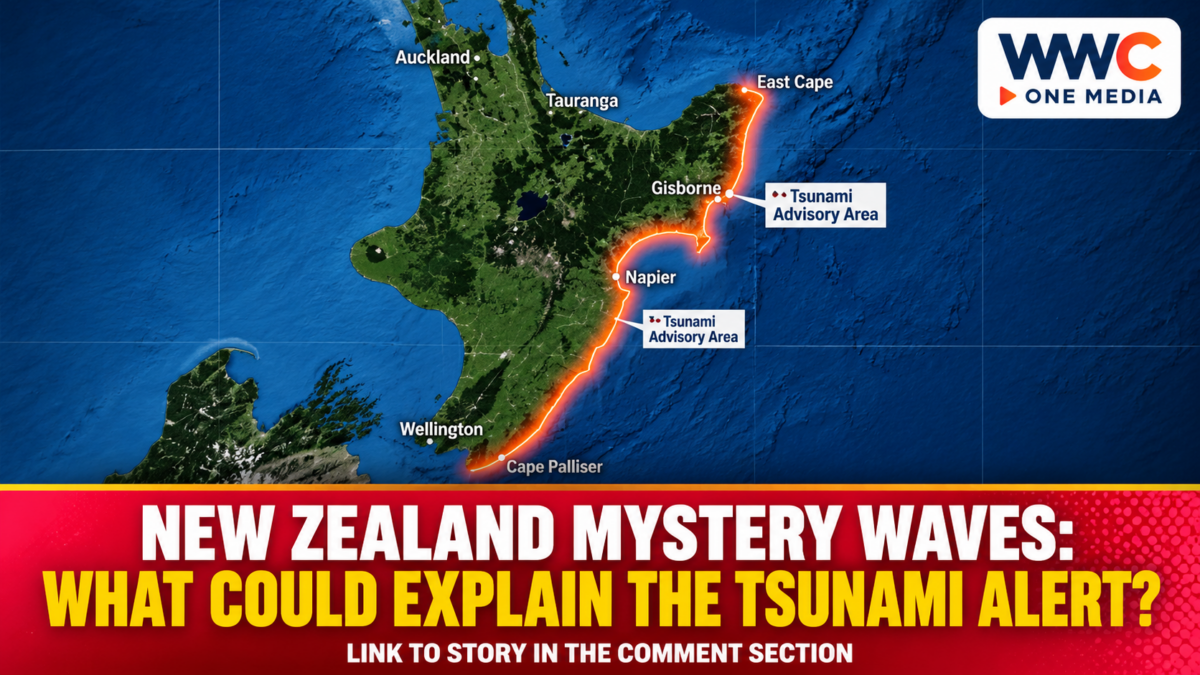
NEW ZEALAND — Nov. 22, 2026. New Zealand’s National Emergency Management Agency issued a tsunami-activity advisory for parts of the North Island’s eastern coast on Nov. 18 after unusual coastal-water activity prompted concern about strong currents and surges. The national emergency notice now identifies the threat as over, but the publicly accessible official material reviewed for this update does not provide a final scientific explanation for the disturbance.
The episode matters because a coastal warning is about the danger people may face, not necessarily a complete diagnosis of the event that created it. Instruments can reveal abnormal water movement before investigators can confidently identify its origin. The distinction between a detected hazard and its confirmed cause is central to understanding the New Zealand mystery waves.
New Zealand mystery waves: What the alert established
The national advisory was recorded on Nov. 18, 2026. The published emergency listing describes a tsunami-activity advisory and subsequently displays a national status of no threat. A contemporaneous coastal navigation-warning text also carried instructions about strong and unusual currents and unpredictable surges near the North Island’s eastern coast.
These are practical hazards. Water may behave dangerously around beaches, harbour entrances, river mouths and vessels without producing the familiar image of a towering wave crossing a shoreline. The absence of a major land-flooding forecast does not make an on-water warning unnecessary.
It does not, by itself, establish why the abnormal marine signal appeared. A warning’s cancellation and an unresolved scientific explanation can both be true.
Why an activity advisory is different from a land warning
New Zealand’s national tsunami guidance separates a tsunami-activity advisory from a warning involving the flooding of land. An activity advisory applies when inundation of land near shore is not expected under the current assessment, but hazardous currents and unpredictable surges remain possible.
The advice is specific. People should stay out of the water, avoid beaches and shore areas, and refrain from swimming, surfing, fishing and small-boat activities while such an advisory is active. Those aboard vessels or at marinas should follow the applicable civil-defence instructions.
A land-threat warning has a different consequence: evacuation may be required in affected places. The instructions attached to the alert are more important than the dramatic associations of its label.
The distinction can also be seen in WWC ONE MEDIA’s separate reporting on an offshore earthquake near Japan’s Ogasawara Islands. Earthquake magnitude alone cannot substitute for an event-specific assessment of coastal hazard.
Could weather or an underwater disturbance explain the waves?
There are several recognised ways to disturb a body of seawater. New Zealand’s scientific institutions have documented meteo-tsunamis, which are long waves generated by atmospheric conditions, including rapid changes in air pressure. Their published explanation describes an earlier event at Papamoa, not the Nov. 18, 2026 advisory.
Undersea movement is another physical mechanism capable of generating sudden water displacement. But identifying a plausible mechanism is not the same as documenting that it occurred on this occasion. The available official record reviewed here does not justify declaring a particular landslide, earthquake or weather system responsible.
Establishing the cause would require event-specific measurements and a scientific assessment explaining how the observations fit together.
The same caution applies when comparing unrelated incidents. WWC ONE MEDIA’s Kumamoto earthquake report discusses an official no-tsunami assessment for a separate Japanese event; that conclusion says nothing about what generated the New Zealand marine activity.
What ocean instruments can actually show
New Zealand’s tsunami-monitoring network includes Deep-ocean Assessment and Reporting of Tsunami, or DART, instruments. The country’s emergency-management guidance explains that seafloor sensors detect changes in water pressure and transmit measurements to monitoring specialists for analysis.
These observations can help scientists distinguish potentially hazardous sea-level changes from ordinary variation. The network is designed to support timely assessment and warnings, especially for threats generated far from communities that could feel an earthquake directly.
There is an important reporting limit, however. A description of how DART works does not prove that a specific buoy recorded or confirmed the Nov. 18 episode. The material reviewed for this update does not establish the role of any individual DART station in that event.
Monitoring and attribution are separate tasks. A system can provide enough information to justify a precaution while specialists continue evaluating what produced the recorded signal. The public should not have to wait for a complete geological or atmospheric explanation before being told to avoid dangerous coastal waters.
Why the episode matters across the Pacific
Analysis: The strongest lesson from this case is about communicating uncertainty without weakening safety advice. A responsible alert can state what has been observed, identify a potential danger and specify protective action, even if the event’s cause remains unclear.
For coastal communities, a message should also distinguish what has ended from what remains unknown. The lifting of an activity advisory means the assessed immediate threat has passed; it does not certify that the observation was imaginary or that future events are impossible.
WWC ONE MEDIA has separately covered Indonesia’s Ruteng earthquake and its no-tsunami assessment. The events are unrelated, but they illustrate a common reporting principle: observation, hazard assessment and public instructions must each be described on their own terms.
What happens next
A decisive scientific update would need to identify the event-specific evidence behind any proposed cause and explain whether it accounts for the coastal observations. Until such a determination can be checked in an official scientific record, the origin of the reported disturbance should remain an open question.
New Zealand’s standing guidance also stresses that coastal residents should recognise natural warning signs. After strong or prolonged shaking, a sudden change in sea level or unusual roaring sounds from the water, people should move to higher ground or inland without waiting for an electronic alert. That advice applies to a new immediate threat, not to the already-ended Nov. 18 advisory.
Frequently asked questions
What happened during the New Zealand tsunami advisory?
A national tsunami-activity advisory was recorded on Nov. 18, 2026, concerning dangerous currents and surges near the coast. The national emergency listing subsequently displayed a no-threat status.
What caused the New Zealand mystery waves?
The official records inspected for this update do not establish a final cause. Weather-driven long waves and underwater disturbances are recognised physical possibilities in general, but neither is confirmed here.
Did the advisory mean homes were expected to flood?
No. New Zealand’s guidance distinguishes a tsunami-activity advisory, which concerns dangerous water movement near shore, from a land-threat warning that may require evacuation.
What is a DART tsunami detector?
A DART system uses deep-ocean pressure measurements to help detect tsunami-related changes in sea level. Its general role does not establish that it detected this particular incident.
What should people do during a future advisory?
Follow the current instructions of civil-defence authorities, stay out of hazardous coastal waters and avoid exposed shore areas. If natural tsunami warning signs occur, move inland or uphill immediately rather than waiting for a formal alert.










