
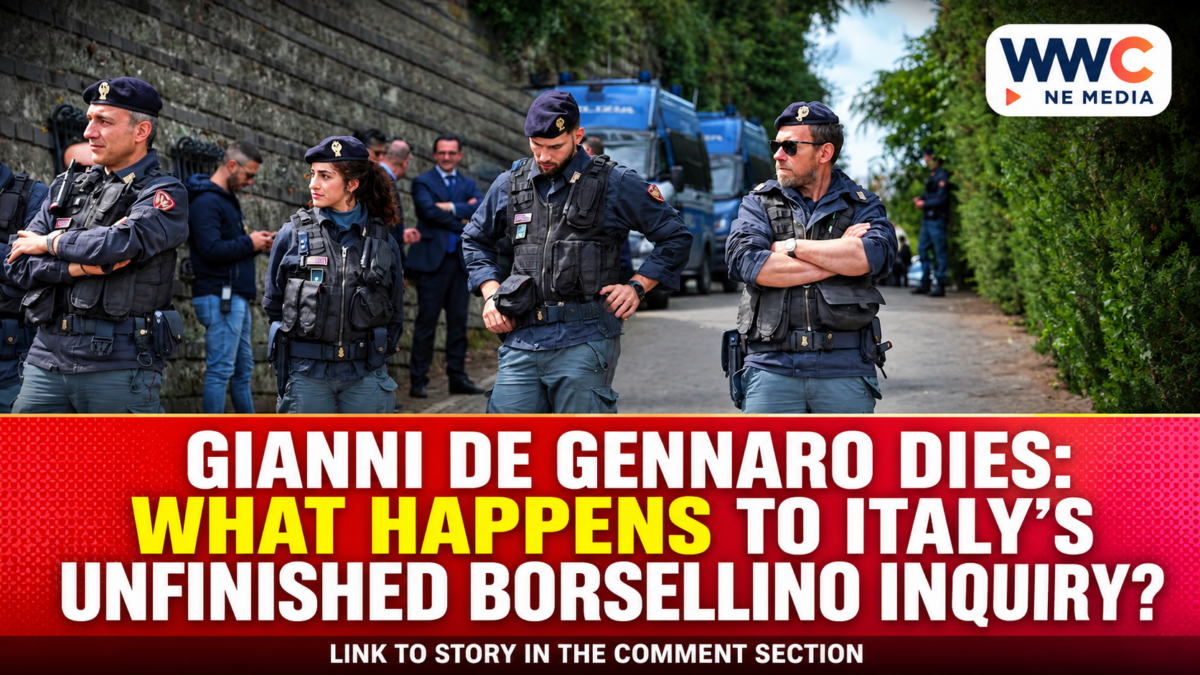
Former Italian national police chief Gianni De Gennaro was reported dead in Tuscany on Nov. 21, 2026, at the age of 78, while prosecutors in Sicily were examining allegations concerning the handling of the investigation into the 1992 assassination of anti-mafia magistrate Paolo Borsellino. His death has brought renewed attention to one of Italy’s most consequential unresolved chapters in its fight against organised crime. AP News+1
The investigation concerns alleged interference with inquiries following the Via D’Amelio bombing in Palermo, which killed Borsellino and five police officers on July 19, 1992. De Gennaro was reportedly among those under investigation, but allegations are not findings of guilt. The public records reviewed do not establish that he was convicted of wrongdoing in this new inquiry. ANSA.it+1
The distinction matters because the death of a person under investigation does not resolve the allegations, establish responsibility or answer the historical questions surrounding the bombing. It also leaves investigators and the public facing difficult questions about what evidence remains available.
What happened in the Via D’Amelio bombing?
The Via D’Amelio attack took place in Palermo on July 19, 1992. A car bomb killed Borsellino and five members of his police escort: Agostino Catalano, Walter Eddie Cosina, Vincenzo Li Muli, Emanuela Loi and Claudio Traina. ANSA.it+1
The bombing came less than two months after the May 23, 1992, Capaci attack, which killed anti-mafia magistrate Giovanni Falcone, his wife Francesca Morvillo and three police officers. The two attacks became defining events in Italy’s struggle against the Sicilian Mafia, known as Cosa Nostra. ANSA.it+1
The investigation into Borsellino’s murder later became controversial because of evidence that parts of the original inquiry had been seriously compromised. An official Caltanissetta court report for 2023–2024 lists proceedings concerning the so-called depistaggio—the misleading or derailing of the investigation into the Via D’Amelio massacre. ca-caltanissetta.giustizia.it
That history is essential to understanding why renewed scrutiny of people who held senior public positions has attracted attention.
Why was Gianni De Gennaro under investigation?
De Gennaro’s name emerged in a new inquiry being conducted by prosecutors in Caltanissetta. Reports published in November described allegations that he had played a role in obstructing or misleading follow-up investigations into the 1992 bombing and questions surrounding the disappearance of Borsellino’s red notebook. ANSA.it+1
These are allegations under investigation, not established facts. The records reviewed do not provide a final judicial finding that De Gennaro obstructed the investigation or was responsible for the disappearance of the notebook.
Reports also said prosecutors had sought a precautionary measure against him, but that an investigating judge rejected the request. The distinction is important: a request by prosecutors is not an order granting the measure, and neither is equivalent to a conviction. ANSA.it+1
De Gennaro’s reported death therefore occurred while the legal questions remained unresolved. His death does not prove or disprove the allegations.
A senior figure in Italy’s police and security institutions
De Gennaro held senior roles in Italy’s public security institutions. The official website of the Direzione Investigativa Antimafia lists him as its director from 1993 to 1994. DIREZIONE INVESTIGATIVA ANTIMAFIA
A farewell address published by the Italian State Police in July 2007 records his departure after seven years as head of the national police. In the speech, he described the responsibility of leading the public security department and thanked colleagues for their work. poliziadistato.it
His career placed him within the institutions responsible for combating organised crime during a period when Italy faced major Mafia violence. That background makes the current allegations particularly consequential, but it should not be used as evidence that the allegations are true.
The broader issue is institutional accountability: how authorities handled evidence, witnesses and investigative decisions after a major attack on the Italian state.
Why the missing red notebook remains important
Borsellino’s red notebook, often referred to as the agenda rossa, has remained a central point of public interest in the Via D’Amelio case. Reports on the new investigation describe renewed scrutiny of its disappearance and whether information connected to it was withheld from investigators. ANSA.it+1
The notebook’s disappearance matters because it raises questions about what the magistrate may have recorded and whether those notes could have assisted investigators. But the absence of the notebook does not establish who removed it, who may have known its location or whether a particular person was responsible.
Those questions require documentary evidence, testimony and judicial examination—not assumptions based on a person’s former position.
Italy’s experience also demonstrates why an investigation can remain significant decades after an attack. The official Caltanissetta court report records the legal proceedings concerning the earlier handling of the Via D’Amelio investigation, showing that the inquiry’s history has continued to receive judicial attention. ca-caltanissetta.giustizia.it
What happens next
The immediate question is what happens to the investigation following De Gennaro’s reported death. Prosecutors may continue examining evidence and the conduct of other people involved, but the precise procedural consequences cannot be established from the public records reviewed.
A separate inquiry into the circumstances of De Gennaro’s death was also reported. Its findings, including any forensic conclusions, should not be anticipated or treated as settled before official results are released. AP News+1
For the Via D’Amelio case, the central issues remain the handling of the original investigation, the treatment of evidence and the unanswered questions surrounding Borsellino’s notebook.
For readers outside Italy, the case is a reminder that accountability does not end when an initial criminal investigation closes. Courts, prosecutors and public institutions may revisit earlier proceedings when new evidence or unresolved questions justify further scrutiny.
De Gennaro’s death may change the course of the latest inquiry, but it does not provide a final answer to the questions surrounding the 1992 bombing.
Frequently asked questions
Who was Gianni De Gennaro?
Gianni De Gennaro was a senior Italian police official who served as national police chief for seven years and directed the country’s Anti-Mafia Investigative Directorate from 1993 to 1994. poliziadistato.it+1
What was the Via D’Amelio bombing?
It was a car-bomb attack in Palermo on July 19, 1992, that killed anti-mafia magistrate Paolo Borsellino and five police officers assigned to his escort. ANSA.it
Why was De Gennaro under investigation?
He was reportedly being investigated over allegations concerning the handling of the inquiry into the bombing and the disappearance of Borsellino’s red notebook. These allegations were not established as proven guilt in the records reviewed. ANSA.it+1
Was De Gennaro convicted in the new investigation?
No conviction in the new investigation was established by the records reviewed. Prosecutorial allegations and requests for precautionary measures must not be confused with a court finding of guilt.
Does his death close the Via D’Amelio investigation?
His death does not, by itself, resolve the wider investigation into the bombing or the handling of evidence. The procedural consequences for the inquiry require confirmation from the relevant Italian authorities.










