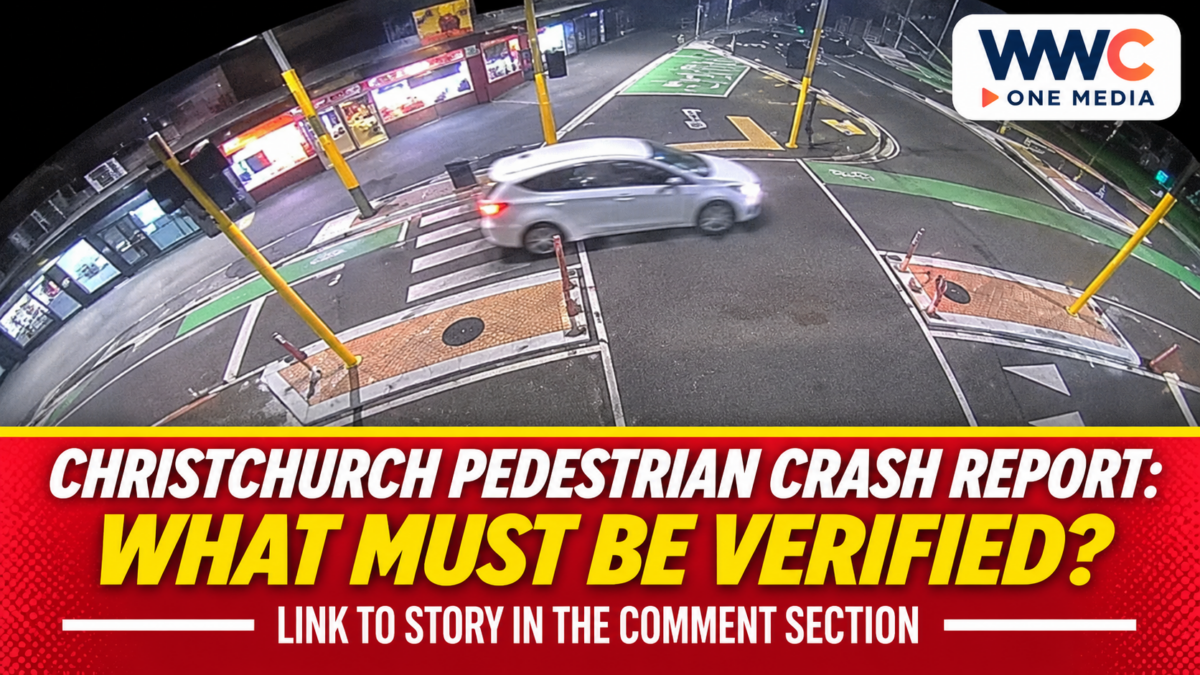
CHRISTCHURCH, New Zealand — Nov. 21, 2026. A Nov. 19 report of a vehicle–pedestrian collision in Christchurch has raised questions about the injured person’s condition, traffic restrictions and how investigators will determine what happened. But the Christchurch pedestrian crash cannot yet be reported by WWC as a fully verified incident: the original case-specific New Zealand Police release and an updated official medical statement were not available for direct inspection during this review.
This distinction does not diminish the seriousness of the reported event. It establishes the limits of the available evidence. New Zealand’s official road-policing and pedestrian-safety records explain what a proper investigation can establish, why temporary road restrictions matter and which conclusions must await direct confirmation.
Christchurch Pedestrian Crash: What Is Still Missing?
An original police alert should confirm the date, precise location, time the incident was reported and whether emergency services attended. A later notice should establish whether any road restrictions ended and whether investigators are seeking witnesses. None of those case-specific records was directly verified for the November report.
Separate published accounts describe a collision at the Montreal Street–Moorhouse Avenue intersection on Nov. 19. Because those accounts reproduce statements attributed to public agencies rather than the agencies’ original documents, the precise intersection and injury classification remain leads for verification, not established facts in this article.
An injured person’s status may also change after the first assessment. An initial description of an injury as serious or critical is tied to a particular time and issuing organisation; it is not a permanent medical finding. Without a current original update, WWC cannot responsibly assert a prognosis or outcome.
Analysis: The public needs timely information, but a report that labels unverified details as confirmed can mislead readers and the affected family. Accuracy requires separating a report of a crash from the evidence that explains it.
What Police Records Can Establish After a Serious Collision
New Zealand Police identifies specialist Serious Crash Units among its road-policing capabilities. Its official description says road-policing teams work on traffic-law enforcement, safer driving practices and road safety, alongside specialist crash investigation.
In other cases, police have publicly documented Serious Crash Unit scene examinations, investigations and subsequent reopening of roads. That pattern shows why an investigation may continue after traffic begins moving normally again. It does not prove that the unit attended this particular Christchurch incident.
A case-specific report could help clarify the point of impact, the movements of the vehicle and pedestrian, witness observations and whether mechanical or roadway conditions need examination. Each remains a question until evidence is assessed.
WWC previously examined how investigators distinguished reported facts from suspected causes in a Quezon jeepney crash. That separate incident does not establish anything about the Christchurch collision, but illustrates why early descriptions should not be confused with final findings.
Why Road Closures Are Not Proof of Fault
Restrictions following a serious collision can create space for emergency responders, protect people at the scene and permit evidence collection. A road being blocked does not, by itself, establish speeding, dangerous driving, pedestrian error or an equipment defect.
New Zealand Police has described scene examinations and road reopenings in official reports on other serious crashes. Those notices show that reopening a road and finishing an investigation are different milestones. They cannot establish whether a particular Christchurch road remained closed on Nov. 21.
For transport users, a historical closure notice should not be republished as a current traffic instruction. Anyone travelling in Christchurch needs current traffic information from the relevant authorities rather than a two-day-old report.
WWC’s report on a van entering a pedestrian area in Singapore concerns a different jurisdiction and collision. Its relevance is limited to the broader distinction between an observed incident and an officially established cause.
What New Zealand’s Pedestrian-Safety Guidance Says
NZ Transport Agency Waka Kotahi’s pedestrian-network guidance treats intersections as complex places where vehicles and people walking need safe, understandable movements. The agency says intersection design should consider its Safe System principles, applicable legal requirements and appropriate pedestrian facilities.
The agency’s crossing guidance also explains that crossings differ in how they assign legal priority and manage traffic. A location’s layout therefore matters when examining a collision, but the presence or absence of a particular crossing cannot be assumed without inspecting the site record.
Analysis: Any meaningful safety assessment should consider the actual intersection design, traffic movements, crossing arrangements and available evidence. A generic warning about pedestrian awareness is not a substitute for finding out whether infrastructure or vehicle operation contributed to the event.
WWC has also reported a Quezon roadside tragedy that raised questions about vehicle condition and pedestrian exposure. It is a separate event, and should not be used to infer what happened in Christchurch.
What an Accountable Update Should Contain
An authoritative follow-up should first identify the incident and provide the correct date and location. It should then distinguish an initial emergency-service assessment from any later patient update, and explain whether traffic controls have been lifted.
Investigative progress needs the same precision. Police can say that enquiries continue without prematurely attributing blame. If a later inquiry identifies a possible contributing factor, it should be described as a finding or allegation at the level supported by the original record.
Names, personal histories and medical details should be limited to information lawfully released and genuinely necessary for understanding the public event. Neither the location of a collision nor an unverified account is grounds for speculating about a pedestrian’s conduct.
What Happens Next
WWC needs an original New Zealand Police incident notice and any subsequent update before a factual crash report can be published. The same check should determine the current condition, if officially released, the actual duration of any traffic closure and whether investigators have identified a cause.
Until those records are obtained, the public-interest story is the verification gap and the established framework for investigating serious road collisions—not an asserted injury outcome or an unsupported account of who was responsible.
Frequently Asked Questions
1. Was a pedestrian critically injured in Christchurch on Nov. 19?
Secondary reports describe a serious incident, but WWC has not directly reviewed the original police or ambulance statement establishing the injury classification. It remains unverified under the required standard.
2. Where did the reported Christchurch collision take place?
Published accounts identify the Montreal Street–Moorhouse Avenue intersection. That case-specific location still needs confirmation from an original official notice.
3. Has the road reopened?
The exact duration of the reported restrictions has not been established from a directly reviewed current official traffic record. An earlier closure report should not be treated as live advice.
4. What does New Zealand’s Serious Crash Unit do?
New Zealand Police identifies Serious Crash Units as specialist road-policing resources. Police reports on other incidents describe scene examinations and investigations.
5. Has anyone been found responsible for the collision?
No original investigative finding or legal determination concerning this specific report was verified. Fault or criminal liability must not be assumed.