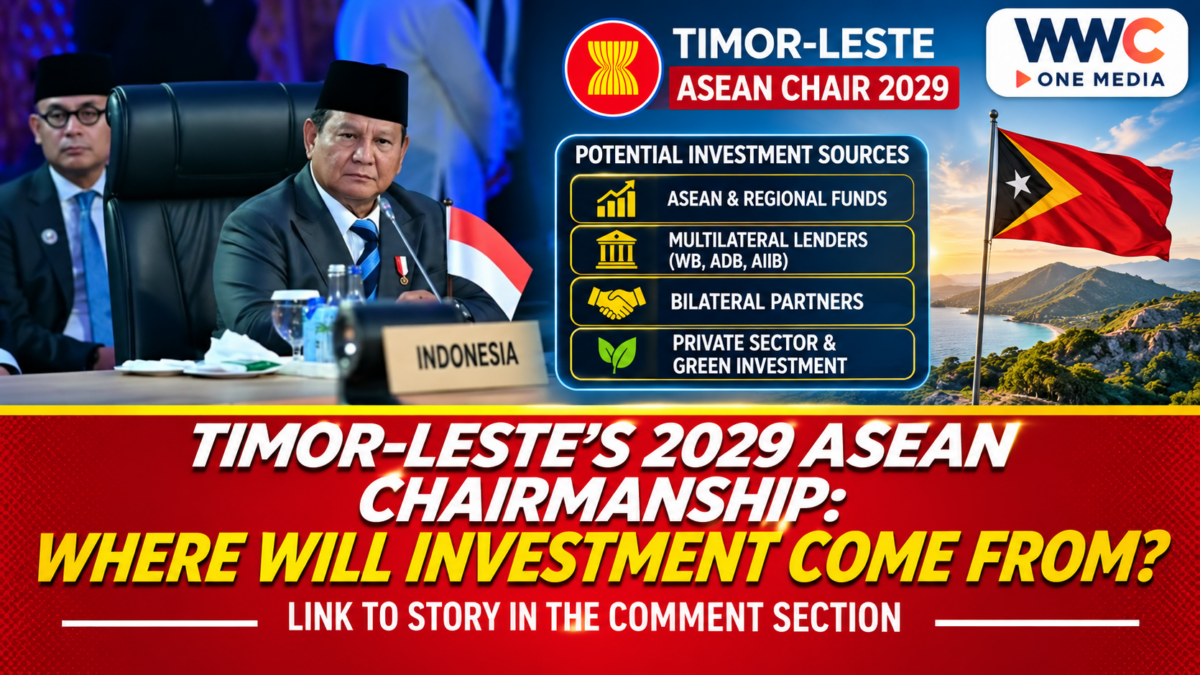
DILI, Timor-Leste — Nov. 21, 2026. Timor-Leste is preparing to lead ASEAN in 2029 after regional leaders formally confirmed its chairmanship at the November summit in Manila. Its government has also approved an economic integration roadmap, raising a practical question for Timor-Leste ASEAN chairmanship preparations: how will regional ambitions become financed projects and functioning public institutions?
The official decisions establish responsibilities and a timetable, but they do not by themselves secure private investment. Separately, Impact Investment Exchange (IIX) has documented financing instruments aimed at social and environmental outcomes. That experience offers a useful comparison, not proof of a signed investment programme in Timor-Leste.
Timor-Leste ASEAN Chairmanship Is Now Confirmed
At the 49th ASEAN Summit in Manila, regional leaders formally confirmed that Timor-Leste would chair the organisation in 2029. The government’s account says the ASEAN Coordinating Council endorsed the arrangement on Nov. 14 and that the leaders confirmed it at the Nov. 15 plenary.
This is more specific than a general expression of readiness. The country joined ASEAN as its eleventh member on Oct. 26, 2025, and is now working toward a scheduled leadership role only a few years after accession.
Chairing ASEAN involves organising meetings, coordinating negotiations and advancing collective priorities. It does not mean the chair can impose national economic policies on other member states or guarantee investment from them.
For background on the organisation’s structure, WWC’s explainer on ASEAN and its eleven members describes how regional cooperation involves governments with distinct legal and economic systems.
An Economic Roadmap Gives the Ambition a Framework
On Oct. 21, Timor-Leste’s Council of Ministers approved a National Roadmap for the Implementation of ASEAN Economic Commitments for 2026–2030. The government described a coordination framework with 19 sectoral strategic action plans covering 2026–2030 and 19 sectoral work plans for 2026–2027.
The roadmap assigns implementation duties to relevant ministries and public bodies. The Ministry of Foreign Affairs and Cooperation, coordinated through the vice minister responsible for ASEAN affairs, is charged with overall monitoring and consolidation of progress.
Government bodies are expected to provide regular implementation reports that identify achievements, obstacles and proposed responses. The announcement does not specify that each planned reform has already been completed.
Analysis: A roadmap with responsibilities and reporting requirements offers a better test of implementation than a broad investment pledge. Its value will depend on whether progress reports describe measurable changes and outstanding barriers.
Why Impact Investment Has Entered the Discussion
Impact investment seeks financial returns alongside specified social or environmental outcomes. The concept is distinct from an unconditional grant or a government procurement contract: investors generally expect a financial structure, defined risks and an account of the intended impact.
IIX identifies Professor Durreen Shahnaz as its founder and chief executive. Its published Women’s Livelihood Bond 7 materials record US$92 million raised through two tranches, including an issuance in May 2026. The financing spans several countries and sectors aimed at women’s economic resilience and environmental sustainability.
Those figures belong to the IIX financing programme; they are not a commitment to Timor-Leste. The public documents examined do not identify an IIX bond tranche earmarked for Timor-Leste or a signed government financing agreement arising from the reported November discussion.
A possible future partnership would need to identify investable projects, counterparties, appropriate protections and funding terms. The existence of a successful financing product elsewhere does not ensure the same result in a new market.
ASEAN Integration Requires More Than Summit Meetings
The Timorese government held an interministerial coordination meeting on Oct. 26 alongside a meeting of its National Advisory Council for the Organisation of the ASEAN Chairmanship. The meetings reviewed the country’s integration process, organisational readiness and potential priority economic deliverables for 2029.
These are practical administrative tasks. A country preparing to chair a regional organisation needs institutions capable of following up on technical commitments while managing meetings and diplomatic responsibilities.
WWC’s report on Prime Minister Xanana Gusmão’s Manila visit and Timor-Leste’s regional role examines a different aspect of the country’s transition into full ASEAN membership. That diplomatic milestone should not be confused with confirmation of new commercial investment.
Analysis: Investors assessing a new market may pay attention to regulatory clarity, payment systems, project documentation and government follow-through. Better regional integration can improve the setting for investment, but no official record reviewed here quantifies how much new capital will result.
What Would Count as a Real Investment Deal?
A discussion between officials and finance specialists is an early-stage activity. A memorandum could signal interest, while an announced financing vehicle could specify intended sectors. Neither alone confirms that money has reached a project or that a project has delivered results.
A more reliable sequence would include a named implementing institution, an agreed financing amount, contractual terms, clear use of proceeds and subsequent reporting. Where public money is involved, published government approvals and procurement records would provide additional accountability.
The distinction also matters for ASEAN’s parliamentary engagement. WWC’s coverage of the AIPA leadership handover and resolutions in Manila describes regional policy cooperation in another institution; parliamentary resolutions are not themselves project disbursements.
Timor-Leste’s newly confirmed chairmanship creates a deadline for administrative readiness. It does not convert the financing proposals under discussion into secured investments.
What Happens Next
The most useful forthcoming records will be government progress reports under the 2026–2030 roadmap, updates from the chairmanship preparation council and any contracts or financing disclosures that identify specific projects.
If IIX or another investment organisation formally enters a financing arrangement involving Timor-Leste, the amount, beneficiaries and implementation obligations should be checked against the original documents. For now, the official record proves the 2029 chairmanship and roadmap, not a completed new impact-investment deal.
Frequently Asked Questions
1. Will Timor-Leste chair ASEAN in 2029?
Yes. Timor-Leste’s government confirmed that ASEAN leaders approved the 2029 chairmanship at their November 2026 summit in Manila.
2. What is Timor-Leste’s ASEAN economic roadmap?
It is a government framework for carrying out economic integration commitments from 2026 to 2030, supported by 19 sectoral strategic plans and 19 shorter-term work plans.
3. What does impact investment mean?
It is financing structured to seek financial returns alongside measurable social or environmental outcomes. It does not automatically mean a government has received funding.
4. Did IIX announce a new US$92 million investment in Timor-Leste?
No. The US$92 million figure relates to IIX’s Women’s Livelihood Bond 7 programme. The reviewed records do not assign that amount to Timor-Leste.
5. What needs to happen before a new investment can be confirmed?
An identifiable agreement or financing disclosure should establish the parties, amount, project purpose and conditions. Later implementation reports would show whether funds reached their intended uses.