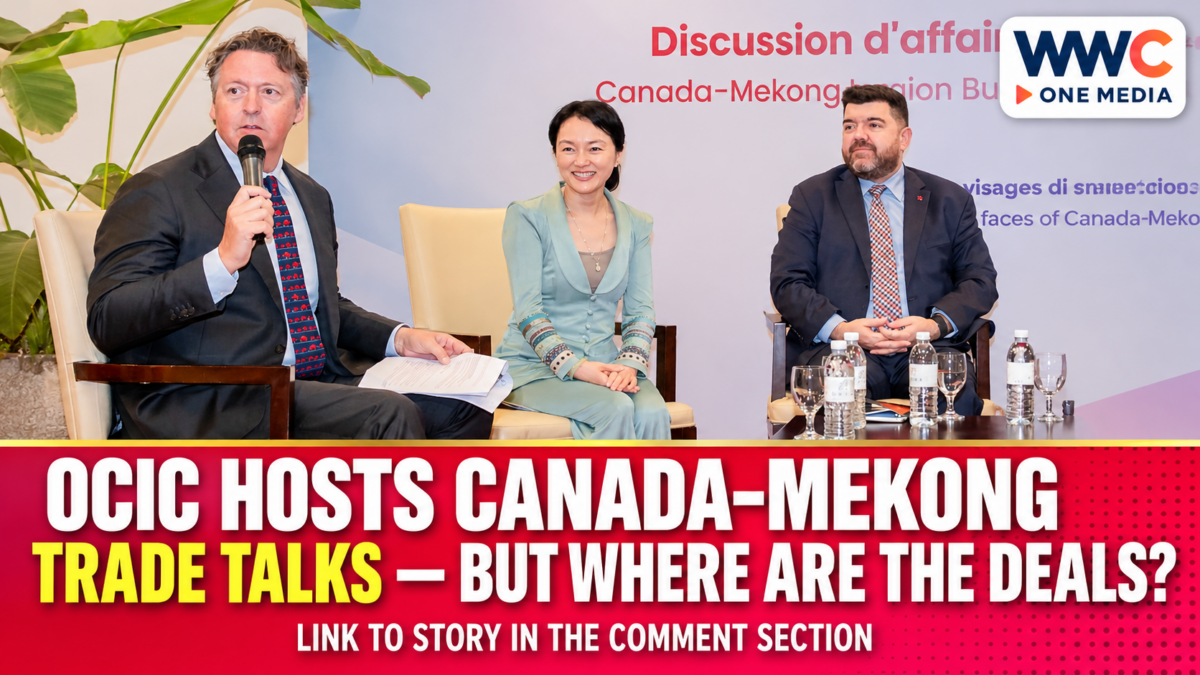
PHNOM PENH, Cambodia — Overseas Cambodian Investment Corporation (OCIC) hosted a Canada–Mekong business roundtable at Connexion Koh Pich on Nov. 14, 2026, bringing Canadian and regional business representatives together to examine trade, investment and commercial partnerships. Organised by the Canada-ASEAN Business Council (CABC) in cooperation with the Canadian Chamber of Commerce in Cambodia, the gathering took place during a week of international diplomatic and business meetings in Phnom Penh.
The event highlighted opportunities in infrastructure, energy, agriculture, manufacturing and technology. But its significance depends on a more demanding measure: whether discussions among companies, financial institutions and government representatives eventually translate into identifiable investment commitments and operating businesses.
Canada Mekong Trade Talks Put Local Partnerships First
The meeting took place at the Innovation Lab inside Connexion, a development on Koh Pich that OCIC promotes as a venue for business collaboration and innovation.
Its participants included Cambodia’s Senior Minister Dr Chhem Kieth Rethy and Canada’s Foreign Affairs Minister Anita Anand.
OCIC Vice-Chairperson Carolyne Pung participated in the business discussion, while OCIC Vice-President Thierry Tea presented Connexion’s role in connecting international companies with Cambodian enterprises and startups.
The programme examined what investors need when entering unfamiliar markets, including dependable local partnerships, market knowledge and access to relevant business networks.
These concerns matter because commercial opportunities do not become viable merely because a foreign company identifies demand. Businesses must still assess operating costs, regulation, customer requirements and financing before committing capital.
For Cambodia, the discussion offered a platform to explain where foreign expertise might complement domestic enterprise development.
Canada’s Existing Cambodia Trade Relationship Gives Talks Weight
The commercial relationship already has considerable scale.
Government of Canada trade records value bilateral merchandise trade with Cambodia at C$3.1 billion in 2025, compared with C$2.4 billion in 2024.
Canadian merchandise imports from Cambodia reached approximately C$3 billion in 2025, with apparel, footwear and furniture among the principal product categories.
Canadian exports to Cambodia totalled C$60.2 million that year. The figures show a trading relationship in which Cambodian merchandise exports account for the overwhelming majority of recorded bilateral goods trade.
Canada also reported C$3.8 billion in Canadian direct investment abroad in Cambodia in 2025.
These figures provide economic context for the roundtable, but they should not be interpreted as investments generated by the November meeting.
Canada’s diplomatic footprint has expanded as well. Its mission in Phnom Penh became a full embassy in March 2025, reinforcing an established relationship that spans trade, development and regional cooperation.
The challenge now is to deepen commercial activity beyond existing trade flows.
Why the ASEAN–Canada Agreement Matters
The Phnom Penh gathering coincided with a major development in Canada’s wider Southeast Asian trade strategy.
On Nov. 15, ASEAN and Canada announced the substantial conclusion of negotiations for the ASEAN–Canada Free Trade Agreement during the 49th ASEAN Summit in Manila.
Negotiations began in November 2021. The proposed agreement comprises 25 chapters covering areas such as goods, services, investment, customs procedures, financial services, e-commerce and sustainable development.
The milestone is important, but it does not mean the agreement has already entered into force.
The negotiating parties must complete the remaining steps before businesses can use any new preferential arrangements.
For investors, this distinction affects practical decisions. A proposed reduction in trade barriers cannot be treated as an existing benefit until the relevant provisions become legally effective.
WWC’s earlier examination of the Philippines–Canada free trade agreement addresses the same implementation challenge from the perspective of Philippine exporters.
The regional agreement could eventually improve commercial predictability. Its actual value, however, will depend on final rules, implementation and how businesses use them.
What the Roundtable Could Mean for Mekong Investment
The Canada–Mekong programme identified infrastructure, energy, agri-food, manufacturing and technology as potential areas for cooperation.
These industries require different forms of investment and partnership.
Infrastructure projects may depend on financing structures, permits and long development periods. Manufacturers need dependable suppliers, logistics networks and competitive production conditions.
Agricultural businesses face additional questions involving product standards, processing capacity, transport and access to customers.
Technology partnerships can involve digital infrastructure, software capabilities, technical training and local enterprise development.
What this could mean: The meeting’s strongest contribution may be helping companies identify viable partners before making larger commitments.
That interpretation is consistent with the wider investment challenge facing Southeast Asia.
WWC’s analysis of shifting ASEAN supply chains and investment competition explains why countries need more than investor attention to secure lasting industrial opportunities.
A useful commercial outcome would be a partnership with a defined project, funding arrangement, timetable or measurable business objective.
The official event announcements reviewed did not establish that the roundtable itself produced a specified investment total or a completed commercial contract.
Business Networks Gain a Longer-Term Framework
The discussions were accompanied by a separate institutional development.
CanCham Cambodia reported that it and the Canada-ASEAN Business Council formalised cooperation through a memorandum of understanding during summit week.
CABC Executive Director for ASEAN Geoff Donald and CanCham Chairwoman Yein Ngo were identified as the signatories.
The agreement establishes a framework for linking business networks, sharing expertise and supporting commercial engagement involving Canada, Cambodia and the wider ASEAN region.
It is a cooperation arrangement between business organisations, not proof that any particular investment has been completed.
Its significance will be determined by subsequent activity, including business introductions, commercial projects and support for companies seeking to operate across borders.
The broader question of market access is also relevant to Philippine enterprises. WWC has examined whether trade partnerships with Canada can expand Philippine agricultural exports, illustrating how international opportunities still require practical follow-through.
What Happens Next
Three developments will help determine whether the Phnom Penh discussions produce meaningful commercial results.
First, companies and business councils may disclose specific partnerships or investment projects arising from their engagement.
Second, ASEAN and Canada must advance the trade agreement from the negotiation milestone towards signing and eventual implementation.
Third, businesses will need to demonstrate whether new contacts lead to procurement, production, service delivery or investment activity.
The official record confirms that the roundtable took place and that participants identified several areas for cooperation. It does not establish that substantial new investment was secured during the event.
For OCIC, Cambodia and Canadian investors, the next measure of success will therefore be commercial execution rather than the number of meetings held.
Frequently Asked Questions
What was the Canada–Mekong business roundtable?
It was a Nov. 14, 2026, business gathering in Phnom Penh organised by the Canada-ASEAN Business Council in cooperation with CanCham Cambodia and hosted by OCIC. It focused on potential trade and investment partnerships.
Where was the OCIC business roundtable held?
The meeting took place at the Innovation Lab at Connexion Koh Pich in Phnom Penh, Cambodia.
Which industries were discussed?
The programme covered infrastructure, energy, agri-food, manufacturing, technology and innovation, alongside market entry and local business partnerships.
Has the ASEAN–Canada Free Trade Agreement taken effect?
No. ASEAN and Canada announced the substantial conclusion of negotiations in November 2026, but further steps are necessary before the agreement can enter into force.
Did the roundtable result in confirmed investment deals?
The official announcements reviewed describe discussions, networking and institutional cooperation. They do not identify a completed commercial contract or a specific investment amount resulting from the roundtable.