
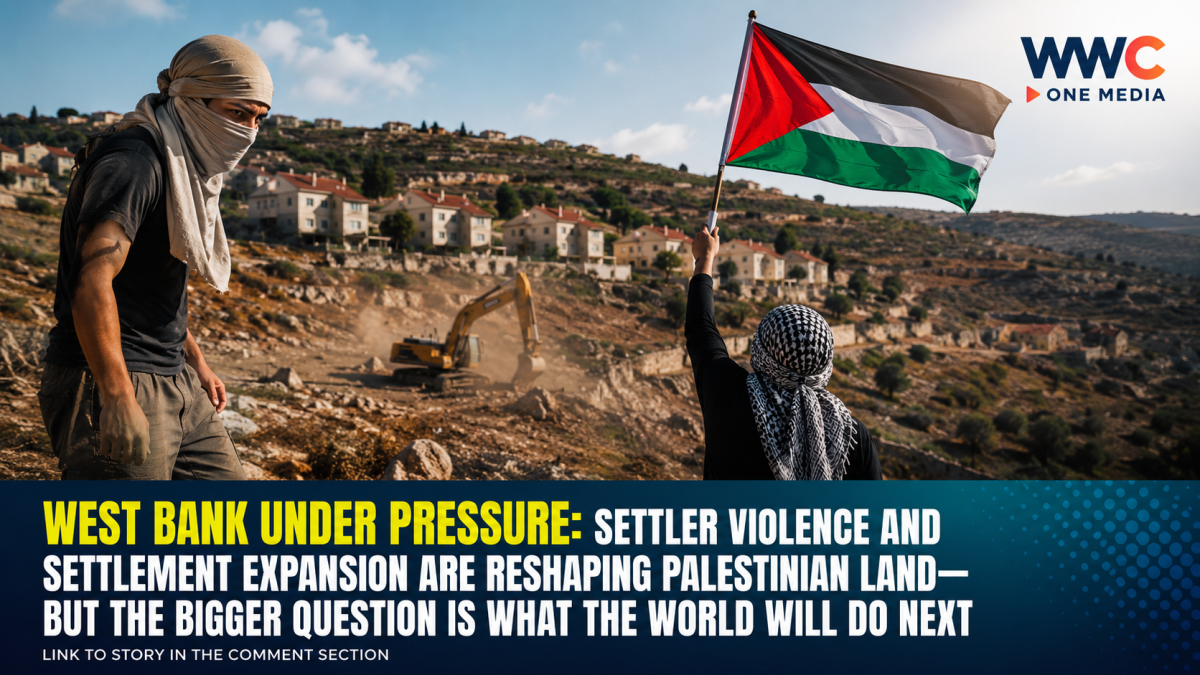
WEST BANK — The war in Gaza may dominate international headlines, but another conflict is intensifying just a few dozen kilometers away.
Across the occupied West Bank, Palestinian communities are facing a growing combination of settler violence, military raids, settlement expansion, demolitions and displacement—raising increasingly urgent questions about whether the territory is being permanently transformed before diplomacy can catch up.
An Asia Times analysis published September 3 described the West Bank as the Middle East’s “orphan war,” arguing that international governments have repeatedly condemned Israeli settlement activity and violence while struggling to translate those objections into effective action.
Recent developments suggest the issue is becoming harder to ignore.
TWO PALESTINIAN TEENS KILLED
On September 2, two Palestinian teenagers, aged 16 and 19, were killed during an incident involving Israeli settlers and soldiers in the village of al-Mughayyir near Ramallah, according to Palestinian officials and the Palestinian Health Ministry.
Reuters reported that the Israeli military said its forces had entered the area to provide security for police officers and an Israeli civilian attempting to recover livestock.
The military said troops fired at what it described as “key instigators” during what it called a violent disturbance involving stone-throwing. The incident is under investigation.
The killings came amid a broader increase in settler violence.
Reuters reported that violence has intensified following a siege of the Palestinian village of Qusra in August, while rights groups say the expansion of Israeli settlements and outposts is increasingly affecting Palestinian communities and territory claimed for a future Palestinian state.
A PATTERN BEYOND INDIVIDUAL ATTACKS
Human Rights Watch says the problem extends well beyond isolated confrontations.
In an August 20 report, the organization said settler attacks had fully or partially displaced 107 Palestinian communities involving about 5,900 people since January 2023.
It also reported that OCHA had recorded an average of 6.6 settler attacks per day during 2026 that resulted in casualties, property damage or both—a level higher than any year in OCHA’s records.
According to the same report, at least 15 Palestinians, including two children, had been killed by settlers by July 24, putting 2026 on track to exceed the previous OCHA record of 16 settler-attributed Palestinian killings in 2023.
The Israeli military, however, remains responsible for the majority of Palestinian deaths recorded in the West Bank, according to the data cited by Human Rights Watch.
That distinction matters.
The West Bank crisis involves both Israeli military operations and violence by Israeli settlers, although the circumstances and responsibility for individual incidents vary and must be established case by case.
FROM VIOLENCE TO DISPLACEMENT
Human Rights Watch says the consequences are not limited to injuries or deaths.
Its investigation documented attacks on Palestinian livelihoods, including restrictions on access to grazing land and water, livestock theft or killing, and destruction or burning of agricultural fields and crops.
The organization argues that these actions, combined with inadequate protection, can create what it calls a coercive environment in which Palestinians feel they have little choice but to leave their homes.
The Asia Times analysis makes a similar argument, describing attacks involving destruction of homes, agricultural property and water infrastructure as part of a wider pressure campaign on rural Palestinian communities.
But descriptions of motive remain politically and legally contested.
Israeli officials have rejected broad characterizations that portray all settlement activity or settler violence as part of a single coordinated campaign, while Prime Minister Benjamin Netanyahu has described violent settlers as extremists who do not represent the wider settler population.
SETTLEMENT EXPANSION ADDS ANOTHER LAYER
The dispute is not only about violence.
Settlement construction is also changing the geography of the West Bank.
Reuters reported this week that Britain is preparing a “comprehensive” package of measures in response to Israeli settlement plans.
British Foreign Secretary Ed Miliband specifically warned that the proposed E1 settlement project east of Jerusalem could cut across territory Palestinians seek for a future state and risk making a two-state solution unviable.
The development has also triggered renewed international concern because of its potential geographic consequences.
Human Rights Watch reported that Israel opened a new construction tender for the E1 project on August 18 and said the development could affect more than 18 Bedouin communities in the area.
Meanwhile, Israeli media reported on September 1 that two settlements were being established deeper inside Palestinian areas of the West Bank.
WHY THE WEST BANK MATTERS
The West Bank is not simply another front in the Israeli-Palestinian conflict.
It is central to the territorial basis of a potential Palestinian state.
The territory was captured by Israel during the 1967 Middle East war. Palestinians seek the West Bank, together with Gaza and East Jerusalem, as the basis for an independent state.
The expansion of settlements therefore has consequences beyond the individual communities directly affected.
Every new road, outpost or settlement can alter access to land, fragment Palestinian communities and complicate the possibility of establishing a contiguous Palestinian state.
That is why the issue has become increasingly prominent in international diplomacy.
THE INTERNATIONAL COMMUNITY IS WARNING — BUT WILL IT ACT?
The international response has become sharper.
The United Nations has repeatedly warned about settler violence and displacement.
Human Rights Watch has called for targeted sanctions against individuals implicated in serious abuses, restrictions on trade with Israeli settlements and the suspension of arms transfers to Israel.
Britain has now signaled that additional measures are being considered.
But the gap between diplomatic condemnation and concrete action remains one of the central questions surrounding the West Bank.
Israel continues to expand settlements and outposts despite international criticism, while Palestinians living near those developments face a deteriorating security and humanitarian environment.
The International Court of Justice also issued a major advisory opinion in July 2024 concerning Israel’s occupation of Palestinian territory. Human Rights Watch says the court concluded that the occupation is unlawful and addressed Israel’s obligations concerning settlements, settler violence and Palestinian displacement.
Israel has rejected the legal and political characterizations made against it and maintains that its security concerns must be taken into account.
A CONFLICT THAT RARELY MAKES THE FRONT PAGE
This is what makes the West Bank crisis particularly significant.
There is no single declaration of war.
There may be no dramatic battlefield dividing two armies.
Instead, the transformation can happen gradually: a settlement expands, an outpost appears, farmland becomes inaccessible, livestock disappears, a home is demolished, a family leaves—and another community becomes smaller.
That gradual process is precisely why rights organizations and Palestinian officials are raising the alarm.
And it is why the West Bank could become one of the most consequential—and least visible—battlegrounds in the wider Israeli-Palestinian conflict.
The question facing the international community is no longer simply whether settlement expansion and settler violence are occurring.
It is whether enough of the West Bank will remain politically and geographically viable for a Palestinian state if meaningful action comes too late.
WWC ONE MEDIA MJE




Leave a Reply