
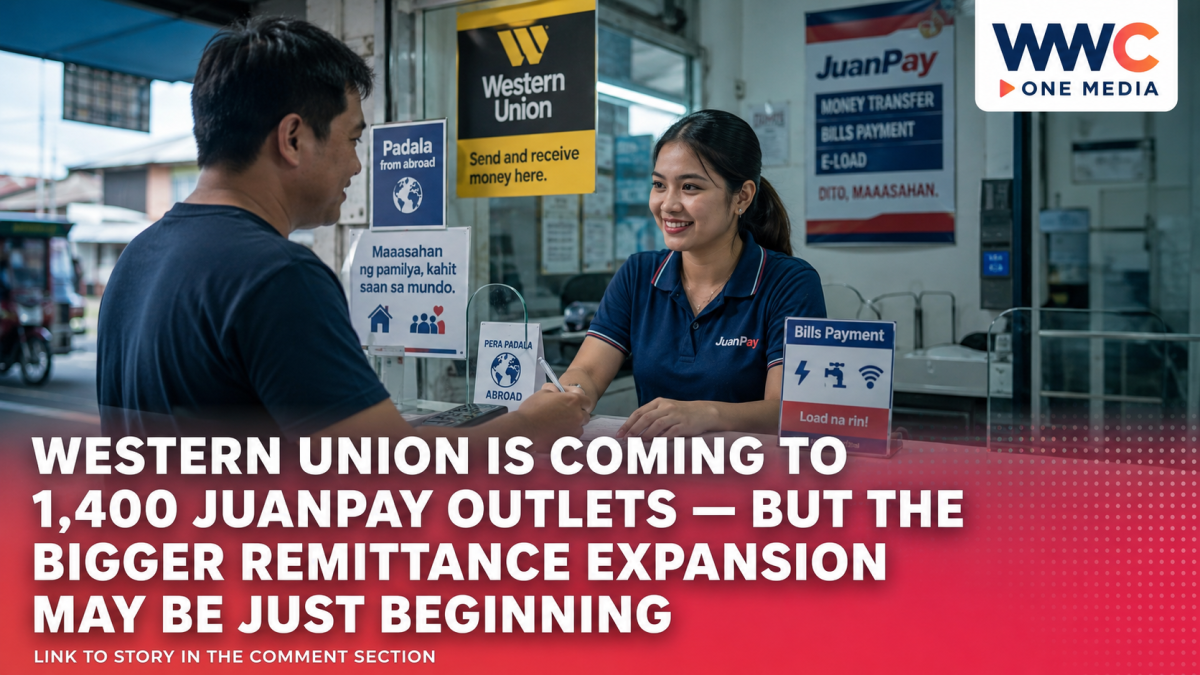
MANILA, Philippines — Western Union is making another major push into Filipino communities, teaming up with JuanPay to bring international money transfers to around 1,400 locations nationwide in the initial phase — with the partnership eventually targeting JuanPay’s broader network of roughly 2,000 owned and franchise-operated outlets.
The deal gives Filipinos another place to send and receive international remittances, particularly in provincial areas and communities with large numbers of families dependent on overseas Filipino workers.
But the significance of the partnership goes beyond adding another remittance counter.
It comes as billions of dollars continue to flow into Filipino households from workers overseas — and as remittance companies increasingly compete to make that money accessible not only through banks and apps, but through neighborhood financial-service outlets.
Western Union taps JuanPay’s community network
Under the partnership announced on September 2, Western Union’s international money-transfer services will initially be introduced across approximately 1,400 priority JuanPay locations.
JuanPay has a wider network of about 2,000 company-owned and franchise-operated outlets, and the companies said the Western Union service is expected to be progressively expanded across that network.
That distinction matters: the full 2,000-location network is the longer-term footprint, rather than the number of outlets necessarily offering Western Union services from day one.
Customers at participating locations will eventually be able to handle Western Union international transfers alongside services JuanPay outlets already provide, including bill and loan payments, government transactions and other consumer financial services.
The partnership combines JuanPay’s local retail presence with Western Union’s network covering more than 200 countries and territories.
Why provincial access matters
JuanPay, a subsidiary of ACM Group of Companies, has focused much of its network on provincial markets and communities with strong OFW connections.
That makes the partnership particularly relevant for families who may prefer cash transactions, need face-to-face assistance or do not have the same level of access to digital financial services available in major urban centers.
Western Union Asia-Pacific chief Vince Tallent said multi-service locations continue to play an important role as customers seek greater flexibility in how they access financial services.
The strategy also shows that the future of remittances in the Philippines may not be purely digital.
Despite rapid growth in mobile wallets and online transfers, physical outlets remain part of Western Union’s distribution strategy.
The company already allows eligible Philippine customers to receive transfers through options including cash pickup, bank accounts and mobile wallets, with supported wallets including GCash, Maya, USSC and PERA HUB.
The timing is significant: Filipinos are still receiving billions
The JuanPay expansion arrives against the backdrop of another strong year for overseas Filipino remittances.
According to the Bangko Sentral ng Pilipinas, cash remittances coursed through banks reached $3.04 billion in June 2026, the highest monthly level during the first half of the year.
From January through June, cash remittances totaled approximately $17.15 billion, up 2.4% from $16.75 billion during the same period in 2025.
Personal remittances — a broader measure that also captures other forms of transfers — reached about $19.12 billion during the first six months of 2026.
Those numbers underline why remittance accessibility remains commercially important.
For millions of Filipino households, money arriving from overseas is used for everyday spending including food, housing, education, medical needs and other expenses. Economists have repeatedly pointed to remittances as an important pillar supporting Philippine household consumption.
Where is the money coming from?
BSP data show the United States remained the largest reported source of cash remittances during the first half of 2026, followed by Singapore and Saudi Arabia.
Approximately $6.76 billion in reported cash remittances were attributed to the United States from January through June, while Singapore accounted for about $1.23 billion and Saudi Arabia for roughly $1.08 billion.
The BSP cautions, however, that country-of-origin figures have limitations because international transfers may pass through correspondent banks — particularly those in the United States — meaning the reported origin does not always indicate where the sender actually earned the money.
Western Union is expanding on several fronts
The JuanPay agreement is not happening in isolation.
Western Union has also been expanding its physical Philippine distribution network through other partners. In August 2026, the company announced an agreement with Cebuana Lhuillier that would add around 2,500 locations capable of handling Western Union money-transfer services as the rollout proceeds.
At the same time, Western Union has been developing its digital presence. Its upgraded Philippine mobile app, launched in October 2025, introduced expanded send-and-request capabilities.
Together, the moves point to a hybrid strategy: compete in apps and mobile wallets while simultaneously increasing the number of physical places where customers can transact.
What JuanPay gets from the deal
For JuanPay, Western Union adds a global cross-border product to a network already built around everyday financial and consumer transactions.
ACM Group chairman Rico Fernando Chico said JuanPay’s goal has been to bring essential financial services closer to Filipino communities, describing the partnership as a combination of Western Union’s global connectivity and JuanPay’s community-based distribution model.
That could give JuanPay outlets another reason for customers to visit while strengthening the company’s position as a multipurpose neighborhood financial-services provider.
The bigger battle is about convenience
For decades, remittance competition centered largely on price, reliability and the number of payout locations.
Today, the battleground is broader.
Consumers can receive money through bank accounts, electronic wallets, dedicated remittance companies and traditional cash-pickup locations. Companies therefore have to compete not simply on whether they can deliver money, but on where, how quickly and how conveniently customers can access it.
That is where the Western Union-JuanPay partnership could become more important than its initial 1,400-location rollout suggests.
If Western Union services ultimately reach JuanPay’s full network of roughly 2,000 locations, more Filipino communities — particularly outside major business districts — could gain another nearby gateway to the global remittance system.
And with more than $17 billion in OFW cash remittances already entering the Philippines during just the first half of 2026, the race to become the most convenient last mile for that money is far from over.
WWC ONE MEDIA MJE




Leave a Reply