
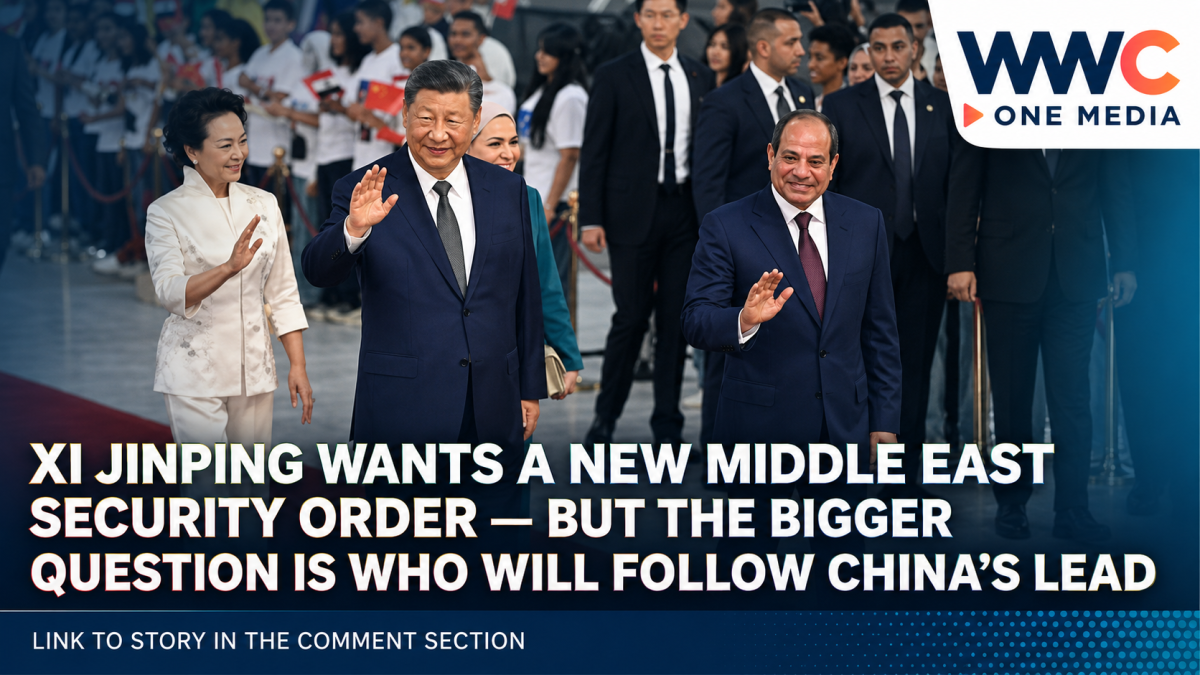
CAIRO — Chinese President Xi Jinping is using his first visit to Egypt in a decade to promote something far bigger than closer relations with Cairo: a new vision for how security in the Middle East should be organised.
Meeting Egyptian President Abdel Fattah al-Sisi on September 2, Xi urged countries across the region to take greater control of their own security arrangements, reduce dependence on outside powers and explore what Beijing describes as a new regional security architecture.
The proposal comes at an unusually volatile moment for the Middle East. Months of war involving the United States and Iran have disrupted shipping and energy flows, shaken regional economies and forced several governments to reconsider how heavily they should depend on Washington for their long-term security.
Xi’s message was unmistakable: Middle Eastern governments should have a greater say in determining the region’s future.
According to Xinhua, Xi presented a four-point proposal built around regional ownership, comprehensive solutions to interconnected conflicts, economic development as a foundation for stability and stronger international coordination under the United Nations and international law.
China’s position is particularly significant because Beijing is no longer approaching the Middle East purely as an energy customer or commercial partner. It is increasingly positioning itself as a diplomatic actor capable of participating in regional security discussions that were once dominated overwhelmingly by the United States.
China wants Middle Eastern states driving the security agenda
Xi argued that Middle Eastern countries should remain the “masters of their own affairs” and that outside interference should be resisted. Beijing says regional governments should strengthen direct dialogue on security and build mechanisms capable of resolving disputes without depending exclusively on external military powers.
The proposal also treats the region’s conflicts as interconnected rather than isolated crises.
Xi specifically identified the Palestinian issue as remaining at the heart of the wider Middle East question and argued that it cannot be sidelined if governments hope to achieve lasting stability.
Both China and Egypt subsequently backed diplomatic efforts aimed at reducing tensions and said political dialogue should play a central role in resolving regional conflicts.
Shipping security is becoming part of Beijing’s strategy
One of Xi’s most consequential offers involved maritime trade.
China said it was prepared to cooperate with Middle Eastern countries to protect international shipping lanes, which have become increasingly vulnerable as instability disrupts traffic through critical waterways including the Strait of Hormuz and Bab al-Mandeb.
For Beijing, this is not an abstract security issue.
China is one of the world’s biggest energy importers, making uninterrupted access to Middle Eastern oil and maritime trade routes strategically important to its economy.
Egypt therefore occupies an unusually powerful position in China’s calculations.
It controls the Suez Canal, one of the world’s most important commercial shipping arteries and an increasingly important alternative route as disruption affects other Middle Eastern waterways. AP noted that the canal’s importance has grown as oil traffic through the Strait of Hormuz has faced severe disruption.
Egypt is balancing Washington and Beijing
Cairo’s growing relationship with China does not necessarily mean Egypt is abandoning its longstanding partnership with the United States.
Egypt remains one of Washington’s major defence partners and receives roughly $1.3 billion in annual U.S. military assistance. But Sisi has increasingly pursued what Egyptian officials describe as a policy of strategic balance — maintaining relations with Washington while expanding ties with China, Russia and other major powers.
That diversification is becoming visible in military cooperation.
China and Egypt recently conducted the “Eagles of Civilization” exercises, including an unusual air combat drill involving Chinese J-16 fighter jets and Egypt’s French-built Rafales. Reuters and AP both highlighted the exercises as evidence that defence relations are moving beyond symbolic diplomacy.
The two governments also agreed during Xi’s visit to deepen security and counterterrorism cooperation.
The economic relationship is getting much larger
Security was only one part of Xi’s Cairo agenda.
China has become an increasingly important economic partner for Egypt. Reuters reported that Egypt imported about $10 billion worth of Chinese goods during the first half of 2026, while AP cited government estimates placing annual bilateral trade at roughly $20 billion.
Chinese investment now stretches across ports, manufacturing, transport infrastructure, green hydrogen and industrial projects.
Egypt says the Suez Canal Economic Zone alone has attracted around $4 billion in Chinese investment. During Xi’s visit, Egyptian officials announced plans to expand a Chinese-developed industrial zone, while China’s ZC Rubber Group signed a preliminary agreement to examine a $500 million tyre manufacturing project.
Beijing and Cairo also agreed to expand cooperation in strategically important sectors including data centres, semiconductors and critical-mineral supply chains, while encouraging greater use of their own currencies in bilateral trade and investment.
Xinhua said the visit produced more than 20 cooperation documents covering areas including the digital economy, artificial intelligence, science and technology, education, transportation, trade and industrial supply chains.
China has been preparing for a bigger Middle East role
Beijing’s latest proposal did not emerge from nowhere.
China scored a major diplomatic success in 2023 when it helped broker the restoration of diplomatic relations between Saudi Arabia and Iran, demonstrating that Beijing was prepared to play a direct role in resolving one of the region’s most important rivalries.
China has also consistently backed a two-state solution to the Israeli-Palestinian conflict while cultivating economic relationships with countries that sit on opposing sides of regional disputes.
This allows Beijing to promote itself as a potential diplomatic partner without replicating the enormous permanent military footprint Washington has built across the region.
Whether Middle Eastern governments are prepared to translate that diplomatic engagement into a genuinely new security structure, however, is far less certain.
The bigger geopolitical question
Xi’s proposal is therefore about more than China-Egypt relations.
Egypt gives Beijing something strategically valuable: a population exceeding 110 million, control of the Suez Canal, access to African and Arab markets and considerable diplomatic influence over issues ranging from Palestine to regional security.
AP described Xi’s visit as part of a wider Chinese effort to establish Beijing as a stabilising force while expanding its influence with countries that have traditionally relied heavily on the United States.
But there is an important distinction between proposing a new security architecture and actually building one.
Middle Eastern governments maintain very different alliances, threat perceptions and relationships with Washington, Beijing and one another. China can offer investment, trade, diplomacy and potentially deeper defence cooperation, but replacing — or even significantly reducing — decades of U.S.-centred security arrangements would be a much larger undertaking.
For now, Xi’s Cairo visit shows that Beijing wants a seat at that table.
And as wars, shipping disruptions and geopolitical uncertainty push governments across the Middle East to reconsider old assumptions, the more important question may no longer be whether China wants a larger regional role.
It is how many Middle Eastern governments are prepared to give it one.
WWC ONE MEDIA MJE
Leave a Reply