
CEBU CITY, Philippines — The race to make housing more affordable in Central Visayas is facing a growing list of obstacles—from expensive land and construction costs to financing, infrastructure and regulatory requirements.
Now, property developers are asking government agencies and local officials to work more closely with the private sector on reforms they say could help bring down development costs and speed up the delivery of new homes.
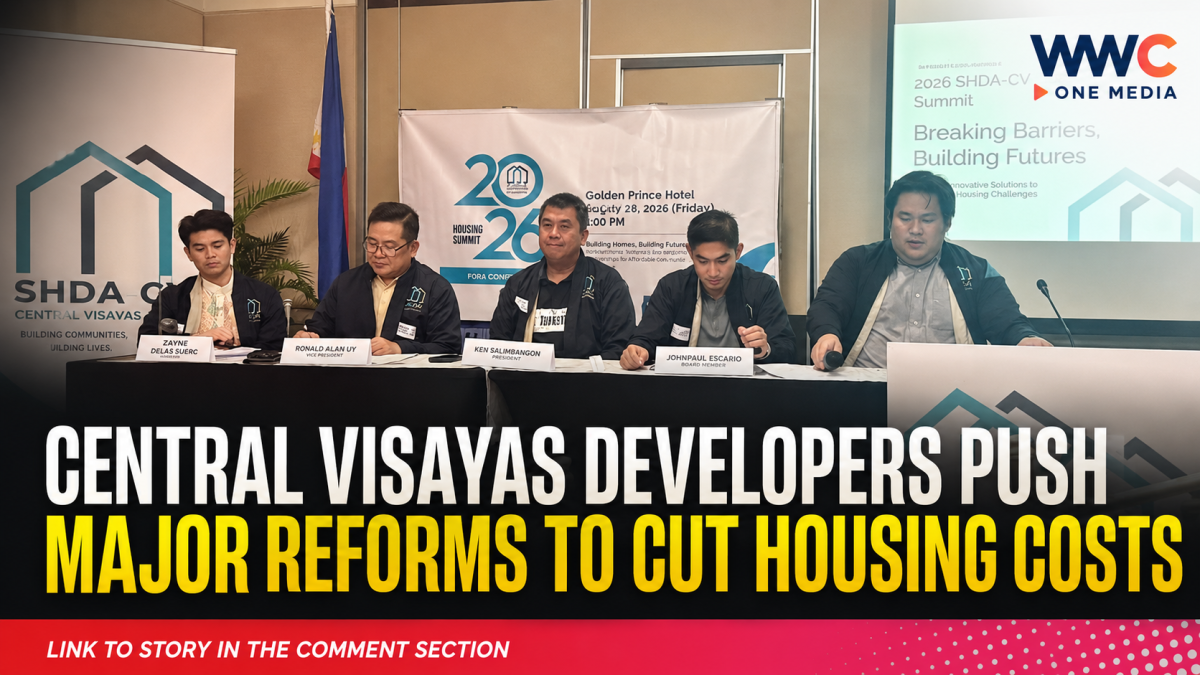
The issue is expected to take center stage at the Housing Summit 2026 on September 11 in Cebu, organized by the Subdivision and Housing Developers Association (SHDA) Central Visayas.
The summit is expected to bring together developers, government agencies, construction companies, urban planners, utility providers and academics to discuss ways to remove bottlenecks affecting housing production.
Why housing affordability is becoming a bigger problem
The pressure is particularly serious in Metro Cebu, where housing prices have continued to outpace what many low- and middle-income households can comfortably afford.
A Central Visayas regional development report said Metro Cebu’s median housing price reached about ₱3.4 million, while condominium prices have also recorded significant increases. The report warned that rising housing prices, combined with the cost of basic goods, could push homeownership further out of reach for many families.
The problem is not simply a lack of demand.
Developers say they are also dealing with higher land prices, construction expenses, financing costs, permitting requirements and the need to secure reliable power, water and other infrastructure before communities can expand.
Recent Philippine Statistics Authority data show just how significant construction costs remain. In May 2026, the average construction cost for residential buildings in Central Visayas was estimated at ₱12,393.23 per square meter. Residential condominiums were considerably more expensive, averaging ₱17,794.26 per square meter.
Developers want cheaper financing
One of the proposals being pushed by SHDA Central Visayas is greater access to lower-cost financing.
Harold Vince See, an SHDA Central Visayas board member, suggested that government financial institutions—including the Development Bank of the Philippines, Land Bank of the Philippines and Pag-IBIG Fund—could consider preferential interest rates for qualified housing developers or projects, provided affordability requirements are met.
The argument is straightforward: if developers can reduce their financing expenses, some of those savings could eventually be reflected in the selling prices of homes.
Developers are also looking at government participation in land acquisition.
In expensive urban areas such as Cebu City, the rising price of developable land can make affordable housing projects increasingly difficult to pursue. One proposal is for government to play a larger role in providing land while private developers concentrate on construction and project delivery.
Cebu’s housing demand is spreading outward
Another issue is where new homes should be built.
SHDA Central Visayas President Ken Salimbangon said housing development should not remain concentrated in the region’s major urban centers.
Cebu City continues to attract workers from other parts of Cebu and neighboring islands because of employment and investment opportunities. That migration creates additional demand for housing, even as land prices inside the city make affordable developments more difficult.
Developers therefore want stronger coordination with local governments on zoning, land-use planning, drainage, roads, utilities and emerging growth corridors.
The concern is that communities could expand faster than the infrastructure supporting them.
Regional planning data have also identified weak or outdated local housing plans as a major challenge. The Central Visayas regional report noted that many local government units either lack current Local Shelter Plans or are operating with plans whose planning periods have already expired.
LTS issue becomes a major point of contention
Among the industry’s biggest concerns is the processing of Licenses to Sell (LTS), which developers need before marketing certain housing projects.
SHDA officials have said delays in obtaining licenses have prevented some developers from launching projects, adding to the pressure created by rising costs.
But there is an important distinction.
DHSUD-7 has disputed the idea that broad regulatory delays are solely responsible for the slowdown.
In June, DHSUD-7 Director Mark Anthony Lindugan said the regional office had only two pending LTS applications at that time and that both were already in the final stages of processing.
In August, DHSUD-7 further said that pending licenses involving Cebu Landmasters Inc. were connected to incomplete submissions, regulatory discrepancies and other documentary or technical deficiencies—not simply agency delays.
That disagreement highlights a larger issue facing the housing sector: developers want faster and more predictable approvals, while regulators continue to emphasize compliance and complete documentation.
Property valuation could add another layer of pressure
Developers are also watching the implementation of the Real Property Valuation and Assessment Reform Act (RPVARA).
The industry is concerned that changes in property valuation could eventually affect real property taxes and other costs associated with owning and developing real estate.
For affordable housing, even relatively small increases in development or ownership expenses can matter because buyers in the segment are highly price-sensitive.
At the same time, developers say they need policies that allow them to remain financially viable while producing homes that ordinary Filipino families can afford.
The housing shortage remains enormous
The affordability problem comes against the backdrop of a significant housing shortage in Central Visayas.
Regional planning data have previously estimated the region’s housing gap at more than 420,000 units, underscoring the scale of the challenge.
The latest regional assessment also found that only 819 socialized housing units were constructed across Central Visayas in 2025, a figure described as inadequate relative to the region’s needs.
The problem is particularly acute in Metro Cebu.
Regional planning documents said the housing needs of each of the seven Metro Cebu local government units with updated planning documents exceed 5,000 units, with Cebu City alone facing a reported need of 64,353 units.
Government is also considering housing reforms
The industry’s call for faster and cheaper housing is occurring alongside broader national housing reforms.
In August, the House of Representatives approved on third and final reading House Bill 9697, which seeks to expand land, financing and partnership options for socialized housing.
Among its proposed measures are one-stop shops, simplified accreditation and a target of issuing complete permits, licenses and clearances within 90 days for qualified projects. The bill also proposes allowing developers to meet socialized-housing obligations through new settlements, joint ventures, community mortgage projects or housing-related payments.
Meanwhile, government has already updated the price ceiling for socialized housing. Under the new rules, the maximum selling price is ₱950,000 for a socialized house-and-lot package and ₱1.8 million for a socialized condominium unit.
The bigger question: Can reforms actually lower home prices?
For Central Visayas developers, the issue is no longer simply about building more houses.
It is about whether homes can be built quickly enough, cheaply enough and at a scale large enough to meet demand without sacrificing quality or consumer protection.
Recent construction data show that the region’s developers are already operating under pressure. During the first quarter of 2026, the value of approved construction projects in Central Visayas fell 12.8% year-on-year to ₱6.47 billion, even though the number of approved building permits increased by 7.4%.
That combination suggests that more permits do not necessarily translate into stronger construction activity or greater housing supply.
The SHDA summit on September 11 could therefore become an important test of whether government and industry can move beyond identifying problems and agree on concrete solutions.
The proposals on the table—faster approvals, lower-cost financing, greater access to land, updated planning, stronger infrastructure coordination and clearer implementation of housing policies—all point toward the same objective:
getting more affordable homes into the hands of Filipino families before rising costs push homeownership even further out of reach.
WWC ONE MEDIA MJE



Leave a Reply