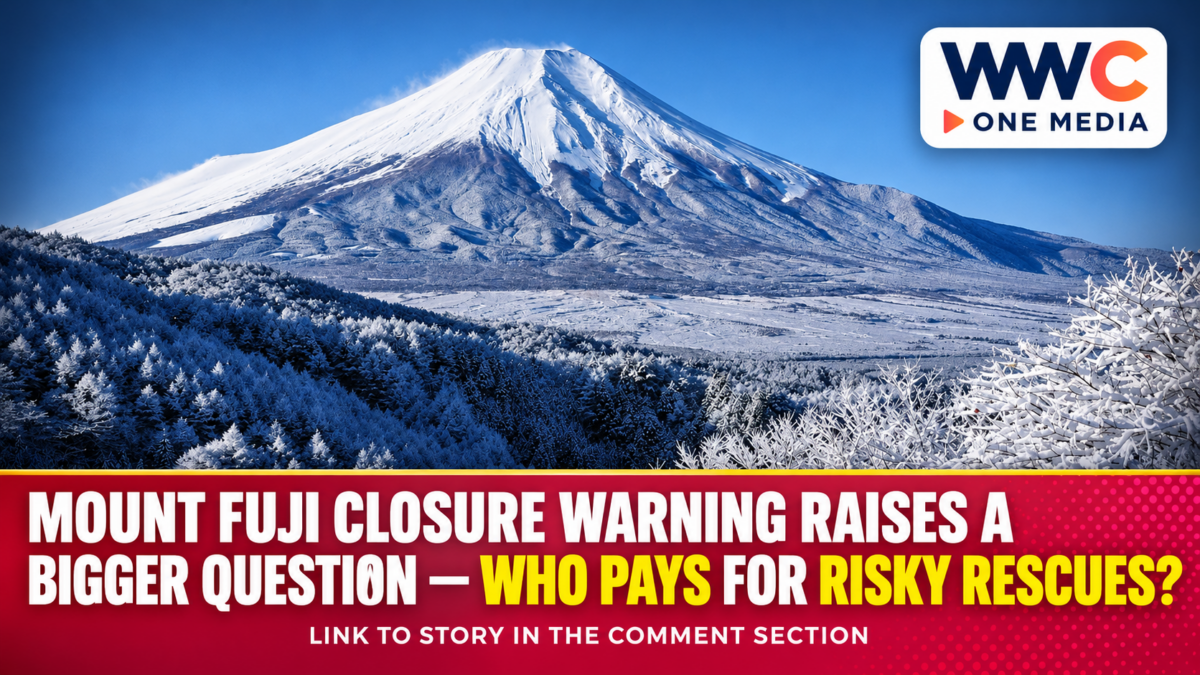
TOKYO, Nov. 21, 2026 — China’s embassy in Japan has warned its citizens against climbing Mount Fuji during its closed season after a Chinese visitor went missing on the mountain. The warning, published on Nov. 17, comes as Japan’s Yamanashi Prefecture considers making certain off-season helicopter rescues chargeable from the 2027 closure period.
The developments raise a question: how can authorities discourage dangerous climbs while maintaining emergency rescue?
Mount Fuji closure: what the embassy confirmed
The Chinese embassy said one Chinese visitor had gone missing while climbing Mount Fuji during the period when summit routes are closed. It said officials contacted Japanese police, repeatedly requested search-and-rescue efforts and assisted the visitor’s family.
The embassy’s Nov. 17 statement did not identify the missing person, give an age or specify the date and precise location of the disappearance. It also did not announce a confirmed outcome of the search. Those details should not be assumed from the warning alone.
The embassy highlighted strong winds, snowstorms and the shutdown of mountain facilities during the closed season. It urged citizens to observe restrictions rather than attempt a summit climb after the permitted season.
With rest areas and first-aid facilities closed, an accident may occur far from expected summer services.
Why winter access is different from summer climbing
Mount Fuji’s official climbing guidance lists the 2026 summer season for the Yoshida and Subashiri routes as July 1 to Sept. 10. The Gotemba and Fujinomiya summit routes opened later, on July 10, and also ended their scheduled season on Sept. 10.
Official guidance states that summit trails are closed outside the climbing season and warns against attempting them. The closure of managed routes is distinct from visiting communities or attractions around the mountain; the fact that Mount Fuji remains visible and popular with tourists does not mean its summit paths are available.
The official climbing website explains that huts, medical facilities and maintained trails are not available in the same way during the off-season. Severe weather, snow and ice can make a route much harder to navigate, while maintenance and construction work may create additional hazards.
Earlier WWC coverage of a Mount Fuji access-point landslide illustrates a separate weather-related risk around the mountain. That event does not establish conditions in the current case.
Yamanashi’s rescue-fee proposal: what would change?
In a policy announcement dated Sept. 14, Yamanashi Prefecture outlined a package intended to discourage reckless attempts during Mount Fuji’s closure period. The measures include charging for rescues conducted by its disaster-prevention helicopter, creating a new climbing-notification system and strengthening measures against entering closed routes.
The prefecture also proposed reducing or waiving charges for climbers who submitted a climbing notice and took appropriate safety precautions. Its policy document describes a proposed system, not an already operating universal rescue fee.
In remarks to the prefectural assembly on Sept. 25, the governor stated an intention to introduce the helicopter cost-sharing system from the 2027 closed season. This is a future target; visitors should not interpret it as proof that a final fee schedule or every implementation detail has already taken effect.
The distinction matters. The proposal concerns the prefecture’s disaster-prevention helicopter service, not an automatic charge for every rescue by every Japanese emergency agency. Nor does filing a climbing notice turn a closed summit route into an ordinary, approved tourist trail.
Who pays, and can a helicopter always reach a climber?
Under Yamanashi’s stated direction, people rescued by the prefectural disaster-prevention helicopter during the closed season could be required to contribute to the expense, with relief contemplated for climbers who registered their plans and prepared adequately. The official announcements reviewed do not establish a final amount payable in an individual case.
Yamanashi Prefectural Police separately warns that helicopters cannot always operate around steep ridges or at high elevations. Bad weather and darkness can prevent deployment, and ground teams may need considerable time to reach someone in difficulty.
This means payment rules are not the central safety guarantee. Even where emergency services are available, conditions may delay or prevent a rescue. A climbing plan is useful for preparedness, but it cannot remove the physical hazards of winter mountaineering.
The policy also creates an important public-interest question: how to discourage preventable rescue missions without giving people an incentive to delay calling for help. Implementation details will matter.
What this could mean for Japan’s visitors
Japan attracts international travellers who may know Mount Fuji as a landmark before they understand its seasonal trail rules. WWC’s reporting on Japan’s October tourism figures provides context for the scale of international travel, although nationwide visitor totals do not measure attempted winter climbs.
Analysis: Combining clearer multilingual warnings with accessible information on trail closures and emergency arrangements could help visitors distinguish sightseeing from high-risk mountaineering. A proposed fee may influence decisions, but safety information needs to reach travellers before they set out.
The official climbing guidance also makes clear that the closed season requires specialised preparation and a climbing plan for those who seek to undertake mountaineering under its safety guidelines. That guidance should not be mistaken for encouragement to climb or an exemption from restrictions governing closed trails.
WWC has previously explored mountain safety concerns involving families. The wider lesson here is different: route closures, rescue capability and personal readiness must be considered together, rather than treating an attractive destination as accessible year-round.
What happens next
The search outcome remains unconfirmed in the primary statements reviewed for this update. Any change in the missing visitor’s status should be checked against an official police or diplomatic announcement before publication.
For Yamanashi, the next developments to watch are the legal and operational details of the proposed notification and helicopter-charge system, including eligibility for reductions and its intended introduction during the 2027 closure period. Until then, Mount Fuji’s present climbing restrictions remain the immediate practical message.
Frequently asked questions
Is Mount Fuji open for summit climbing in November 2026?
No. The official 2026 climbing season has ended, and the managed trails to the summit are closed during the off-season.
Has the missing Chinese climber been found?
The embassy’s Nov. 17 public notice confirms a missing visitor but does not report a search outcome. No later primary-record confirmation was established for this update.
Are helicopter rescues on Mount Fuji already chargeable under the new policy?
Yamanashi has announced a proposal to charge for certain closed-season rescues by its disaster-prevention helicopter, aiming for implementation during the 2027 closure period. It should not be described as a fully implemented universal fee in November 2026.
Will submitting a climbing notice make winter climbing safe or permitted?
No. A notice may help authorities understand a climbing plan and could matter under a future fee-reduction scheme, but it does not eliminate dangerous conditions or override trail restrictions.