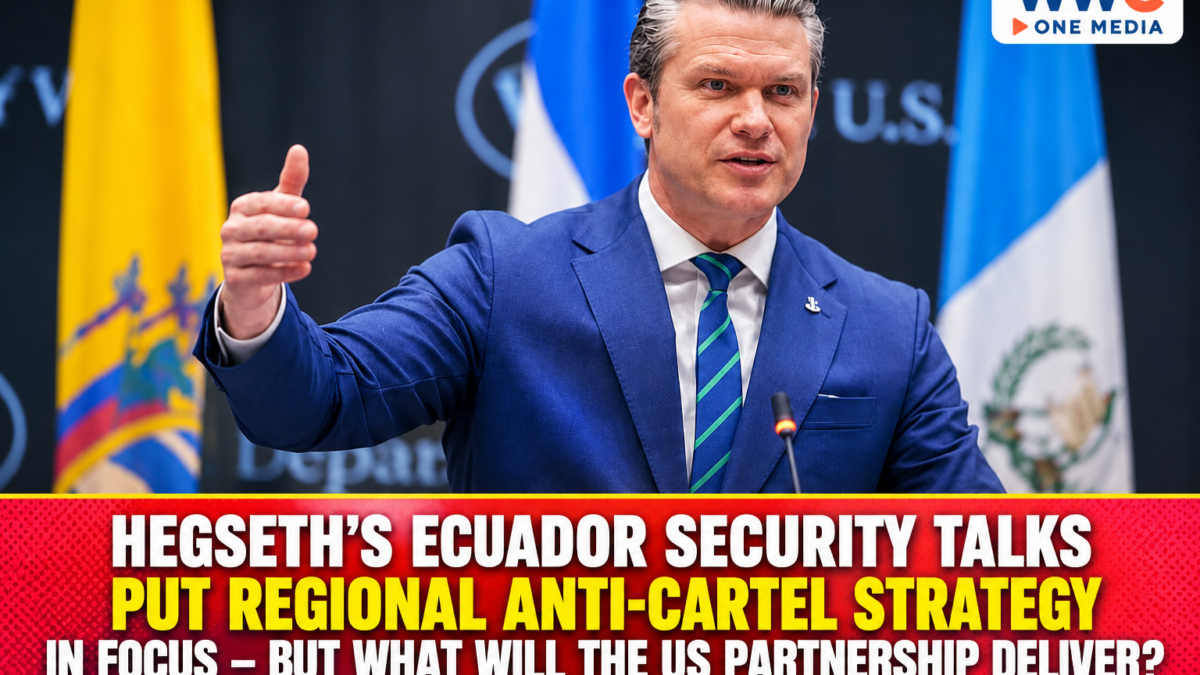
US Secretary of War Pete Hegseth met Ecuadorian President Daniel Noboa in Quito on Nov. 19, 2026, as Washington moved to deepen security cooperation with governments across Latin America. Their discussions covered border security, maritime interdictions and efforts to disrupt criminal networks, including those involved in illegal mining.
The meeting was part of a wider US effort to build regional cooperation against organised crime. But the public record leaves an important question unanswered: how much of the expanding security partnership will translate into specific operations, resources and measurable results?
Ecuador moves closer to Washington’s security agenda
The US Department of War’s Nov. 19 readout described the meeting as the third bilateral engagement between Hegseth and Noboa.
The two officials discussed expanding operational cooperation to strengthen Ecuador’s border security and restrict the ability of criminal networks to operate across the country. They also addressed efforts to counter illegal mining activities linked by the US department to criminal financing.
Hegseth commended Ecuador’s leadership in joint maritime interdictions and combined operations. He also expressed continued US support for Ecuadorian security forces.
The statement confirms the subjects discussed, but it does not publish a new agreement, identify a specific operation launched during the meeting or disclose additional funding.
That distinction is important. A diplomatic discussion can establish priorities, but it does not automatically mean that new military resources have been delivered or that a particular operation has begun.
Ecuador has become an important partner in Washington’s regional security plans. The country’s participation in the Americas Counter Cartel Conference earlier this year provided a formal foundation for closer cooperation.
A regional coalition already has a written commitment
The March 5, 2026, Joint Security Declaration from the Americas Counter Cartel Conference sets out the framework behind the latest discussions.
The declaration commits participating governments to expand bilateral and multilateral cooperation in areas that include border security, countering narcoterrorism and trafficking, and protecting critical infrastructure.
It also states an intention to join a coalition against narcoterrorism and other shared threats in the Western Hemisphere.
The document was signed in Doral, Florida, and lists the United States, Ecuador and Honduras among its participating signatories. Pete Hegseth signed for the US Department of War.
Honduras’ inclusion is significant because it shows that the regional initiative is not limited to Washington’s relationship with Quito. The declaration provides a common political framework for governments that have agreed to pursue cooperation against cross-border security threats.
However, the document does not create a single regional military command or publish a detailed operational plan. It leaves the participating countries to develop cooperation through their own institutions, laws and bilateral arrangements.
Why maritime operations are part of the strategy
The emphasis on maritime interdictions reflects the importance of sea routes in efforts to disrupt international trafficking networks.
Criminal organisations can exploit coastlines, ports and shipping routes to move illicit goods between countries. Cooperation between governments can help authorities share information, coordinate patrols and respond to suspected trafficking activity.
For Ecuador, maritime security is connected to the wider challenge of controlling criminal networks operating across national borders. For the United States, cooperation with regional governments offers a way to coordinate enforcement efforts beyond its own territory.
The March declaration identifies trafficking and border security as shared priorities. Hegseth’s November meeting with Noboa shows those priorities remain part of the bilateral agenda.
The challenge is turning broad commitments into practical arrangements. Effective cooperation requires clear responsibilities, lawful procedures, reliable intelligence-sharing and accountability for operations conducted by participating agencies.
For Philippine readers, the maritime dimension is familiar. WWC has reported on how the Philippine Drug Enforcement Agency is working with Quezon fisherfolk to detect suspected drug smuggling at sea. The circumstances differ, but both developments illustrate why coastal monitoring and coordination among authorities matter in counter-trafficking efforts.
Honduras and the wider US security network
Honduras appears in the same March declaration as Ecuador, with its Ministry of National Defense listed among the signatories.
That provides documentary evidence of Honduras’ participation in the regional security initiative. It does not, by itself, establish the details or outcome of any separate bilateral meeting during Hegseth’s November travel.
The broader framework is relevant because Washington is seeking cooperation across several countries rather than relying on a single partner.
The declaration includes commitments to respect national sovereignty and existing bilateral agreements, while allowing governments to determine additional areas of cooperation by mutual agreement.
This is an important qualification. Regional security cooperation does not automatically grant the United States authority to conduct operations inside another country. The declaration itself recognises the sovereignty of participating nations and the role of their domestic laws.
The practical scope of cooperation will therefore depend on the agreements and operational arrangements each government makes.
The Venezuela agreement adds another dimension
Hegseth’s regional engagement also included a separate defence-cooperation development with Venezuela.
The United States and Venezuela signed a defence-cooperation document in Caracas on Nov. 18. The public announcement identified the intention to advance military cooperation and combined operations, but did not disclose the document’s complete provisions or implementation timetable.
The distinction between the Venezuela document and the March regional declaration matters. One is a bilateral defence-cooperation document; the other is a multilateral political commitment involving several governments.
WWC’s examination of what the US-Venezuela defence pact officially confirms explains why the signing of a document should not be mistaken for proof that every proposed activity has already begun.
The wider US military footprint and its strategic priorities also form part of the regional discussion. WWC previously examined the changing risks surrounding US overseas military bases, including the operational challenges that come with maintaining military capabilities across distant regions.
The Ecuador meeting should be understood within this broader diplomatic setting, while keeping the limits of each public announcement clear.
What happens next
The next indicators of progress will be specific announcements from the governments involved.
These could include details of joint operations, maritime security arrangements, border initiatives, intelligence-sharing mechanisms or additional agreements setting out responsibilities and resources.
For Ecuador, the immediate question is whether the discussions with Washington lead to expanded operational cooperation and measurable improvements in the country’s ability to confront criminal networks.
For the wider coalition, the test is whether its members can turn a shared declaration into sustained cooperation while respecting national sovereignty and domestic legal requirements.
The Nov. 19 meeting confirms that Ecuador remains an important partner in the US regional security agenda. It does not yet show the full scale, cost or operational consequences of the next phase.
Frequently Asked Questions
Why did Pete Hegseth meet Ecuadorian President Daniel Noboa?
They discussed expanding security cooperation, strengthening Ecuadorian border security, joint maritime interdictions and efforts to counter criminal networks involved in activities such as illegal mining.
When did the meeting take place?
Hegseth met Noboa in Quito on Nov. 19, 2026.
Is Ecuador part of a US-led anti-cartel coalition?
Ecuador is listed as a signatory to the March 5, 2026, Americas Counter Cartel Conference Joint Security Declaration, which sets out commitments to cooperate against narcoterrorism and other shared threats.
Is Honduras part of the same regional initiative?
Yes. Honduras’ Ministry of National Defense is listed among the signatories to the March declaration. That confirms its participation in the initiative, but does not establish the details of a separate November bilateral meeting.
Did the November meeting produce a new military agreement?
The public US Department of War readout confirms that Hegseth and Noboa discussed expanding operational cooperation. It does not announce a new agreement, disclose additional funding or identify a newly launched operation.