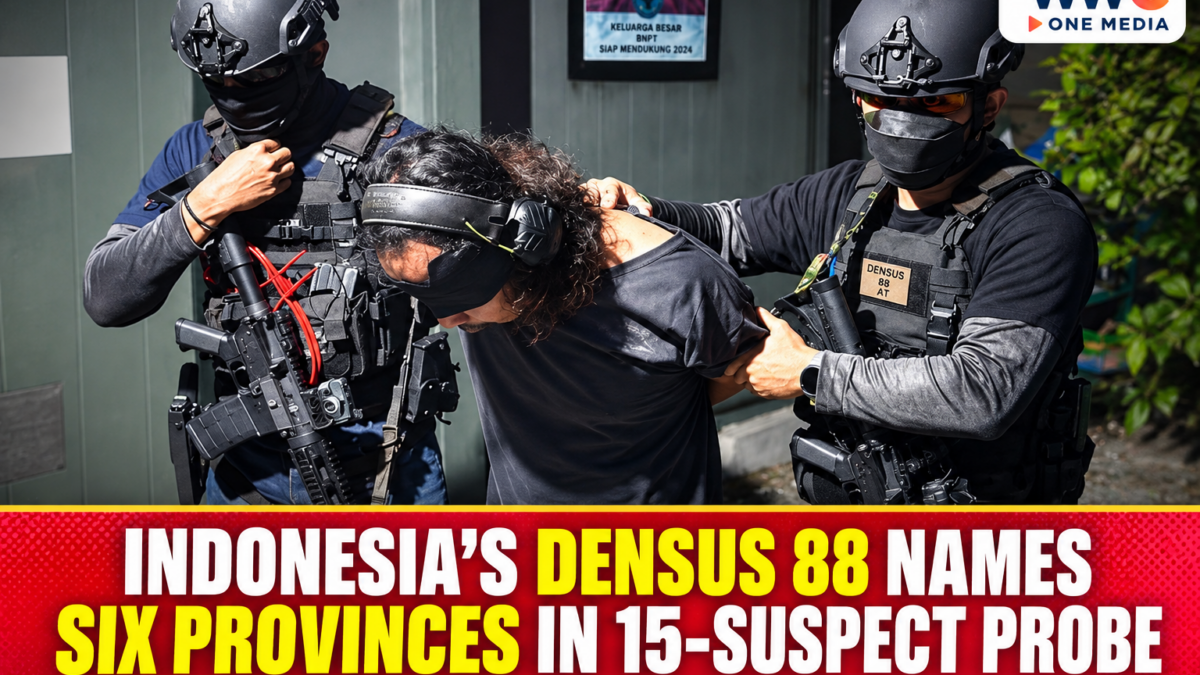
Indonesia’s counterterrorism unit, Densus 88, detained 15 people suspected of terrorism-related offences during operations across six provinces between Nov. 13 and 18, 2026. Police say the investigation is continuing, with officers examining the suspects’ alleged links, activities and possible connections to other individuals.
The operations covered Aceh, West Sumatra, Riau, West Java, Central Java and West Nusa Tenggara. The police account identifies several networks that investigators were targeting, but it does not establish that the suspects have been convicted of terrorism offences.
The case highlights the continuing work of Indonesian authorities against alleged extremist networks, while raising questions about how investigators will establish each person’s role and whether the operations will lead to further arrests.
Where the 15 arrests took place
The largest number of arrests was reported in Central Java, where four suspects were detained in operations spanning Nov. 17 and 18. Police described the four as allegedly affiliated with the Anshor Daulah network in Solo.
Aceh, Riau and West Java each accounted for three arrests. In Aceh, the operations took place in Bireuen, Aceh Besar and Banda Aceh on Nov. 17.
In Riau, three people were detained in Pekanbaru and Kampar on Nov. 13. West Java operations on Nov. 17 covered Bandung city, Bandung regency and Indramayu.
The remaining two arrests were reported in West Sumatra and West Nusa Tenggara. One suspect was detained in Padang on Nov. 13, while another was arrested in Bima on Nov. 17.
Police identified the individuals through initials rather than full names. The public statement also gave their ages, but did not provide a detailed account of each person’s alleged conduct. <Cite refs={[“turn568873view0”]} />
Which networks are part of the investigation?
The police statement named three networks as targets of the operations: Negara Islam Indonesia (NII), Jamaah Ansharut Daulah (JAD) and Anshor Daulah (AD), which police described as affiliated with the Islamic State group.
The statement did not provide a full breakdown linking every detained person to a specific organisation. It specifically described the four Central Java suspects as affiliated with the Anshor Daulah network in Solo.
That distinction matters. Naming a network targeted in an operation does not, by itself, establish that every person detained belonged to that group. Investigators still need to determine the alleged role and evidence against each individual.
Police also said some of the people detained were former terrorism convicts. However, the statement did not disclose how many had previously served sentences or identify them individually.
Police describe alleged propaganda, recruitment and fundraising
Densus 88 spokesperson Mayndra Eka Wardhana said investigators had identified different alleged activities among the suspects. These included spreading extremist ideological propaganda, recruiting members, raising funds to support group activities and conducting training connected with terrorism offences.
The police account did not provide individualised evidence for each alleged activity. It also did not explain which suspect was allegedly involved in propaganda, recruitment, fundraising or training.
For that reason, the allegations should not be treated as proof that every person detained carried out all—or any particular one—of those activities. The investigation must establish the evidence and the alleged involvement of each suspect.
The distinction between an arrest, an investigative allegation and a court finding is important in terrorism cases. Detention marks a law-enforcement step; it is not a final determination of guilt.
Indonesia’s wider counter-extremism framework
The arrests come as Indonesia operates under a national action plan for 2026 to 2029 on preventing and countering violent extremism linked to terrorism.
Presidential Regulation No. 8 of 2026 sets out a framework involving national ministries and agencies as well as provincial and local governments. Its themes include national preparedness, community and family resilience, education, protection of women, young people and children, strategic communication and electronic systems, deradicalisation, human rights and international cooperation.
The regulation also lists human rights, the rule of law, justice and child protection among the principles guiding implementation. It requires local governments to develop corresponding regional action plans.
This broader framework is relevant because the police operation addresses alleged enforcement concerns, while the national plan also sets out prevention and coordination responsibilities. The two approaches are different but complementary: investigations address suspected offences, while prevention policies seek to reduce the conditions that allow violent extremism to spread.
The regional dimension is also important. WWC has previously examined Singapore and Indonesia’s joint air patrol, a defence cooperation initiative that identified transnational terrorism among the shared security concerns. Separately, Singapore’s assessment of its terrorism threat has highlighted the importance of online radicalisation and prevention.
Why the next stage of the investigation matters
The immediate question is no longer simply how many people were detained. Investigators must establish what evidence connects each suspect to the alleged offences, whether the alleged networks overlap and whether other individuals were involved.
Densus 88 said its investigators were continuing to collect and complete evidence. The police statement did not provide a timetable for the next stage or announce any final findings.
The operation also adds to the broader security developments in Indonesia that WWC has followed, including the military deployment in Jakarta during a separate police investigation. That case is separate from the terrorism investigation and should not be treated as evidence of a connection between the two.
What happens next
Densus 88 says the investigation remains active, with evidence-gathering and inquiries into possible links involving other people still under way.
Further official updates may clarify the individual allegations, the evidence collected and whether prosecutors will bring formal cases. Until those details are made public and tested through the legal process, the 15 people should continue to be described as suspects.
The police statement also urged the public to remain alert to extremist propaganda, particularly online, and emphasised the role of families and communities in preventing radicalisation. It did not identify a specific imminent attack connected with the arrests.
Frequently asked questions
1. How many people did Indonesia arrest in the latest Densus 88 operation?
Police said Densus 88 detained 15 people suspected of terrorism-related offences during operations from Nov. 13 to 18, 2026.
2. Which provinces were involved?
The six provinces were Aceh, West Sumatra, Riau, West Java, Central Java and West Nusa Tenggara.
3. Which groups were named by police?
The police statement named Negara Islam Indonesia (NII), Jamaah Ansharut Daulah (JAD) and Anshor Daulah (AD), which it described as affiliated with ISIS.
4. Have the 15 suspects been convicted?
The police statement describes them as suspects and says the investigation is continuing. It does not report convictions.
5. What happens after the arrests?
Investigators say they are continuing to collect evidence and examine possible links to other individuals. Further legal steps will depend on the evidence and the subsequent proceedings.