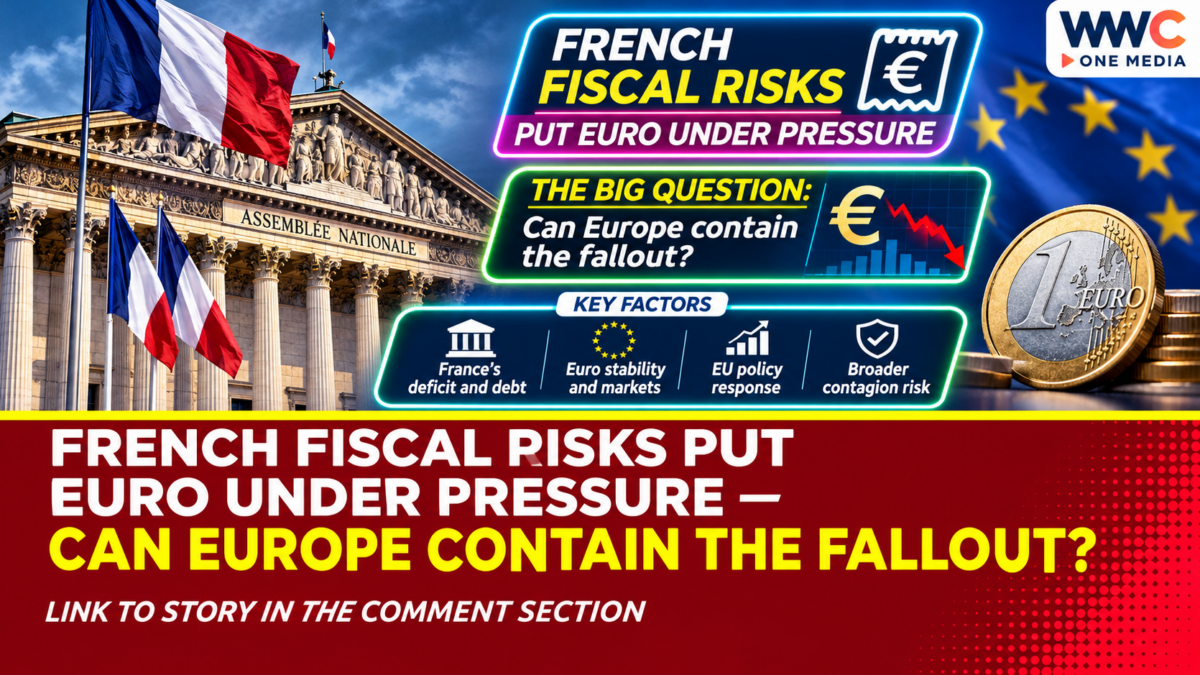
PARIS, France — French fiscal risks have returned to the centre of the euro debate after the European Central Bank warned on Nov. 18 that high sovereign borrowing needs and sensitive bond markets could amplify financial shocks. A day earlier, the European Commission projected a French budget deficit of 5.5% of gross domestic product in 2026, while the ECB’s Nov. 18 euro reference rate stood at US$1.0968, below its Nov. 17 reading of US$1.0989.
These official figures establish a difficult setting for the currency but do not prove that French politics caused every movement in the euro. Currency markets also respond to American interest-rate expectations, European economic performance and global risk appetite.
French Fiscal Risks Are Visible in the Budget Numbers
The European Commission’s autumn forecast projects French economic growth of 0.4% in 2026 and 0.6% in 2027. It expects the government deficit to reach 5.5% of GDP this year, then ease only slightly to 5.4% in 2027.
It projects public debt rising from 115.7% of GDP in 2025 to 123.2% in 2028. These are forecasts, not final debt measurements for future years.
The outlook reflects modest growth, persistent deficits and mounting interest payments. The Commission estimates government interest spending will increase to 3% of GDP in 2027, limiting how much budget adjustment translates into a lower overall deficit.
France’s government has proposed measures to restrain spending, including adjustments affecting pensions and social benefits. These remain subject to the relevant budget process; a projected saving is not money already collected.
WWC previously examined France’s rising government borrowing costs and debt dilemma. The new Commission figures provide a dated official test of the broader fiscal concern.
Euro Reference Rate Shows Pressure, Not Its Sole Cause
The ECB published an indicative euro reference rate of US$1.0968 for Nov. 18, compared with US$1.0989 on Nov. 17 and US$1.1014 on Nov. 16. The two-day movement indicates a weaker euro against the dollar at those reference fixing points.
Reference rates are not the same as intraday lows, trading-platform quotations or a prediction of the next exchange rate. They are useful for comparing the currency on a consistent published basis.
A falling euro against the dollar may reflect a stronger dollar, a weaker euro or both. As a result, these readings alone cannot quantify the share of the move attributable to French fiscal concerns.
Analysis: A large euro-area member’s budget problems can affect confidence, but the euro represents a shared monetary area. Its price cannot responsibly be reduced to the politics of one national government.
ECB Warns of Sovereign-Bond Repricing
The ECB’s Nov. 18 Financial Stability Review identified sovereign fiscal imbalances, geopolitical strains and elevated artificial-intelligence valuations as risks to the euro-area financial system.
It warned that high public debt and increasing government financing needs, alongside more price-sensitive and leveraged bond-market investors, raise the risk of abrupt price adjustments. The assessment also said markets have continued functioning in an orderly manner.
A bond’s yield generally rises when its price falls. If investors demand higher yields from a government, issuing replacement or additional debt can become more expensive over time.
This is not a statement that a French default is inevitable. The ECB’s review describes vulnerabilities and possible channels through which adverse events could spread.
WWC’s coverage of the ECB’s warning on French bond-market tensions provides related context for why borrowing costs and fiscal credibility are being examined together.
What Futures Positions Can and Cannot Reveal
The US Commodity Futures Trading Commission’s financial-futures report for positions as of Nov. 10 records euro futures activity at the Chicago Mercantile Exchange.
For its leveraged-funds category, it lists 114,051 long contracts and 185,727 short contracts in Euro FX futures. On that date, the category’s reported short positions exceeded its long positions by 71,676 contracts.
These are published futures positions in one market segment, not a complete tally of all global currency trades. They also predate the Nov. 18 central-bank review and do not identify what motivated each trader.
The data therefore cannot establish that particular investors placed their bets because of French budget negotiations. Options positions, over-the-counter transactions and changes after the reporting date may paint a different picture.
What this could mean: The positioning shows that some leveraged traders had meaningful downside euro exposure, but a crowded short position can also be vulnerable to reversal if new information changes expectations.
France’s Growth Weakness Complicates Fiscal Repair
A separate Banque de France business survey published in November notes that French GDP declined 0.1% in the third quarter after no growth in the preceding quarter, based on preliminary national accounts.
Sluggish activity can reduce tax collection and complicate deficit targets even when policymakers announce spending restraint. Faster growth, on the other hand, may improve the ratio of debt to the size of the economy without automatically eliminating the underlying deficit.
The European Commission also anticipates rising interest costs and weak activity. Those mechanisms help explain why the projected 2027 deficit declines only marginally from the 2026 level.
WWC’s earlier analysis of the euro-area economy as France contracted shows how economic performance varies within the currency union. A national slowdown need not imply that every euro-area member is shrinking.
For Philippine readers, euro weakness can change the peso cost of European purchases or travel, but the actual outcome depends on the euro-peso exchange rate, transaction charges and timing, not the euro-dollar reference rate alone.
What Happens Next
The next tests will be France’s budget legislation, subsequent national debt and deficit figures, ECB financial-stability updates and later CFTC reports showing how currency traders adjust their positions.
A stronger fiscal plan or better growth figures could ease concern; an adverse market shock could intensify it. Neither result is guaranteed.
The primary record supports a measured conclusion: France faces a difficult fiscal outlook, the ECB sees vulnerability in sovereign bond markets, and reported leveraged euro futures positions were net short as of Nov. 10. It does not prove that France alone explains the euro’s fall or that a further decline is inevitable.
Frequently Asked Questions
Why are French fiscal risks important for the euro?
France is part of the euro area, so concerns about its borrowing needs can affect perceptions of regional financial stability. Exchange rates also depend on many other factors.
What did the European Commission forecast for France’s deficit?
Its autumn forecast puts the deficit at 5.5% of GDP in 2026 and 5.4% in 2027. These are forecasts, not final outcomes.
What was the official euro-dollar reference rate on Nov. 18?
The ECB published a reference rate of US$1.0968 per euro, compared with US$1.0989 on Nov. 17.
Are traders definitely betting against the euro because of France?
No. CFTC data show positions in listed futures, not each trader’s motivation or the entire foreign-exchange market.
Does the ECB say France will default?
No. Its November financial-stability review describes the risk of abrupt sovereign-bond repricing and other vulnerabilities, not a prediction of default.