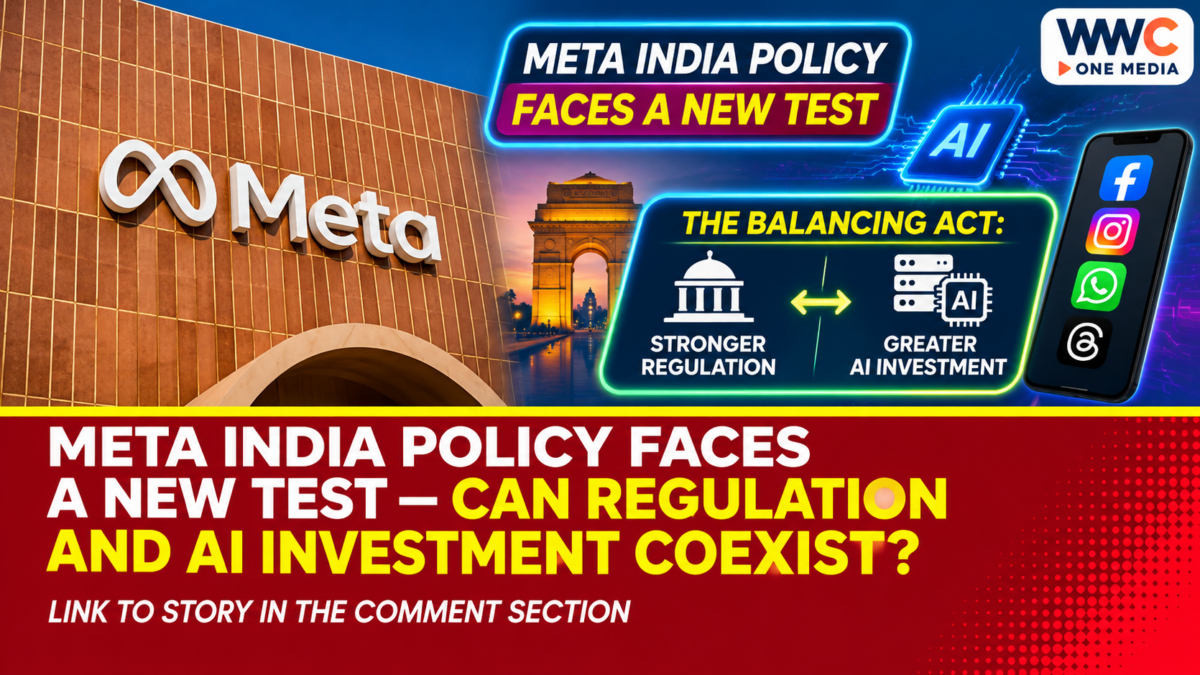
NEW DELHI — Nov. 19, 2026. Meta’s India policy operation is navigating competition enforcement, evolving online-safety rules and expanding investment in artificial intelligence infrastructure. The company appointed Aman Jain as its India public-policy head in an announcement published Dec. 11, 2025, while its latest November 2026 statement details changes to Instagram content recommendations in the country.
The available official announcements do not establish that Meta is presently replacing Jain or that a new recruitment process is intended to repair relations with India’s government. What the records do establish is a substantial challenge: Meta must manage regulatory compliance while pursuing commercial growth across WhatsApp, Facebook, Instagram and artificial intelligence.
Meta India Policy: Leadership Already Has a Public Record
Meta’s December 2025 announcement named Aman Jain as head of Public Policy in India and said he would join in early 2026. The company said he would report to Simon Milner, its Asia-Pacific vice president of policy, and sit on the India leadership team.
Meta described Jain’s background as including senior positions at Amazon, Google and the Government of India. His appointment announcement is evidence of a leadership decision made in 2025, not proof of any new appointment or departure in November 2026.
The firm separately appointed Arun Srinivas as managing director and head for India, effective July 1, 2025. That is a business-leadership position distinct from the public-policy role. Conflating the two would obscure who is responsible for commercial operations and who leads relations with regulators.
Comparable questions about technology-company public affairs have arisen elsewhere. WWC previously examined Indian technology companies and government-relations leadership, although the specific personnel decisions at Samsung and Meta are unrelated.
WhatsApp Competition Ruling Defines a Real Dispute
India’s Competition Commission imposed a penalty of ₹213.14 crore on Meta in November 2024 after finding that aspects of WhatsApp’s 2021 privacy-policy update violated competition law. The decision concerned user choice and the sharing of information across Meta services.
Meta and WhatsApp challenged the ruling. The competition authority’s published account of the November 2025 appellate judgment explains that the tribunal upheld the financial penalty and major findings but set aside the five-year restriction on sharing WhatsApp data for advertising. Other user-choice and transparency remedies continued to apply, including to non-WhatsApp purposes.
These are specific decisions, not evidence that every feature of WhatsApp is unlawful or that the company has exhausted every legal avenue. The operative status of any individual obligation must be assessed from the latest court orders and compliance documents.
Why it matters: Privacy, advertising and competition intersect when information gathered in one service can be used to improve the commercial position of another. A regulatory settlement or ruling can therefore shape product design as well as potential financial exposure.
India Is Tightening Digital-Platform Obligations
India’s Ministry of Electronics and Information Technology published amendments and explanatory guidance in 2026 addressing synthetically generated information and intermediary responsibilities. The guidance describes due diligence for social platforms and a framework for dealing with AI-generated content and user complaints.
The exact obligations depend on platform type, the relevant rule and implementation arrangements. A policy team must interpret these requirements alongside competition remedies rather than assume that satisfying one law automatically satisfies another.
On Nov. 16, Meta issued its own update about Instagram recommendations in India. It said its systems had been adjusted to avoid recommending more content that failed its guidelines, and that reports about recommended content were occurring about half as often as a year earlier.
That reported improvement is Meta’s internal measure; it is not an independent finding that harmful content has disappeared. The statement also distinguishes removing material that breaches community standards from limiting distribution of content that may be permitted but unsuitable for wider recommendation.
For international context, WWC examined Meta’s privacy obligations in another regulatory market. India’s laws and remedies differ from those in Europe, so a penalty or requirement in one jurisdiction should not be described as automatically applicable in another.
AI Investment Raises the Commercial Stakes
In June 2026, Meta and Reliance Industries announced an agreement for an AI-enabled data centre in Jamnagar, Gujarat. Reliance will develop a facility with an initial capacity of 168 megawatts for Meta to lease, with an option to expand.
Meta also announced renewable-energy contracts with CleanMax and Fourth Partner Energy. It said it would cover the energy and water costs associated with the leased Jamnagar facility, which is intended to use desalinated seawater for cooling.
An agreement to lease computing infrastructure is not a disclosure of the centre’s final construction cost, annual profit or completed operating capacity. Those measures would require later corporate and operational records.
What this could mean: Meta has a strong commercial incentive to maintain predictable engagement with Indian authorities because regulation can affect its products, data practices and physical infrastructure. But an investment commitment does not establish that outstanding regulatory disputes have been resolved.
The Philippine Comparison Is About Accountability
There is a useful regional comparison. Governments seek contact points inside major platforms so complaints, public-safety issues and official information requests can be addressed through defined procedures. Companies also need to protect users against unnecessary disclosure and errors.
WWC has reported on Meta’s public-policy discussions in the Philippines. Those Philippine discussions are not evidence of how India will rule on any WhatsApp or Instagram issue; they illustrate why a platform’s government-relations team has duties beyond publicity.
Analysis: The effectiveness of Meta’s India operation should be judged by lawful compliance, transparent platform policies and verifiable service outcomes. An executive’s appointment is only one organisational measure, and the absence of a public statement about recruitment cannot establish the reason for any internal decision.
What Happens Next
A confirmed new appointment, departure or public job listing from Meta would be needed before reporting an additional leadership change. Subsequent competition orders, ministry notifications and product-compliance updates will be stronger indicators of whether regulatory disagreements are being addressed.
The independently documented position is clear: Meta already announced a public-policy leader for India, remains subject to significant competition-law remedies and is expanding AI infrastructure. Whether its government relations improve is a future outcome, not a fact established by the reported hiring narrative.
Frequently Asked Questions
Who did Meta appoint as its India public-policy head?
Meta announced Aman Jain’s appointment on Dec. 11, 2025, saying he would join the company in early 2026. No original November 2026 announcement replacing him was authenticated for this article.
How much was the Indian competition penalty against Meta?
The Competition Commission of India imposed ₹213.14 crore in November 2024. A November 2025 appellate decision upheld the penalty while modifying certain remedies.
Is Meta expanding AI infrastructure in India?
Yes. Meta announced a lease arrangement for a Reliance-developed, 168-megawatt AI-enabled data centre in Jamnagar in June 2026. Its eventual performance is not yet established by that announcement.
Has Meta confirmed a new India policy-chief recruitment in November 2026?
No authenticated official recruitment announcement or statement explaining such a leadership change was identified in the primary records reviewed.