Alibaba is expanding its artificial intelligence hardware and cloud infrastructure as new US export controls place greater scrutiny on access to advanced computing power. The Chinese technology group has announced a new AI processor, a longer-term data-centre expansion target and further development of its Qwen models, while Washington’s latest rules address both physical semiconductor transfers and remote access through overseas data centres.
The developments put a practical question at the centre of Alibaba’s AI strategy: can the company build enough computing capacity using its own technology while maintaining access to the wider semiconductor and cloud ecosystem?
The distinction matters because a domestic processor strategy is not automatically a complete substitute for imported hardware. Nor does a new US licensing framework establish that Alibaba has been prohibited from using every foreign chip or that its cloud business has already suffered a specific disruption.
Alibaba AI chips become part of a broader technology strategy
Alibaba’s September 2026 Apsara Conference announcements show that its hardware ambitions extend beyond designing a single processor.
The company presented a full-stack AI roadmap connecting its T-Head chip-design unit, Qwen foundation models, cloud infrastructure and AI agents. It also said its next-generation Qwen 4 model was in training, with future Qwen 4.5 and Qwen 5 models projected to scale to between five trillion and 10 trillion parameters. These are company-announced development plans, not evidence that those future models have already been released. Alibaba Group+1
One of the most significant hardware announcements was the Zhenwu V900, a processor designed for AI training and inference. Alibaba says it offers three times the performance of its predecessor, the Zhenwu M890, with 216GB of GPU memory and 1,200GB/s of inter-chip bandwidth.
The company scheduled mass production and commercial release for the first quarter of 2027. It also reported that its Zhenwu AI chips were already serving more than 650 customers across industries including automotive, finance, energy and manufacturing. Alibaba Group
Those figures indicate the direction of Alibaba’s development programme. They do not independently establish that the V900 can replace every advanced foreign processor or deliver equivalent results across all AI workloads.
WWC previously examined Alibaba’s new AI chip and its next-generation model plans. The next stage is whether the company’s announced hardware can be manufactured, deployed and supported at the scale required by its cloud business.
Cloud growth gives the chip strategy commercial importance
Alibaba’s AI hardware investment is connected to a business that is already generating substantial revenue.
For the June 2026 quarter, Alibaba reported AI Cloud and Compute Services revenue of RMB48.437 billion, equivalent to approximately US$7.139 billion. That was an increase of 45% from the same quarter a year earlier.
Adjusted EBITA for the segment increased 133% to RMB5.628 billion, or approximately US$830 million. The company attributed the revenue growth primarily to public cloud expansion and increasing adoption of AI-related products. Alibaba Group Data+1
These figures help explain why processor access matters. AI cloud services require computing capacity, and the cost and availability of that capacity can affect how quickly a provider expands its products.
However, strong revenue growth should not be confused with proof that the entire AI infrastructure investment is already profitable. Businesses must also account for equipment purchases, electricity, networking, data-centre construction, software and ongoing operations.
WWC’s earlier examination of Alibaba’s shift from advertising and e-commerce towards AI and cloud revenue provides additional context for the scale of this business transformation.
Alibaba had scheduled its September-quarter financial results for release on Nov. 19 before the US market opened. Those figures are not included here because they were not available in the primary records reviewed at the time of this update. Alibaba Group+1
New US rules look beyond the physical shipment of chips
The regulatory change announced by the US Department of Commerce on Nov. 16 is important because it addresses how computing power can be accessed remotely.
The interim final rule, titled Addressing Remote Access to Advanced Semiconductors, establishes licensing requirements for certain advanced computing items intended for use in data centres that provide significant computing capacity, directly or indirectly, to companies headquartered in Macau or destinations listed in Country Group D:5.
The rule includes arrangements involving data centres outside the restricted jurisdictions. It also requires due diligence into customers’ direct and indirect ownership or control. Bureau of Industry and Security+2
The document identifies a threshold of more than 12 million in aggregate total processing performance for the relevant computing arrangements. It also provides for linked data centres to be considered together where their infrastructure allows them to share resources and operate as a unified system.
Certain existing facilities that were already providing covered computing services before publication must obtain the required licence within 90 days of the rule’s effective date if they intend to continue those services. Applications are subject to case-by-case review. Bureau of Industry and Security+1
The rule also introduces additional licensing requirements for specified advanced semiconductor exports, re-exports and transfers involving Indonesia, Malaysia, Singapore, Thailand and Brazil. Qualifying transactions involving US-headquartered recipients or their US-headquartered ultimate parent companies have a stated exception, subject to reporting requirements. Bureau of Industry and Security+1
This is not a blanket ban on every AI chip sale to China, every cloud service or every Alibaba operation. The applicable requirements depend on the technology, transaction, destination, end user and intended use.
Why Alibaba’s overseas cloud footprint matters
Alibaba is not building its AI business solely for customers in mainland China.
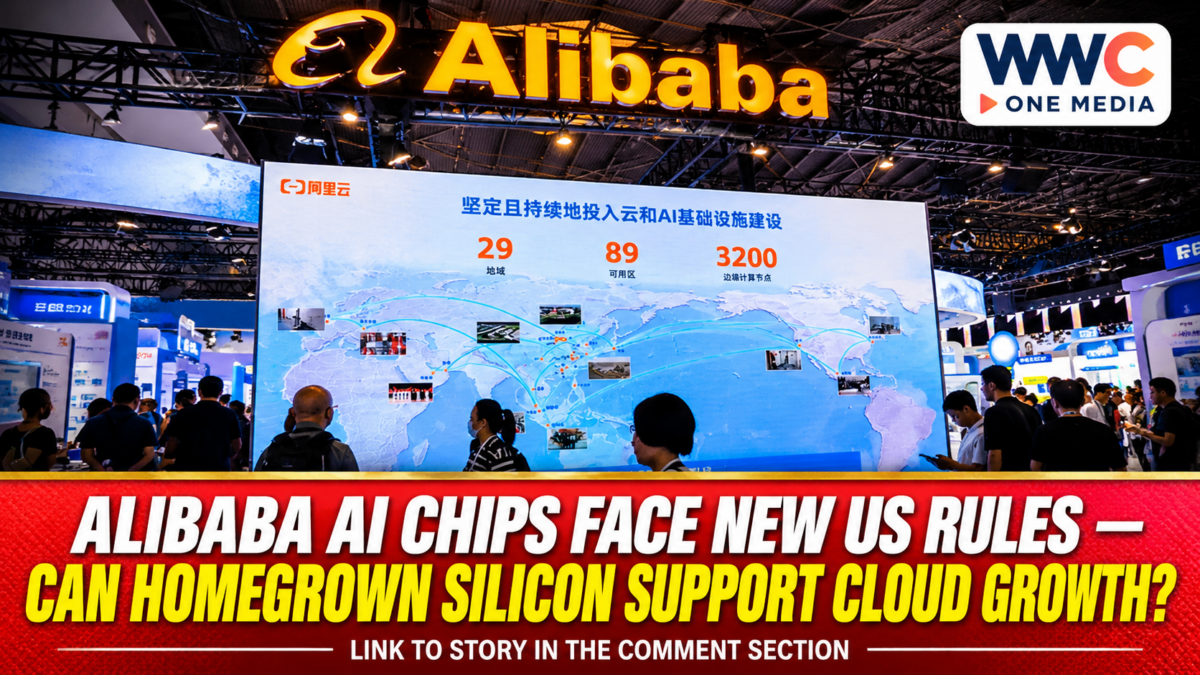
Its September roadmap includes plans to establish its first cloud regions in Türkiye, Finland and the Netherlands over the following 12 months. It also outlined expansion of its data-centre footprint in Malaysia, Germany, the United Arab Emirates, France and Hong Kong.
The company said it operated 107 availability zones across 31 regions at the time of the announcement. It also set a target of more than 20 gigawatts of global data-centre capacity operated by Alibaba Cloud by 2032. Alibaba Group+1
This international footprint makes regulatory compliance more complicated than simply checking where a processor is physically installed.
A cloud operator may need to understand who ultimately receives computing capacity, whether customers are controlled by restricted entities and whether linked facilities are sharing resources in a way covered by the rules.
The issue is particularly relevant to Southeast Asia. WWC’s report on the new US AI-chip rules affecting overseas data centres explains why a facility’s location alone does not settle the question of whether a remote-computing arrangement requires authorisation.
For Alibaba, the public documents reviewed do not establish that a named overseas facility has been ordered to stop serving customers or that a specific cloud contract has been cancelled because of the Nov. 16 rule.
Homegrown processors offer flexibility, not complete independence
Alibaba’s investment in T-Head gives it greater control over part of the technology stack supporting its AI services. Its own processors can be designed around its models, software and cloud infrastructure.
That could give the company more options when planning future computing capacity. It may also help it optimise selected workloads rather than relying on a single category of external processor.
But hardware independence is not achieved simply by announcing a new chip. Commercial production, manufacturing yields, memory supply, networking, software compatibility and performance across different workloads all influence whether a processor can be deployed at scale.
The company’s September announcement sets out its product specifications and production timetable. It does not provide an independent comparison proving that the Zhenwu V900 matches every competing accelerator in performance, cost or energy efficiency.
The wider export-control debate also affects regional operators and other chip suppliers. WWC has examined how the new US controls could affect Nvidia and AMD’s access to overseas computing markets.
The business question is therefore not simply whether Alibaba can design its own chips. It is whether it can combine domestic processors, permitted external technology, reliable manufacturing and compliant international cloud services into a commercially sustainable system.
What happens next
The next evidence to watch is Alibaba’s September-quarter financial disclosure, followed by details of processor production and deployment during 2027.
The US rule’s implementation and any subsequent licensing decisions will also help clarify how the remote-computing provisions affect international data-centre operators and their customers.
For investors and technology businesses, the most useful indicators will be cloud revenue, segment profitability, capital expenditure, processor deployment, supply availability and any company-specific disclosure of regulatory costs.
For now, the official record supports a measured conclusion: Alibaba is building a broader domestic AI hardware and software ecosystem while US controls are extending scrutiny to certain remote-computing arrangements. Neither development proves that the company has achieved full semiconductor independence or that its AI business has been shut out of essential computing resources.
Frequently asked questions
What AI chip did Alibaba announce in September 2026?
Alibaba announced the Zhenwu V900, an AI training and inference processor developed by its T-Head chip-design unit.
When is the Zhenwu V900 expected to enter production?
Alibaba scheduled mass production and commercial release for the first quarter of 2027.
How much did Alibaba’s AI cloud business earn in the June 2026 quarter?
Alibaba reported RMB48.437 billion, or approximately US$7.139 billion, in AI Cloud and Compute Services revenue, up 45% year on year.
Do the new US rules ban all Alibaba AI chip use?
No. The interim final rule establishes specific licensing requirements involving advanced computing items, certain remote-computing arrangements and named destinations. It does not establish a universal ban on every Alibaba chip or cloud service.
Why does remote access matter to chip export controls?
A restricted customer may be able to use computing power through a data centre in another country without physically importing the processor. The new rules address certain arrangements of that kind, including indirect access and linked data centres.