
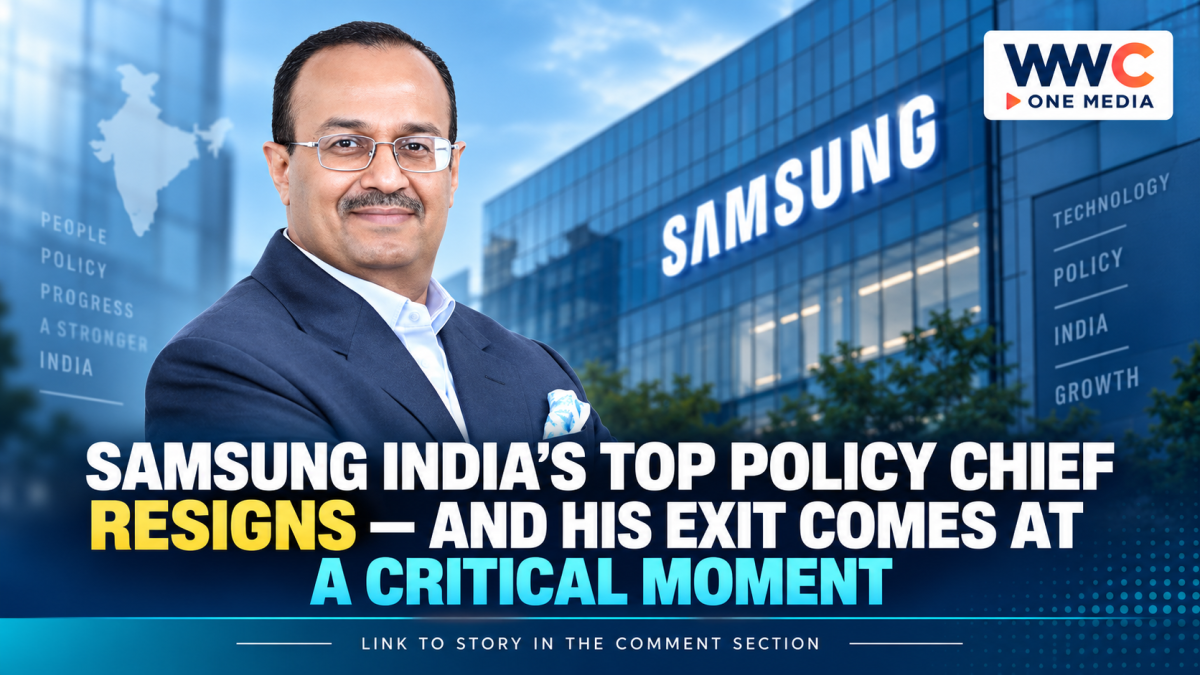
NEW DELHI — Samsung India is facing a significant leadership change after Rajiv Aggarwal, the company’s head of public affairs and ESG, resigned after nearly four years in the role, according to two people familiar with the matter.
Aggarwal is expected to complete his final week at Samsung India, the sources told Reuters. The reason for his resignation has not been disclosed.
Neither Aggarwal nor Samsung Electronics responded to Reuters’ requests for comment.
The departure comes at a particularly sensitive time for Samsung’s India operations, with the South Korean electronics giant navigating tighter government regulation, disputes over electronic-waste obligations and increasing pressure across parts of its consumer-electronics business.
Who is Rajiv Aggarwal?
Aggarwal is a former Indian bureaucrat with extensive experience in government and corporate public policy.
Before joining Samsung, he worked at Uber and Meta, where he handled public-policy responsibilities. He previously served in India’s civil service and held senior government positions, including work related to industry and intellectual-property policy.
His role at Samsung was particularly important because public affairs executives serve as a key bridge between multinational corporations and government authorities — especially in a market as heavily regulated and strategically important as India.
Aggarwal joined Samsung in 2022 and later became a senior vice president overseeing public affairs and ESG for Samsung Southwest Asia, according to professional-profile information.
His exit comes as regulatory pressure grows
Samsung and other major technology companies have recently faced increased demands from India’s government.
One issue involves a government proposal requiring smartphone manufacturers to pre-install a state-run application. Samsung and Apple have opposed such requirements on privacy grounds, according to Reuters.
Samsung is also among companies that have challenged in court a government policy involving increased payments by businesses to electronic-waste recyclers.
That puts public-policy teams in an increasingly important position as technology companies balance commercial interests with India’s evolving regulatory environment.
Aggarwal’s departure therefore comes at a time when Samsung’s relationship with Indian policymakers remains strategically significant.
Samsung is also restructuring its India business
The resignation follows reports of broader changes inside Samsung India.
Last week, Indian media reported that Samsung had begun cutting jobs in its television and home-appliance businesses, with approximately 80 to 100 executives reportedly asked to leave in batches.
The affected positions reportedly include directors, team leaders, branch managers and area managers. Reports also indicated that as much as 25% of the sales and marketing workforce in Samsung’s electronics business could eventually be affected, although the company has not publicly confirmed those figures.
The reported restructuring is being driven by several pressures, including sharply higher memory-chip costs, weaker consumer demand, a weaker rupee and pressure on profit margins.
The Economic Times reported that Samsung has also been consolidating parts of its regional office structure and considering changes to overlapping functions between its television and home-appliance operations.
Why India’s electronics market is becoming tougher
Samsung’s challenges are unfolding against a difficult backdrop for India’s consumer-electronics industry.
Memory-chip prices have surged, increasing costs for manufacturers. At the same time, higher retail prices and economic pressures are weighing on consumer demand.
Samsung’s smartphone business is particularly important because mobile phones account for a large share of its Indian revenue.
Industry data also show that India’s smartphone market has slowed significantly.
Counterpoint Research reported that India’s smartphone shipments declined 11% year-on-year in the second quarter of 2026, with higher memory costs contributing to price increases and weaker consumer demand. Samsung held a 16% shipment share during the quarter, placing it behind market leader Vivo and OPPO.
Omdia similarly reported that India’s smartphone shipments fell 5% year-on-year in the first quarter of 2026, with Samsung recording a 16% share of shipments.
The figures underscore why Samsung is under pressure to protect margins while maintaining its position in one of the world’s most important smartphone markets.
But Samsung India is not collapsing
Despite the restructuring, the latest developments should not be interpreted as evidence that Samsung is abandoning India.
Samsung remains one of the country’s largest electronics companies and has a substantial manufacturing, sales and distribution presence there.
The reported workforce reductions have been concentrated primarily in television and home appliances, while the smartphone organization has so far been largely protected.
Indian media reports have described Samsung’s current moves as cost rationalisation and restructuring, rather than a withdrawal from the Indian market.
Samsung India also reported strong financial performance for fiscal 2025, with revenue of roughly ₹1.1 lakh crore and net profit of about ₹11,287 crore, according to Indian media reports based on company filings.
A leadership change worth watching
Aggarwal’s resignation is consequently taking place against a much bigger backdrop.
Samsung is simultaneously trying to manage its relationship with the Indian government, respond to changing regulations, control costs and defend its position in an increasingly competitive consumer-electronics market.
Chinese smartphone manufacturers, Apple and other global brands continue to compete aggressively for Indian consumers, while rising component costs make pricing decisions increasingly difficult.
For Samsung, the challenge is not simply selling more devices.
It is maintaining growth and profitability while navigating one of the world’s most important — and increasingly demanding — technology markets.
Aggarwal’s departure adds another question to that equation: who will take over the critical public-affairs role, and what direction will Samsung’s government-relations strategy take next?
For now, Samsung has provided no public explanation for the resignation, leaving the circumstances surrounding the leadership change unresolved.




Leave a Reply