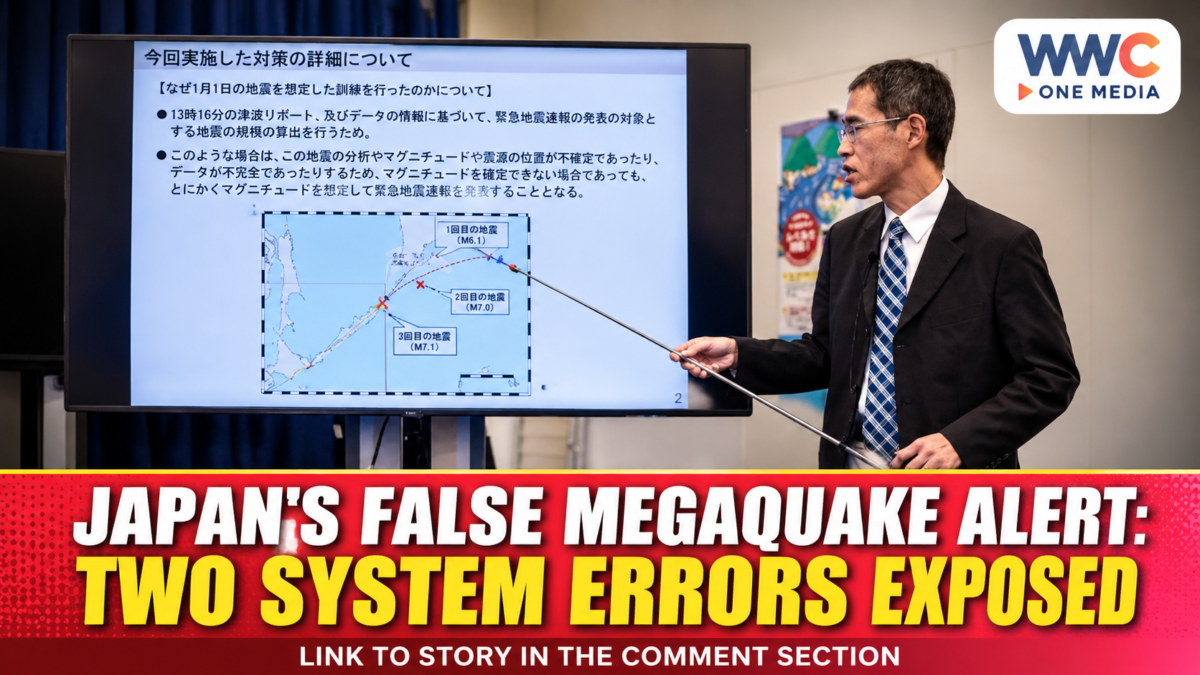
Japan’s Meteorological Agency (JMA) has completed corrective work on its earthquake early-warning system after identifying two technical defects behind the false magnitude-9.9 warning issued on Oct. 16, 2026.
In an update released on Nov. 17, the agency confirmed that it had addressed both problems, including one involving the use of distant seismic observation stations and another that allowed different earthquake locations to be used for magnitude calculations and shaking forecasts.
The findings provide a clearer explanation of how an earthquake near Russia’s Kamchatka Peninsula triggered an emergency warning across a large part of Japan, even though the actual tremor measured magnitude 6.9.
How the false warning happened
The JMA issued an emergency earthquake warning at 12:40 p.m. on Oct. 16, covering areas from Hokkaido to central Japan.
Its system had incorrectly placed the earthquake in the Kuril Islands area and estimated its magnitude at 9.9. The agency later cancelled the warning at 12:48 p.m.
The actual earthquake occurred near the Kamchatka Peninsula at 12:35 p.m. and had a magnitude of 6.9. The JMA’s earthquake records show that the maximum observed seismic intensity in Japan was 1.
The eight-minute period between the warning and its cancellation highlighted the importance of accurate automated calculations in a country where earthquake alerts can prompt immediate public-safety and transport responses. 気象庁+2
The first defect involved distant observation stations
The agency identified two separate problems in the processing system.
The first involved seismic observation points located too far from the estimated earthquake source. Data from these distant stations were included in the calculation of the earthquake’s magnitude, even though they should have been excluded.
The JMA explained that it had introduced a safeguard to prevent observation points more than 700 kilometres from the estimated source from being used in magnitude calculations.
However, the safeguard did not operate as intended during the October incident.
To address the problem, the agency introduced an emergency measure on Oct. 16 that excluded observation points more than 700 kilometres from the earthquake source when calculating magnitude. The JMA said this resolved the first defect. 気象庁+1
The second problem involved two different earthquake locations
The other defect concerned how the system used the estimated earthquake location.
The JMA said the location used to calculate an earthquake’s magnitude should be the same as the location used to forecast seismic intensity and other ground-motion information.
That requirement was not met during the Oct. 16 event.
In practical terms, the system used inconsistent source locations for two calculations that needed to be connected. This contributed to the excessive warning issued for parts of Japan.
The agency said its initial emergency measures on Oct. 16 also prevented this defect from producing another excessive warning.
It then implemented an additional correction at around 10 a.m. on Nov. 17, completing the response to the second problem. 気象庁+1
The agency says the corrective work is complete
The Nov. 17 announcement was the JMA’s fourth report concerning the incident.
It confirmed that the agency had completed measures addressing both defects. The announcement also said the agency would continue improving how it manages its computer programs and works to provide appropriate earthquake early warnings.
The completion of these corrections is an important development, but it should not be interpreted as a guarantee that future false alerts are impossible.
In an Oct. 21 press conference, the JMA chief explained that earthquake early warnings are issued automatically without waiting for human intervention. Because the system must process seismic information within an extremely short period, eliminating every possibility of an erroneous warning is practically difficult.
The agency said it would continue investigating causes of errors and improving forecast accuracy. 気象庁+1
Why accurate earthquake alerts matter
Japan’s earthquake early-warning system is designed to provide information about the possibility of strong shaking before it reaches affected areas.
Even a short warning can give people an opportunity to protect themselves, while transport operators and other organisations can take precautionary action.
However, the October incident illustrates the consequences when automated calculations produce an excessively high estimate.
An alert suggesting a magnitude-9.9 earthquake can create serious concern, particularly when it covers a wide geographical area. The reliability of the underlying calculations therefore matters not only to the agency but also to the public and organisations that depend on its warnings.
For the Philippines, which also faces significant earthquake and volcanic hazards, the incident offers a reminder that emergency communication systems need more than fast information delivery. Their software, data-processing safeguards and maintenance procedures also require continuous attention.
Japan’s experience is relevant to the broader discussion of disaster preparedness, including regional cooperation on early-warning technology. WWC previously examined Japan’s disaster-warning cooperation in Asia and what it could mean for the Philippines.
What happens next
The JMA has confirmed that the two corrective measures were completed on Nov. 17. Its next challenge is to maintain the system, strengthen program-management procedures and improve the accuracy of future warnings.
The agency has not claimed that the corrections eliminate every possible source of error.
For residents, the practical message remains unchanged: an official earthquake early warning should still be treated seriously. The October incident was an erroneous alert, but it does not mean future warnings should be ignored.
Japan’s latest findings show why both speed and accuracy matter when automated systems deliver information intended to protect lives.