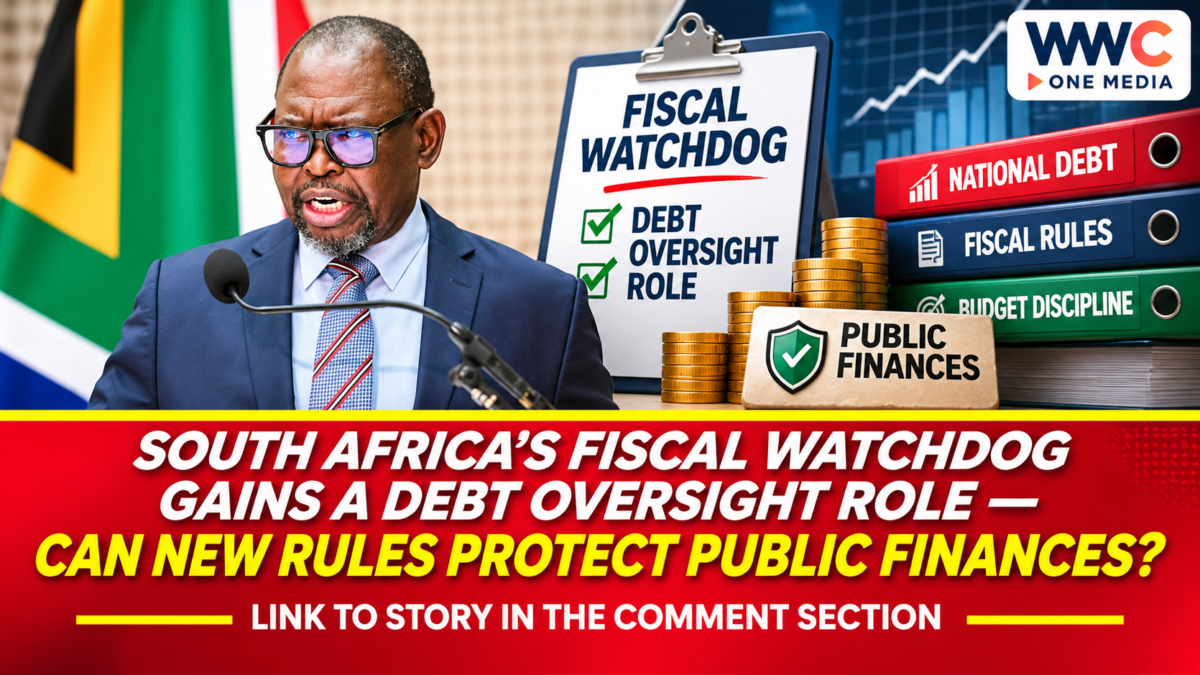
South Africa is preparing to give its Financial and Fiscal Commission a formal role in scrutinising government debt plans, under fiscal legislation released for public comment in October 2026. As of Nov. 18, the proposed framework would require future administrations to set out fiscal objectives and explain significant departures from them, but the law has not yet been enacted.
The proposal matters because sustainable budgets depend on more than announcing a declining debt ratio. South Africa must manage interest costs, slow economic growth and demands for basic services while giving Parliament a credible way to assess whether governments keep their financial commitments.
South Africa fiscal rules: a plan, not an enacted debt ceiling
Finance Minister Enoch Godongwana’s Oct. 21 medium-term budget address described a proposed amendment to the Public Finance Management Act built around fiscal sustainability. Instead of imposing one permanent numerical ceiling on debt, each administration would publish objectives reflecting its mandate and report progress at successive budgets.
The proposal also assigns the Financial and Fiscal Commission (FFC) an independent assessment role: it would report on whether the government’s fiscal framework remains consistent with its published plan. This is oversight, not a power to approve the budget or set interest rates.
The National Treasury had already explained in March why it favoured principles over a rigid debt number. Officials argued that the approach could preserve room to respond to economic shocks while requiring a credible path for the public finances.
Analysis: Flexibility can help governments respond to emergencies. Its weakness is that goals may be softened when circumstances become difficult. The proposed reporting requirement matters because it would create a public record against which Parliament could challenge deviations.
Who is the watchdog, and who appointed its leadership?
The FFC is an existing constitutional advisory body, not a new agency being created for this proposal. Its ordinary remit includes recommendations to Parliament, provincial legislatures, local government and other state institutions on financial and fiscal matters.
President Cyril Ramaphosa appointed former finance minister Nhlanhla Musa Nene as chairperson and Malijeng Ngqaleni as deputy chairperson on Aug. 18, 2026. The Presidency said the appointments run for five years from the date the appointees assume office.
The planned fiscal-law amendments would add a more explicit independent reporting function to that institution. They do not establish that Nene or the commission can unilaterally impose spending limits, block debt issuance or replace elected lawmakers’ budget responsibilities.
For readers tracking sovereign financing, WWC’s report on Africa’s renewed bond issuance explains why access to investors and the cost of borrowing are different measures of fiscal strength.
South Africa’s debt ratio changed after the budget
The October medium-term budget statement estimated that government debt had stabilised at 78.4% of gross domestic product in the 2025/26 fiscal year. But that is no longer the newest official comparison.
On Nov. 5, National Treasury recalculated fiscal ratios after Statistics South Africa revised its GDP data. The Treasury said the debt-to-GDP peak was 74.6% for 2025/26, down from the earlier estimate of 78.4%. Its revised projection puts the ratio below 70% by 2032/33.
The distinction is essential: Treasury said the change was mechanical. The GDP measure used as the denominator became larger; the department did not change its underlying cash debt, spending or revenue projections in the update.
The same revision put the projected 2026/27 main-budget deficit at 3.5% of GDP, compared with 3.7% previously, and the primary surplus at 1.6% rather than 1.7%. A primary surplus means revenue exceeds expenditure before interest payments; it does not mean the entire budget is in surplus.
Analysis: Better ratios can improve the presentation of fiscal risk, but actual affordability still depends on revenue, interest payments, refinancing and growth. A statistical revision cannot pay bondholders or finance infrastructure by itself.
Why debt service and slow growth complicate the strategy
In the October budget address, the government reduced its 2026 economic-growth forecast from 1.6% to 1.2%. It projected growth of 1.6% in 2027 and 2% by 2029. These are official forecasts, not results already achieved.
The finance minister also explained that the government wants lower debt-service costs while protecting capital investment and essential programmes. That balance is difficult: spending cuts can undermine service delivery, while persistent borrowing can leave less revenue available for priorities other than interest.
The wider debt question extends beyond South Africa. WWC’s coverage of developing-country debt relief proposals explores the pressures faced when repayments compete with public services. South Africa’s proposed fiscal anchor is a domestic accountability reform, not an international debt write-off.
Analysis: The fiscal framework will be most credible if it sets measurable objectives and explains how authorities would respond when growth or revenue falls short. A promise of prudence without transparent follow-through would be harder to evaluate.
Parliamentary oversight remains a critical test
On Nov. 11, parliamentary finance committees adopted reports on the revised fiscal framework, following consideration of Treasury, parliamentary-budget and FFC presentations. They flagged the need for further engagement over the proposed fiscal anchor and the oversight capacity of Parliament and its advisory institutions.
That is distinct from Parliament passing the proposed fiscal-sustainability legislation. The government has indicated that the bill is intended for tabling in 2027, after public consultation.
The commission’s role also raises a practical question: whether independent assessments arrive in time to influence budget scrutiny and whether lawmakers can obtain sufficiently detailed explanations of material departures from fiscal plans.
For a Philippine comparison, WWC previously examined efforts to broaden access to Philippine government bonds. Wider market access can help financing, but it does not substitute for sustainable budgets or transparent liabilities.
What happens next
The next concrete steps are consultation on the proposed Public Finance Management Act changes, eventual tabling of legislation in 2027 and further Treasury fiscal forecasts. The 2027 Budget should also show how the revised GDP baseline affects the government’s debt projections and other fiscal ratios.
For now, South Africa has outlined a clearer watchdog function and updated its debt measurements. Whether the arrangement creates durable budget discipline will depend on the final law, the commission’s ability to scrutinise plans and Parliament’s willingness to act on its findings.
FAQ
Has South Africa passed a new debt rule?
No. As of Nov. 18, 2026, the fiscal-sustainability legislation remains proposed, with parliamentary tabling expected in 2027.
What would the Financial and Fiscal Commission do?
Under the proposal, the existing advisory commission would independently assess whether government fiscal frameworks match an administration’s published fiscal plan.
What is South Africa’s latest official debt-to-GDP peak?
Treasury’s Nov. 5 revision puts the 2025/26 peak at 74.6%, replacing the older 78.4% estimate following GDP statistical revisions.
Did South Africa reduce its debt by changing the GDP figures?
No. Treasury said the revised ratios resulted from a larger measured GDP denominator, not a change in borrowing, spending or revenue assumptions.