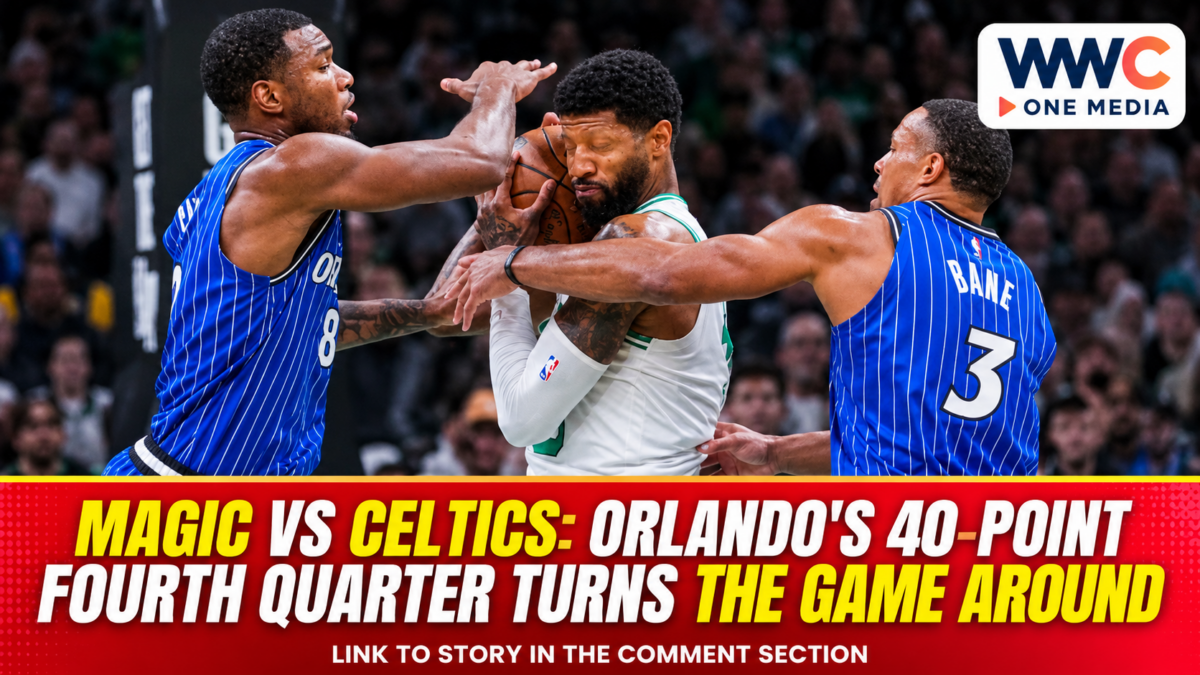
The Orlando Magic defeated the Boston Celtics 115–105 at TD Garden on Monday, November 16, 2026, producing 40 points in the fourth quarter to take control of a closely contested game.
Orlando entered the final period trailing 77–75 but outscored Boston 40–28 to complete the comeback. Desmond Bane and Jayson Tatum shared game-high scoring honours with 24 points apiece.
The result was shaped by more than the final-quarter scoring burst. Orlando also dominated points in the paint, generated more transition opportunities and recorded a higher overall field-goal percentage, overcoming Boston’s advantage in three-point shooting.
The Fourth Quarter Changes the Magic vs Celtics Game
Boston held a two-point advantage entering the fourth quarter after producing a strong third period.
The Celtics scored 36 points in that quarter, compared with Orlando’s 25, reversing the advantage established by the Magic in the first half.
However, the final 12 minutes produced a different contest.
Orlando scored 40 points while limiting Boston to 28. The Magic’s fourth-quarter performance turned a two-point deficit into a 10-point victory.
The scoring progression illustrates the shift:
| Quarter | Orlando | Boston |
|---|---|---|
| First | 20 | 17 |
| Second | 30 | 24 |
| Third | 25 | 36 |
| Fourth | 40 | 28 |
| Final | 115 | 105 |
The game featured 11 lead changes and 10 tied scores, showing how frequently possession and momentum shifted between the teams.
Orlando’s biggest lead reached 11 points, while Boston’s largest advantage was six.
Desmond Bane and Franz Wagner Lead Orlando’s Scoring
Desmond Bane led Orlando with 24 points, eight rebounds and five assists.
His shooting efficiency was particularly important. Bane converted eight of his 13 field-goal attempts, including three of eight from beyond the arc, while making all five of his free throws.
Franz Wagner contributed 21 points, eight rebounds and nine assists, providing another major source of offensive production.
Anthony Black added 20 points and seven assists. Tristan da Silva finished with 13 points, while Jalen Suggs contributed 12.
The distribution gave Orlando multiple scoring options instead of relying entirely on one player.
For Philippine basketball followers, the importance of balanced team production is also reflected in WWC’s coverage of the Gilas Pilipinas roster and its preparations for the FIBA World Cup qualifiers.
Boston’s 20 Three-Pointers Were Not Enough
One of the most unusual features of the result was Boston’s three-point production.
The Celtics made 20 of their 56 attempts from long range, finishing with a 35.7% conversion rate.
Orlando made 13 of 34 attempts, recording a better percentage at 38.2% but producing seven fewer successful three-point shots.
Despite that difference, Boston struggled to match Orlando’s overall shooting efficiency.
The Magic converted 41 of 82 field-goal attempts for 50%. Boston made 38 of 90 attempts, finishing at 42.2%.
Orlando therefore scored more efficiently from the field despite taking eight fewer attempts.
This distinction demonstrates why three-point totals alone do not determine a basketball result. Teams must also create productive opportunities closer to the basket and convert their overall shooting chances.
Paint Scoring and Fast Breaks Give Orlando the Advantage
Orlando’s strongest statistical advantage came inside the arc.
The Magic recorded 54 points in the paint, compared with Boston’s 32. That 22-point difference was one of the clearest explanations for the final result.
Orlando also generated 20 fast-break points, while Boston managed only seven.
The difference suggests that the Magic were more effective at turning transition opportunities into scoring possessions.
The Magic also finished with 46 rebounds and 31 assists. Boston recorded 40 rebounds and 24 assists.
Although Boston made more three-pointers, Orlando’s interior production and distribution created a broader offensive advantage.
These numbers provide an interesting comparison with another recent NBA contest covered by WWC, in which Denver and Indiana produced a dramatic comeback battle in Mexico City.
Jayson Tatum and Payton Pritchard Keep Boston Competitive
Jayson Tatum led Boston with 24 points and 12 rebounds, recording a double-double.
Paul George contributed 22 points and eight rebounds, while Payton Pritchard added 21 points and five assists.
Sam Hauser scored 12 points, making four of his six three-point attempts.
These performances helped Boston remain competitive, particularly during the third quarter when the Celtics scored 36 points.
However, the team’s overall field-goal conversion remained below Orlando’s.
The defeat also comes amid a season in which Boston’s roster and team structure have attracted attention. WWC previously examined Jayson Tatum’s public exchange with former Celtics teammate Jaylen Brown, offering additional context on the franchise’s changing basketball landscape.
What the Result Means for Both Teams
Orlando’s victory highlights the value of maintaining offensive balance throughout a game.
The Magic did not need to match Boston’s three-point total because they found other ways to score. Their production in the paint, transition offence and fourth-quarter execution compensated for the difference from long range.
Boston, meanwhile, demonstrated that perimeter shooting can keep a team competitive without necessarily providing enough scoring efficiency to secure a victory.
The Celtics’ 20 successful three-pointers were a substantial contribution, but their 42.2% overall field-goal percentage left room for improvement.
For Orlando, the performance provides a positive example of how a team can recover after surrendering the lead during the third quarter.
For Boston, the fourth-quarter defensive performance is an area worth examining before its next matchup.
What Happens Next
The NBA’s published schedule lists Orlando’s next game against the Philadelphia 76ers on Wednesday, November 18, at Kia Center.
Boston is scheduled to travel to Denver to face the Nuggets on the same date.
Those matchups will provide both teams with another opportunity to respond to the latest result.
Orlando will look to carry its fourth-quarter execution into its next game, while Boston will seek a stronger finish after allowing 40 points in the final period.
Frequently Asked Questions
1. Who won the Magic vs Celtics game on November 16, 2026?
The Orlando Magic defeated the Boston Celtics 115–105 at TD Garden.
2. How many points did Desmond Bane score?
Desmond Bane scored 24 points, alongside eight rebounds and five assists.
3. How many three-pointers did Boston make?
Boston made 20 of its 56 three-point attempts, compared with Orlando’s 13 successful shots.
4. How did Orlando win despite making fewer three-pointers?
Orlando recorded 54 points in the paint, compared with Boston’s 32, and scored 20 fast-break points against Boston’s seven.
5. When do the Magic and Celtics play next?
Orlando is scheduled to face Philadelphia on November 18, while Boston is scheduled to play Denver on the same date.