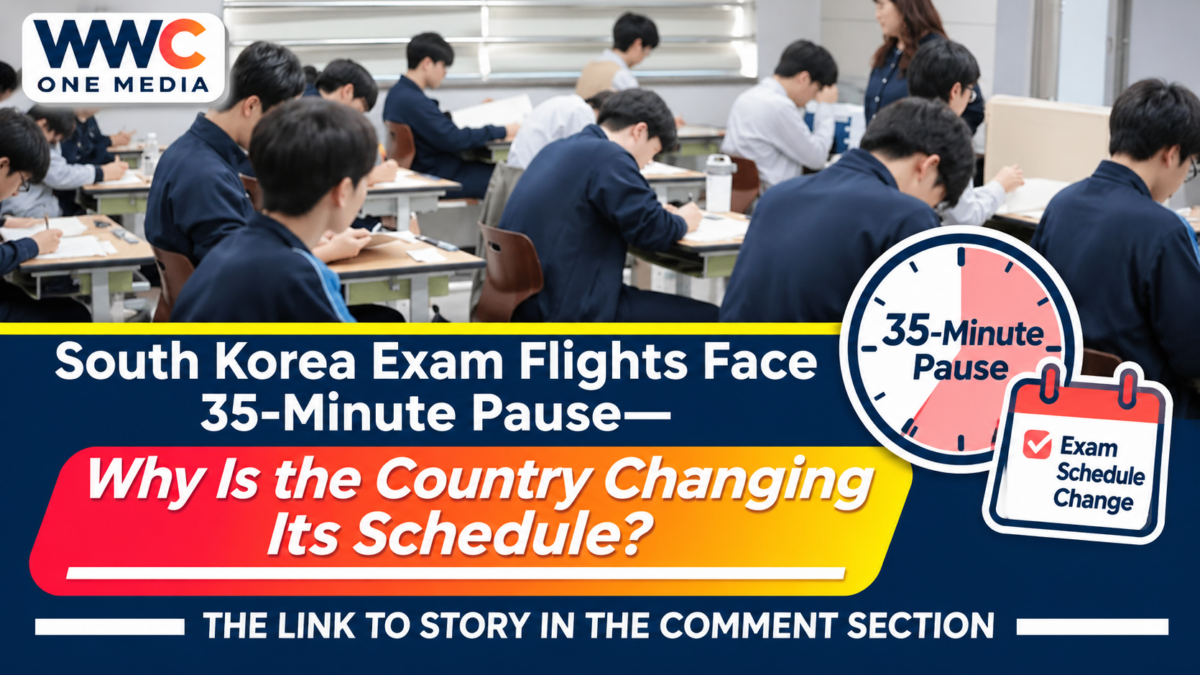
SEOUL, South Korea — South Korea will restrict aircraft takeoffs and landings for 35 minutes on Thursday, Nov. 19, 2026, as hundreds of thousands of candidates sit the country’s national college entrance examination. The transport ministry announced on Nov. 17 that 130 flights would have their schedules adjusted, while education authorities have also arranged later workplace start times and extra morning transport.
The South Korea college exam is more than a school timetable event. The government has designed temporary measures around students’ journeys and the English listening test, illustrating how a single examination can affect aviation, urban transport and daily business routines without shutting those systems for an entire day.
South Korea college exam: The confirmed schedule
The Ministry of Education has scheduled the College Scholastic Ability Test, or CSAT, for Nov. 19. It is the exam for the 2027 academic year, even though candidates take it in 2026. The published education plan sets the main examination period at 8:40 a.m. to 5:45 p.m., with a later finishing time for some candidates receiving accommodations.
The ministry’s October implementation plan counted 551,864 prospective candidates across 1,312 test centres in 85 examination districts. These figures describe registered or expected participants before the examination, rather than the final number who will attend.
The government has also scheduled the release of results for Dec. 11, 2026. This distinction between test day and result day matters for families planning travel, school applications and subsequent admissions decisions.
Why flights will pause for 35 minutes
The Ministry of Land, Infrastructure and Transport announced an aviation restriction from 1:05 p.m. to 1:40 p.m. Korean time on Nov. 19. Its Nov. 17 notice states that 130 flights will have their operating times adjusted.
The 35-minute restriction surrounds the English listening assessment. The education ministry’s earlier planning document identified the listening segment as 1:10 p.m. to 1:35 p.m. The longer operational window gives aviation authorities additional time on either side of that segment.
The essential distinction is between a temporary restriction and a nationwide, all-day grounding. Aircraft movements are being controlled during a specific window to reduce intrusive noise; the records do not say every flight throughout Nov. 19 has been cancelled.
Analysis: For travellers, the practical risk is an altered flight timetable rather than automatic cancellation. Passengers flying near the restricted period should consult their airline’s itinerary and airport departure information instead of assuming a general shutdown.
Work hours and train services are also changing
The education ministry’s Oct. 20 government plan requested that public offices and businesses shift morning reporting times to after 10 a.m. on examination day. It is a coordination request directed at reducing early-morning road congestion, not an announcement that the country has declared a public holiday.
In the Seoul metropolitan area, authorities arranged additional subway capacity between 6 a.m. and 8:10 a.m. Emergency transport support is also intended to help candidates reach examination venues.
Vehicles will be restricted from entering areas within 200 metres of examination sites, under the published traffic plan. For candidates and their families, that makes advance planning particularly important: the nearest possible drop-off location may not be the school gate.
The government also called for less noise from buses, trains, construction activity and other surroundings. These practical arrangements help explain why protecting the examination is not solely the responsibility of teachers and invigilators.
What the restrictions say about exam pressure
The education system places considerable weight on an examination that must operate at the same time across the country. The government’s response is designed to give candidates a predictable opportunity to complete the paper without avoidable disruption.
WWC previously examined the pressure behind South Korea’s university entrance tests, including questions about alternative routes into higher education. This year’s transport arrangements demonstrate another dimension of that pressure: government agencies organise ordinary services around the needs of test-takers.
Analysis: Such measures can be understood as a fairness safeguard, because a late arrival or unexpected aircraft noise should not determine a candidate’s result. They also impose short-term inconvenience on people who are not taking the test, which makes clear and accurate advance communication essential.
Neither consideration means that every student faces the same circumstances. Authorities still need to implement restrictions consistently and provide workable arrangements for candidates who require additional support.
Security preparation is a separate issue
The exam’s logistics are taking shape while officials review how to keep prohibited electronic devices out of testing rooms. WWC’s earlier report on South Korea’s exam-security preparations covers the separate rules and checks relating to suspected AI-enabled devices.
That security debate should not be confused with the aviation and traffic measures. Flight restrictions protect the listening environment, while device rules address what candidates may bring into an examination room. They serve different purposes and must be assessed against different official instructions.
South Korea is also working on separate TOPIK examination reforms. TOPIK is a Korean-language proficiency test, not the university entrance CSAT, so its announced changes should not be described as alterations to Thursday’s examination.
What happens next
The immediate operational test comes on Thursday, Nov. 19, when the examination, travel arrangements and 35-minute flight restrictions are scheduled to take effect. The education ministry’s published timetable then points to Dec. 11 for results.
For investors, a separate temporary change in Korea Exchange trading hours has been described in public reports, but the exchange’s original 2026 notice was not independently accessible for this verification. Exact session times are therefore deliberately excluded from this primary-record-based article pending confirmation from the exchange itself.
The confirmed story is substantial without overstating it: South Korea is temporarily reshaping parts of its transport and working day so candidates can complete a national examination with fewer avoidable interruptions.
FAQ
When is South Korea’s 2026 college entrance exam?
The CSAT for the 2027 academic year is scheduled for Thursday, Nov. 19, 2026. Results are scheduled for Dec. 11.
Are all flights in South Korea cancelled on exam day?
No nationwide all-day cancellation was announced. The transport ministry identified a 35-minute restriction from 1:05 p.m. to 1:40 p.m., affecting the scheduling of 130 flights.
Why does South Korea restrict flights during the test?
The restriction reduces aircraft noise around the English listening assessment, scheduled for 1:10 p.m. to 1:35 p.m.
Will employees start work later during the exam?
The government’s plan asks public offices and companies to move reporting times until after 10 a.m. to reduce congestion. It does not declare a national holiday.
What time will South Korea’s stock market open on Nov. 19?
The exchange’s original 2026 trading-hours notice was not independently retrieved for this review. Traders should verify the special schedule directly with Korea Exchange or their broker before placing time-sensitive orders.