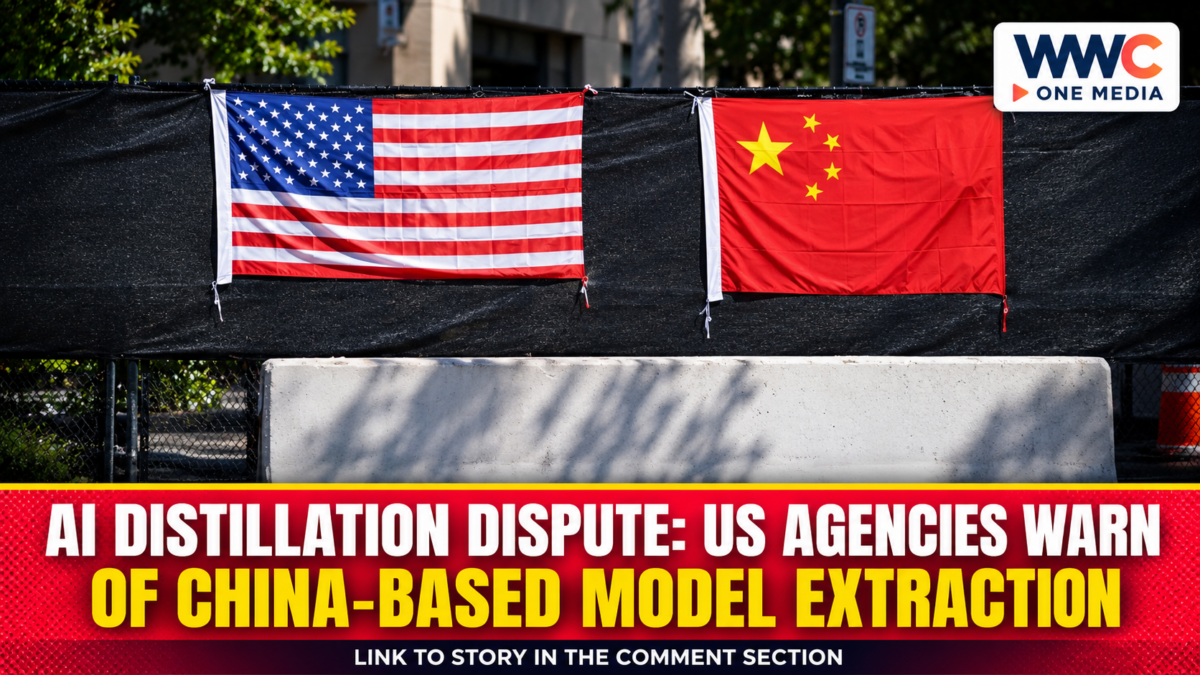
The United States has issued a formal warning about alleged industrial-scale efforts by China-based companies to extract capabilities from American artificial intelligence systems, adding a new dimension to the competition over advanced AI technology.
The warning has been backed by a White House memorandum and a September cybersecurity advisory involving the National Security Agency, Federal Bureau of Investigation and Cybersecurity and Infrastructure Security Agency.
The dispute concerns a technique known as AI distillation. Although the method is widely used in legitimate AI development, US authorities say some operations targeting American models involve unauthorised extraction of proprietary capabilities.
The distinction matters for technology companies worldwide. AI developers increasingly depend on access to powerful models, cloud infrastructure and training data, while the rules governing how those resources may be used are becoming more important.
What AI distillation actually does
AI distillation is a process in which a larger model acts as a teacher for a smaller model.
The larger system generates answers, examples or demonstrations. Developers then use that material to train another model to perform selected tasks.
The technique can reduce the computing resources required to build and operate certain AI systems. It can also help developers create smaller models suited to specific applications.
However, the method itself is not automatically unlawful or abusive.
The central issue is whether the developer has permission to use the original model’s output and whether the collection process violates applicable contracts, intellectual-property rights or other legal requirements.
That distinction is important because legitimate model training and unauthorised extraction are not interchangeable.
China’s domestic AI development also involves investment in computing infrastructure and alternative hardware. WWC previously examined DeepSeek’s work with Huawei on AI-chip programming tools, illustrating how the domestic technology ecosystem extends beyond model training alone.
US government raises concerns about industrial-scale activity
On April 23, 2026, the White House Office of Science and Technology Policy issued a memorandum titled Adversarial Distillation of American AI Models.
The document said the US government had information indicating that foreign entities, principally based in China, were conducting deliberate, industrial-scale efforts to distil American frontier AI systems.
It described alleged use of proxy accounts and techniques intended to expose proprietary information.
The memorandum also made an important qualification: legitimate distillation is a useful part of AI development.
Its concern was industrial activity intended to systematically undermine American research and development or obtain proprietary information without authorisation.
The memorandum directed US agencies to share information with American AI companies, improve private-sector coordination, develop defensive practices and explore measures to hold foreign actors accountable.
The document is a statement of the US government’s position and planned response. It is not a judicial determination against every company or developer operating in China. GovInfo
NSA, FBI and CISA publish a cybersecurity warning
The issue received another official response on Sept. 8, 2026, when the NSA announced a joint cybersecurity advisory with the FBI and CISA.
The agencies described what they characterised as industrial-scale distillation campaigns targeting American AI companies.
The advisory explains how developers and infrastructure operators can identify possible extraction activity and improve their defences.
It also identifies the wider technology ecosystem as part of the security challenge. Cloud providers, API aggregators and infrastructure operators may all have a role in identifying suspicious activity and protecting model access.
For businesses, the message is that AI security cannot be treated as a concern limited to the company that develops a model.
Organisations that provide access to AI systems or host the infrastructure supporting them may also need to examine account behaviour, usage patterns and safeguards.
The agencies’ statement remains an official US assessment. The publication of an advisory does not independently establish the liability of every company discussed in other reporting. National Security Agency
OpenAI’s terms place restrictions on competing-model training
The commercial rules governing access to AI systems are another important part of the dispute.
OpenAI’s Terms of Use, effective Jan. 1, 2026, state that users may not use its output to develop models that compete with OpenAI.
The document applies to individual services such as ChatGPT and distinguishes those terms from the separate Business Terms governing Enterprise, API and other business services.
This means the relevant contractual conditions depend on the service and agreement involved.
For organisations using AI tools in research or product development, the practical implication is that generated output should not automatically be treated as unrestricted training material.
Companies need to examine the applicable service agreement, permitted exceptions and the rights attached to the information they collect.
The question is not simply whether a model can technically generate useful training examples. It is whether the intended use is allowed under the relevant terms and applicable law. OpenAI+1
China is also defining boundaries for AI technology exports
China’s Ministry of Commerce addressed its own technology-export framework in an October 16, 2026 statement about proposed revisions to the Catalogue of Technologies Prohibited and Restricted from Export.
The ministry said the consultation covered 40 proposed technologies across artificial intelligence, biomedicine and photovoltaics.
Within the AI category, the statement identified 23 technologies related to large models, intelligent agents, computing-power clusters and information processing.
It proposed restrictions on certain technologies, including AI-assisted vulnerability discovery and AI-driven malicious-code generation.
The ministry also said the proposed framework was intended to manage risks while supporting international technology exchanges and cooperation.
The statement does not confirm that Chinese companies have conducted the specific distillation activities alleged by US authorities. Nor does it establish that ordinary AI distillation is prohibited under Chinese law.
Instead, it shows that Beijing is developing its own approach to controlling certain technology exports while continuing to describe international AI cooperation as an objective. MOFCOM
Why the dispute matters beyond China and the United States
The argument has implications for the wider AI industry because models are increasingly connected through cloud platforms, application programming interfaces and third-party services.
A company may develop its own model while relying on external providers for computing capacity, testing or specialised capabilities.
That creates questions about data handling, contractual permissions, account security and the ownership of training material.
The infrastructure side of the issue is also significant. WWC’s earlier examination of China’s expanding AI data-centre network explored the computing resources required to support the country’s AI ambitions.
Meanwhile, the United States has been tightening controls around advanced computing equipment and overseas access to restricted technology. WWC has also examined the latest US AI-chip rules affecting Southeast Asian data centres.
These are connected but separate policy questions. Restrictions on chip exports govern access to hardware and computing resources; AI distillation concerns the use of model outputs and capabilities.
One does not automatically prove a violation of the other.
What happens next
The US government has indicated that it intends to improve coordination between federal agencies and private AI companies to detect and respond to unauthorised extraction.
The September cybersecurity advisory provides technical guidance, while the April memorandum sets out the administration’s broader response.
China’s October technology-export consultation represents a separate regulatory process. The ministry’s statement describes proposed controls and the conditions under which certain technology exports may be managed.
For AI companies, the immediate priority is to establish clear rules for model access, training-data collection, third-party services and the use of generated outputs.
For cloud and infrastructure providers, account monitoring and customer verification may become increasingly important.
The dispute is therefore about more than which country can develop the strongest AI model. It is also about who controls access to the technology, what permissions apply to its outputs and how the industry protects the systems on which it depends.
Frequently asked questions
What is AI distillation?
AI distillation is a training technique in which a larger model generates examples or demonstrations that help train a smaller model.
Is AI distillation illegal?
Not automatically. Its legality depends on the circumstances, including applicable law, contractual terms, permissions and how the original model is accessed.
What did US agencies say about China-based AI companies?
The White House and US cybersecurity agencies published statements alleging industrial-scale efforts to extract capabilities from American AI models. These are official US government assessments, not court judgments against every Chinese AI company.
Has China banned AI distillation?
The October 16 statement from China’s Ministry of Commerce describes proposed controls on selected AI technologies for export. It does not announce a general ban on AI distillation.
Why does AI distillation matter to businesses?
It raises questions about data rights, model-access security, contractual restrictions, intellectual property and the protection of proprietary AI systems.