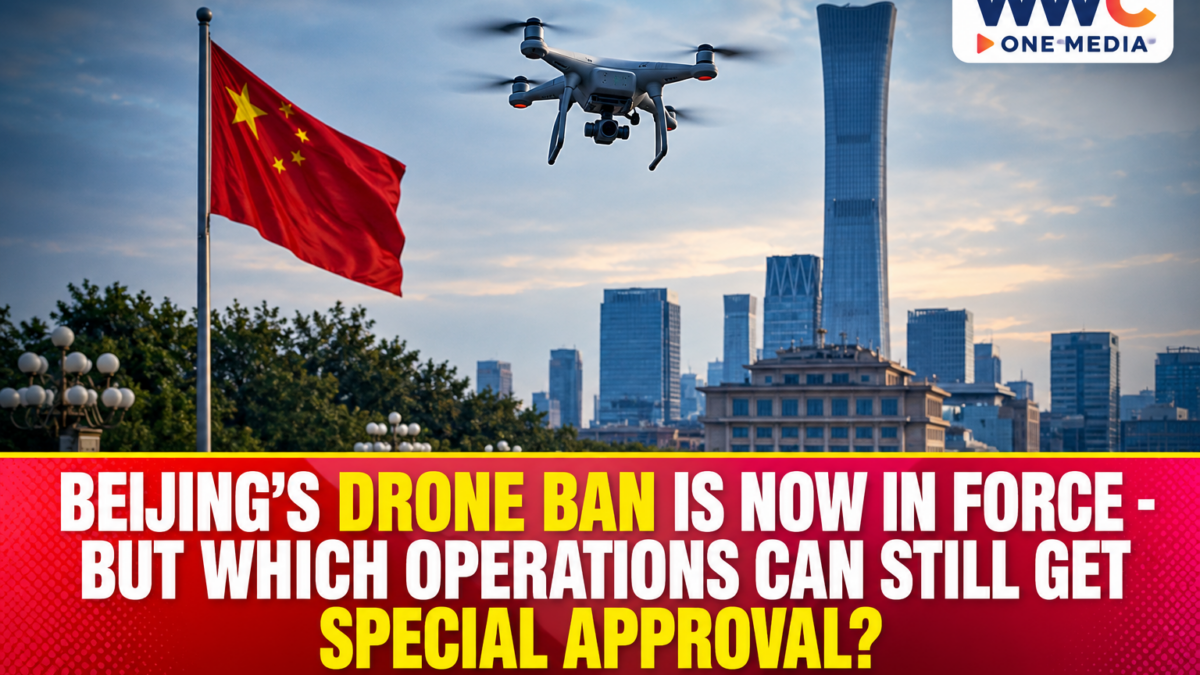
Beijing’s drone restrictions took effect on November 15, 2026, but the revised rules do not eliminate every authorised use of unmanned aircraft. A separate regulation issued by the Beijing Municipal Public Security Bureau explains how certain organisations can seek permission to purchase, transport, store and use drones under a special security arrangement.
The distinction is important for schools, research institutions, manufacturers and agricultural operators. They cannot assume that their work automatically exempts them from the restrictions. Their applications must pass a review involving the relevant supervisory department and the municipal public-security authorities. gaj.beijing.gov.cn+1
Special Approval Is Limited to Specific Activities
The revised municipal regulation identifies three broad grounds for special arrangements:
- Counterterrorism, public-order maintenance, emergency rescue and major events.
- Teaching, technical research and development, and production activities involving schools, research institutions and manufacturing enterprises.
- Agricultural and forestry production.
The rules require an official safety assessment before qualifying organisations can receive special treatment. Approved organisations must establish security procedures covering the purchase, transportation, storage and use of drones and their designated core components. gaj.beijing.gov.cn+1
The implementing rules also require applications to undergo review by the appropriate supervisory department before being forwarded for public-security assessment. Authorities assess whether the proposed activity qualifies, whether the application documents are complete, and whether the need for the equipment and the proposed storage arrangements are adequately justified.
For approved storage facilities, the implementing rules require security measures that include controlled access, video surveillance, assigned responsibility and records covering equipment movement. 首都之窗_北京市人民政府门户网站
This means the policy is not simply a blanket exemption for government agencies, universities or businesses. It establishes a controlled approval process in which the purpose of the equipment and the safeguards around it matter.
The Penalties Differ Depending on the Violation
Article 8 of the revised regulation sets separate penalties for unauthorised flights and prohibited possession or storage.
For unauthorised drone flights, authorities may order the activity to stop, confiscate the aircraft and impose a fine ranging from 1,000 to 10,000 yuan.
For prohibited possession, storage, transportation into Beijing or restricted sales, the regulation provides for confiscation. Individuals may face fines of 500 to 5,000 yuan, while organisations may face fines of 5,000 to 50,000 yuan.
Businesses that fail to comply with the sales restrictions may also face action from market regulators. The regulation provides for fines of 10,000 to 100,000 yuan for relevant sales violations, with a separate range of 20,000 to 100,000 yuan for e-commerce platform operators that violate their compliance obligations. gaj.beijing.gov.cn
These are penalties authorised by the regulation. They should not be presented as fines already imposed unless authorities publish specific enforcement cases.
Why the Regional Security Debate Matters
Beijing’s approach is one example of how governments are tightening controls over unmanned aircraft in sensitive locations.
Taiwan has also taken enforcement action involving restricted drone operations near sensitive facilities, including airports and science parks. Its published enforcement figures provide a separate example of the regulatory challenges facing authorities as drone use expands. Taiwan’s drone enforcement cases.
In the Philippines, temporary restrictions have also been imposed in areas hosting major diplomatic activities. Makati’s November citywide drone restriction illustrates how local security requirements can affect recreational, commercial and media operators. Makati’s November drone restrictions.
Security concerns also extend to military installations. The recent alert involving suspected unauthorised drone activity at RAF Lakenheath in the United Kingdom shows why authorities distinguish between a reported security concern and a confirmed violation. The RAF Lakenheath drone security alert.
For Beijing, the next test is whether the special-approval system can accommodate legitimate institutional and commercial needs while maintaining the security controls required by the new law. The regulations establish the framework; their practical effectiveness will depend on consistent implementation and transparent enforcement.
What remains unverified: No official post-November 15 enforcement figures or confirmed penalty cases were established in the records reviewed. Do not claim that authorities have already confiscated a particular number of drones or fined specific owners.