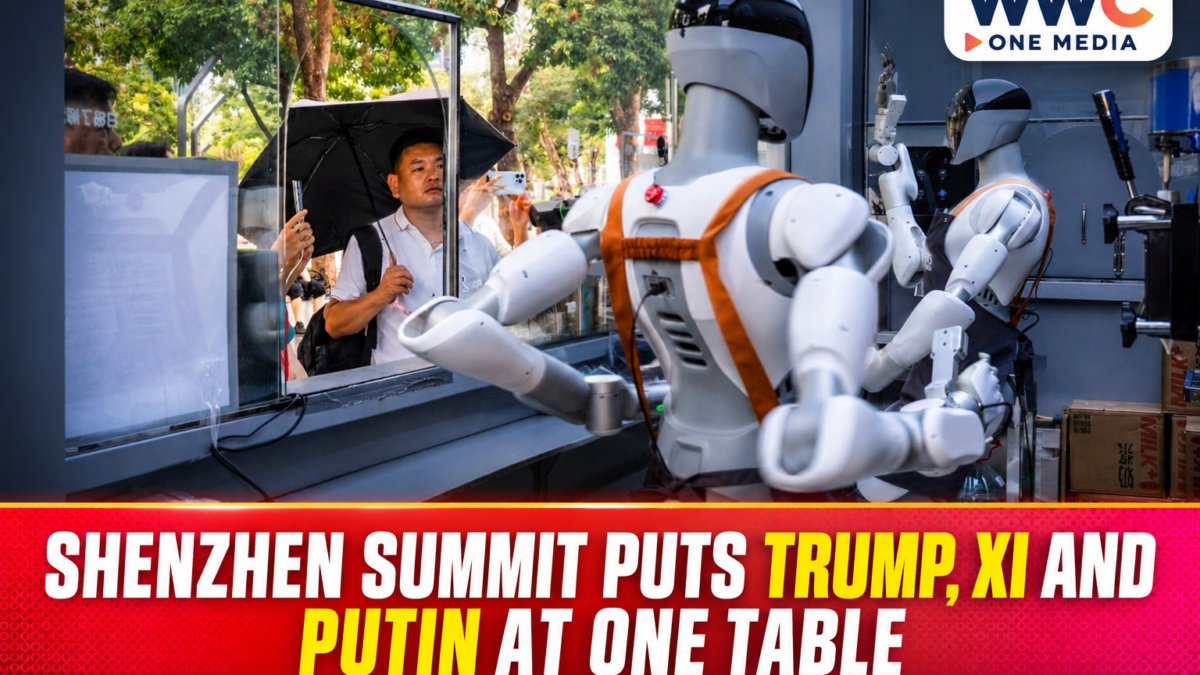
China has confirmed that President Xi Jinping will meet US President Donald Trump and Russian President Vladimir Putin in Shenzhen on November 19, bringing the leaders of three major powers together for a face-to-face summit during the city’s hosting of the 2026 Asia-Pacific Economic Cooperation (APEC) meetings.
The meeting is being presented by China’s Foreign Ministry as the first face-to-face gathering involving the three countries’ leaders. But the bigger test will be whether their discussions can produce practical progress on global security and economic stability while the wider APEC programme tackles trade, artificial intelligence, supply chains and regional growth. China Foreign Affairs+2
For Shenzhen, the gathering places the southern Chinese technology and manufacturing centre at the centre of an unusually significant diplomatic week. For the Asia-Pacific, however, the importance extends beyond the three presidents: decisions and disagreements among Washington, Beijing and Moscow can influence the business environment in which regional economies operate.
Shenzhen Becomes the Setting for a Rare Three-Power Meeting
China’s Foreign Ministry formally announced on November 16 that Xi would hold a China-Russia-US summit with Trump and Putin in Shenzhen on November 19.
At a subsequent briefing, spokesperson Mao Ning described it as the first face-to-face meeting in history involving the leaders of China, Russia and the United States. She said the presidents would exchange views on safeguarding world peace and promoting strategic stability in relations among major powers. China Foreign Affairs Ministry+1
The announcement establishes that the three leaders are scheduled to meet. It does not, by itself, establish that they have agreed on a joint policy, a security arrangement or a new economic agreement.
That distinction matters. A summit can create an opportunity for direct communication, but agreements involving security, trade or military cooperation require further negotiations and, in many cases, formal implementation by the governments concerned.
The meeting also comes after Xi and Trump held a state-level meeting in Washington in September. The subsequent Chinese government statement identified eight areas of agreed outcomes, including continued economic and trade consultations, an artificial intelligence dialogue and a communication channel for AI-related incidents. State Council of China+1
The Shenzhen gathering therefore takes place against an existing diplomatic record, rather than starting from a blank page.
APEC’s Economic Agenda Is Much Wider Than the Three Leaders
The presidential meeting is only one part of the programme taking place in Shenzhen.
The 33rd APEC Economic Leaders’ Meeting is scheduled for November 18–19 under the theme “Building an Asia-Pacific Community to Prosper Together.” Xi is due to chair the meeting and deliver remarks.
The APEC CEO Summit is scheduled for November 17–18, with the theme “To Prosper and Win the Future Together.” The Chinese president is also scheduled to attend its opening ceremony and deliver a keynote speech. China Foreign Affairs
APEC brings together 21 member economies. Its work covers trade, investment, customs procedures, digitalisation and cooperation on shared economic challenges.
The APEC Secretariat has identified several issues expected to feature prominently in the leaders’ discussions: artificial intelligence, digital transformation, supply-chain resilience, energy security and food systems.
The organisation has also highlighted the need for greater compatibility between digital trade systems. Its research indicates that digitalising trade documents could reduce trade transaction costs by 5.8%, illustrating how technical cooperation can have practical consequences for companies moving goods across borders. APEC+1
That agenda is important because the region’s economic concerns cannot be reduced to the relationship among three major powers. Smaller and middle-sized economies also need predictable trade rules, reliable supply chains and access to emerging technologies.
Trade and Technology Remain Important Tests for Washington and Beijing
The September meeting between Xi and Trump produced commitments to continue economic and trade consultations, advance a reciprocal tariff-reduction arrangement covering about US$30 billion in trade on each side, and extend earlier negotiating outcomes.
The Chinese government statement also said the leaders instructed their respective teams to implement those outcomes. It did not establish that every proposed tariff adjustment had already taken effect. State Council of China
That distinction is important for businesses. A political commitment or negotiating framework does not automatically change the customs duty applied to a shipment. Companies still need official schedules, implementation dates and product-specific guidance before making commercial decisions based on a tariff change.
The two governments also agreed to establish a China-US artificial intelligence dialogue to discuss AI-related risks and benefits, alongside a communication channel for AI-related incidents. The next round of the dialogue was scheduled for November. State Council of China
These arrangements provide a basis for further discussion, but they do not resolve the wider disagreements over technology access, export controls and national security.
WWC has previously examined the fragile nature of the US-China trade truce and the outstanding issues behind the tariff negotiations. The Shenzhen meeting now gives both governments another opportunity to maintain dialogue, but any claim that the trade dispute has been settled would require stronger evidence.
The Philippines Has Economic Reasons to Watch the Outcome
Although the Philippines is not a party to the three-power meeting, developments involving China, the United States and Russia can affect the regional economy in which Filipino businesses operate.
The Philippines is connected to international production networks through electronics, manufacturing, imported components, shipping and services. Changes in trade restrictions or technology rules can influence sourcing decisions and the cost of moving goods between markets.
For example, a new round of US-China trade restrictions could complicate supply chains that rely on components or materials crossing several economies. Conversely, clearer trade rules and more stable commercial relations could reduce uncertainty for companies planning investments and shipments.
That is why the broader APEC programme matters to Manila as much as the presidential summit. Discussions on customs digitalisation, connectivity and supply-chain resilience address practical obstacles faced by exporters and importers.
The Philippines’ own trade strategy also makes regional cooperation important. WWC has examined how Asian markets are becoming more important to Philippine trade, as companies look beyond dependence on individual overseas markets.
A more predictable Asia-Pacific trading environment could support that diversification. However, no specific benefit to Philippine exports, investment or consumer prices should be assumed simply because the three presidents meet.
The Security Questions May Be Harder Than the Diplomatic Opening
The presence of the United States, China and Russia at one table will inevitably draw attention to global security.
The Chinese Foreign Ministry has framed the meeting around peace, stability and communication among major powers. That provides the official description of Beijing’s stated objective, but it does not mean the three governments have already agreed on how to address their differences.
Nuclear risks, regional conflicts and military communication are difficult subjects because they involve national security interests and different strategic priorities.
The September China-US statement offers one example of a more limited approach: the two governments agreed to establish a military communication channel and work towards a memorandum of understanding on strengthening crisis communication and prevention. State Council of China
Such arrangements can help reduce the risk of miscalculation, but their value depends on whether officials use them consistently and whether they lead to practical procedures.
The same principle applies to any discussion in Shenzhen. A statement of shared intentions is a starting point. A durable agreement requires defined commitments, responsible agencies and mechanisms for implementation.
What Happens Next?
The APEC CEO Summit runs from November 17 to 18, followed by the 33rd APEC Economic Leaders’ Meeting on November 18 and 19. The China-Russia-US summit is scheduled for November 19. China Foreign Affairs+2
The next evidence to watch will be the official statements issued after the meetings. These should clarify whether the leaders have agreed on concrete steps involving security, trade, technology or further diplomatic consultations.
For businesses, the most useful outcomes will be those translated into clear policies and implementation schedules. For governments across the region, the priority will be to ensure that major-power competition does not undermine economic cooperation.
Shenzhen may host a meeting that attracts global attention because of the three presidents in attendance. But the summit’s lasting importance will depend on what happens after they leave: whether communication continues, commitments become operational and the wider Asia-Pacific economy gains greater stability.
The historic photograph may bring the leaders together. Turning that moment into measurable progress will be the harder task.